
For 242 years, Americans assumed the bald eagle was the national bird. They were right — but until December 2024, it was never actually official.
On Christmas Eve 2024, President Joe Biden signed legislation that Congress had unanimously passed, formally designating the bald eagle as the United States’ national bird. As NPR reported, the bill had been spearheaded by Minnesota legislators — Senator Amy Klobuchar and Representative Brad Finstad — and passed the Senate with full bipartisan support before clearing the House. “For nearly 250 years, we called the bald eagle the national bird when it wasn’t,” said Jack Davis, co-chair of the National Bird Initiative for the National Eagle Center. “But now the title is official, and no bird is more deserving.”
The legislation itself put it simply: “Bald eagles are a historical symbol of the United States representing independence, strength, and freedom.”
A symbol so woven into the fabric of American identity that the country forgot to make it official for two and a half centuries. Now that it is, it is worth understanding what the American eagle symbol actually means — where it came from, what it carries, and why cultures on every continent have looked to the eagle for the same qualities across thousands of years.
The American eagle symbol operates on three levels at once: as a national symbol, it encodes freedom, sovereignty, and the balance between peace and power into the Great Seal since 1782; as a cultural symbol, it appears on currency, military insignia, government buildings, the Philadelphia Eagles’ helmet, and in Native American sacred traditions that predate the United States by thousands of years; and as a spiritual symbol, it represents divine connection, personal renewal, and the courage to rise above what keeps you grounded. This guide covers all three.
American Symbols: The Bald Eagle and the Six-Year Fight for the Great Seal
Most Americans know the bald eagle ended up on the Great Seal. Very few know how close it came to never getting there — and how long the fight actually took.
On July 4, 1776 — the same day the Declaration of Independence was signed — the Continental Congress gave Benjamin Franklin, Thomas Jefferson, and John Adams the task of designing an official seal for the new nation. Three of the most celebrated minds in American history sat down together and could not agree. The designs they submitted were rejected.
A second committee was formed. It also failed to produce an approved design. A third committee tried. Also rejected.
In June 1782 — six years after that first commission — all the work from the three failed committees was handed to Charles Thomson, the Secretary of Congress. Thomson sorted through every rejected proposal and chose what he considered the strongest elements. Among the contributions was a design submitted by Philadelphia lawyer William Barton, who had introduced an eagle into his version. Thomson elevated that eagle, specified it must be an American bald eagle rather than the generic heraldic eagle used in earlier drafts, and built the Great Seal around it.
As the American Eagle Foundation documents, Thomson’s reasoning was precise: the bald eagle is unique to North America, making it our eagle and no one else’s. Barton had written of the eagle: it is “the symbol of supreme power and authority.” Congress adopted the design on June 20, 1782.
What the Great Seal encodes:
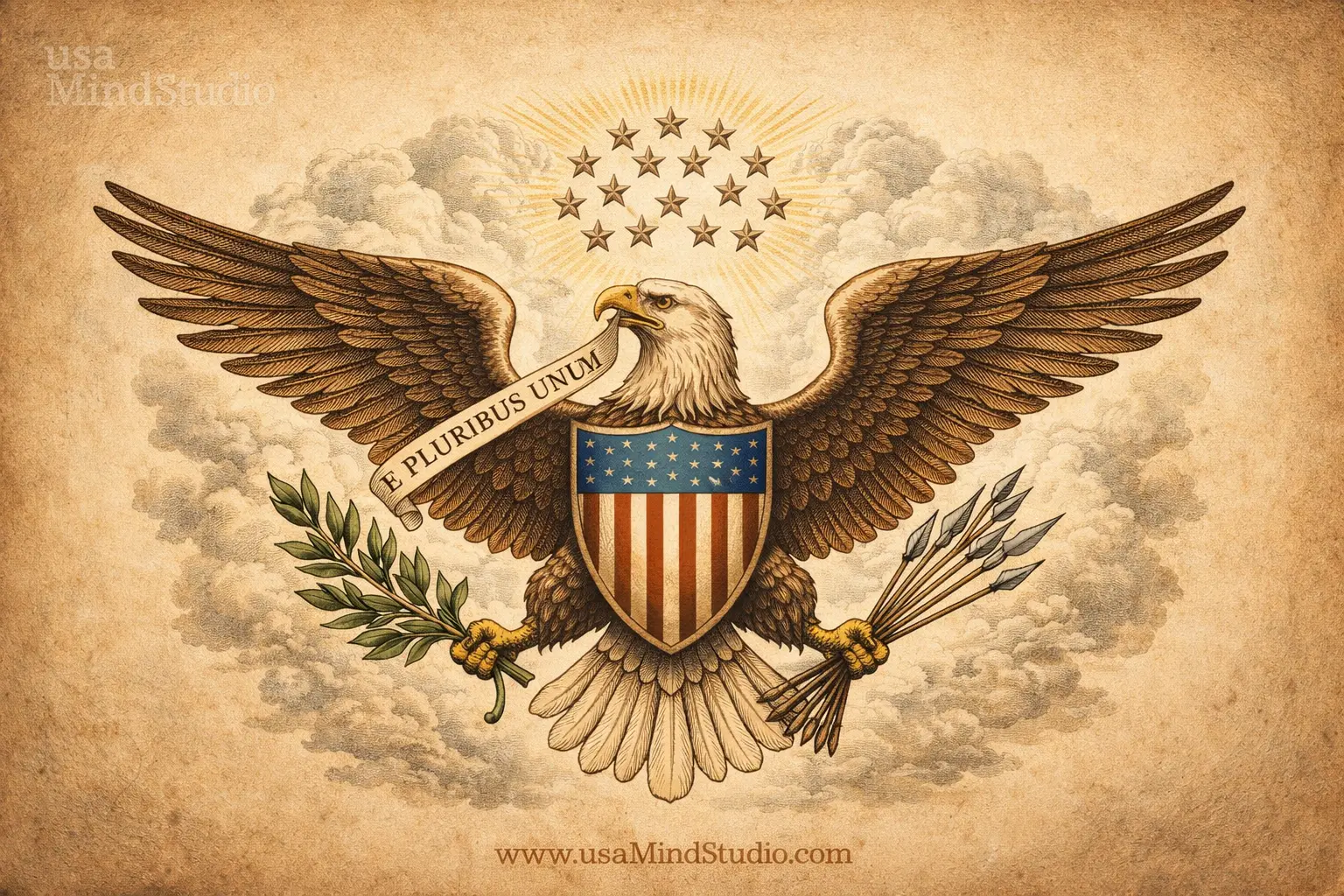
Every element of the design was deliberate. The eagle holds an olive branch in its right talon — 13 leaves, 13 olives — representing the preference for peace. It holds a bundle of 13 arrows in its left talon, representing readiness for war. The head turns toward the olive branch, toward peace, as the default posture of the nation. The scroll in the beak reads “E Pluribus Unum” — out of many, one. Thirteen stars appear above the eagle’s head, representing the original 13 states.
The Benjamin Franklin myth — set straight:
The popular story holds that Franklin lobbied Congress against the eagle and pushed for the wild turkey instead. As History.com confirms, there is no evidence Franklin ever brought this argument before Congress. What is real is an 1784 private letter to his daughter in which he called the bald eagle “a bird of bad moral character” — a personal observation written two years after the Great Seal was already finalized. The turkey story is a myth. The eagle was chosen without Franklin’s opposition.
What Does the American Bald Eagle Symbolize?
The bald eagle was not selected because it looked impressive. Every quality the Founding Fathers wanted their new nation to project was already embodied in this specific bird — in its biology, its behavior, and its geography.
Freedom. The bald eagle is native exclusively to North America. It belongs to this land and no other continent on earth. That geographical exclusivity made it the ideal symbol for a nation that was defining itself as something the world had never seen before — not inherited, not borrowed, but entirely its own.
Strength and courage. As the official legislation signed in December 2024 states directly: “bald eagles are a historical symbol of the United States representing independence, strength, and freedom.” Eagles had been recognized across civilizations for millennia as symbols of power — Roman legions carried eagle standards into battle, ancient Aztec culture revered the eagle as a solar deity, and Greek mythology associated the eagle with Zeus, king of the gods. The Founding Fathers were drawing on six thousand years of established symbolic weight.
Vision. The bald eagle’s eyesight is up to eight times sharper than a human’s. It can spot prey from nearly two miles away while soaring at altitude. As a national symbol, this vision represents the capacity to see what is coming — to look further than the present moment and hold a course toward it.
Balance between peace and war. This is the most specific and deliberate piece of symbolism in the Great Seal. The eagle holds both — peace in one talon, war in the other — and faces toward peace. Not as an idealistic statement. As a constitutional posture: force is available, but preference is always for the olive branch.
Loyalty and endurance. Bald eagles mate for life. They return to the same nest year after year, enlarging it with each return. As the Library of Congress documents, eagle nests have been found weighing up to 2,000 pounds — the accumulated evidence of decades of faithful return. The national symbol of the United States carries this loyalty in its own biology.
Eagle Native American Symbolism — The Sacred Messenger
Long before the Founding Fathers placed the bald eagle on the Great Seal, Native American peoples across the continent had already established it as the most sacred bird in existence. The two traditions arrived at the same bird for reasons that are deeply different but equally profound.
The U.S. Congress acknowledged this directly in the December 2024 legislation: “Bald eagles are integral to the spiritual lives and sacred belief systems of most Indigenous peoples and Tribal communities” and “are prevalent in belief, practice, stories, ceremonies, dance, traditions, songs, regalia, flags, insignias, arts, craft, and other forms of spiritual reverence.”
The eagle as divine messenger. In indigenous traditions across North America, the eagle is understood as the creature with the closest relationship to the Creator — the one whose prayers and messages travel furthest. Unlike other birds that carry messages downward from the sky, the eagle is the one that carries them upward. When an eagle appeared during a ceremony or prayer gathering, it was understood as confirmation that the prayer had been received.
Kisosen — the Sun-Bringer. In Abenaki tradition, the eagle called Kisosen — meaning “the one who brings the sun” — opens his wings to create day and closes them to bring night. The eagle in this tradition does not merely represent the sky. The eagle governs the relationship between humanity and light itself.
Eagle feathers — the highest honor. To be given an eagle feather in Native American culture is among the highest honors available within any indigenous community. Each feather on a ceremonial headdress represents a specific act of courage, leadership, or honor. Feathers are never discarded carelessly — when a feather falls to the ground, it is understood to carry all the energy of the bird it came from, a deliberate gift from the sky world.
Legal recognition. The United States government formally recognizes this sacred status. Under the Bald and Golden Eagle Protection Act, possessing eagle feathers without a federal permit is a federal offense — with a specific legal exemption granted to enrolled members of federally recognized Native American tribes for ceremonial use. This is one of the few places where federal wildlife law explicitly bends to honor indigenous spiritual tradition.
Cherokee Eagle Medicine. The Cherokee use eagle feathers for healing, purification, and ceremony. Eagle Medicine aims to achieve clarity, expanded awareness, and personal vision. The eagle feather adorns the sacred pipe because the eagle represents the Great Spirit from whom all strength and courage flow.

Bald Eagle Spiritual Symbolism — Renewal, Vision, and Scripture
The bald eagle’s spiritual meaning draws from the same qualities that made it a national symbol — but extends into the realm of personal transformation and divine connection.
Isaiah 40:31 — the most quoted eagle verse in Scripture:
“But those who hope in the Lord will renew their strength. They will soar on wings like eagles; they will run and not grow weary, they will walk and not be faint.”
This verse is the most widely recognized biblical eagle reference in American Christian tradition — and its spiritual meaning maps directly onto the eagle’s physical reality. Eagles do not flap continuously to stay aloft. They find thermal currents — rising columns of warm air — and soar on them without effort. The image in Isaiah is not metaphorical energy. It is a precise description of what trust actually looks like in practice: finding the current beneath you rather than fighting the air in front of you.
The molting cycle — renewal in the wild. Eagles molt their feathers regularly, shedding worn ones so new ones can grow in. The bald eagle famously goes through a significant color transformation — born with brown head and tail feathers, it does not develop its iconic white head until around age five. In spiritual traditions, this biological cycle has long been read as a symbol of transformation: the willingness to release what no longer fits in order to grow into what comes next. What looks like loss from the outside is preparation from the inside.
What it means to see a bald eagle:
Seeing a bald eagle in the wild — or at a moment that feels like more than coincidence — carries specific spiritual weight across multiple traditions.
A bald eagle flying directly overhead is widely read as a call to gain broader perspective: to rise above the noise of the immediate and see the larger pattern. An eagle crossing your path is interpreted as a sign that divine guidance is near and that your instincts deserve trust right now. An eagle perched and still is a message of patience — wisdom is available, but it requires stillness to receive. Two eagles together signal partnership, shared vision, and loyalty built over time.
As a spirit animal, the eagle is associated with people who are most fulfilled when they are moving toward something with complete focus — not circling without purpose, but soaring with intention toward a specific horizon.
Deutschland Eagle Symbol vs. the American Eagle — Two Eagles, One Ancient Root
Both the American eagle and the German Bundesadler — the Federal Eagle — trace their ancestry to the same source: the eagle of the Roman Empire, which represented supreme imperial authority across the ancient world. Two modern democratic republics, an ocean apart, both reached back to Rome and chose the eagle. But what they built from that shared root tells two different stories.
The German Bundesadler (Federal Eagle):
The German eagle is black on a gold background — the colors of the Holy Roman Empire. It faces left, wings spread wide, claws open. The current Bundesadler was formally adopted for the Federal Republic of Germany in 1950 and appears on the official seal of the German government. Its meaning is specifically institutional: the Bundesadler represents the authority of the democratic federal state, operating on behalf of its citizens. It is a symbol of government legitimacy rather than national identity in the broader cultural sense. The eagle in the German tradition signals: the state exists, the state is accountable, the state serves the people.
The American bald eagle:
The American eagle faces right — toward the olive branch, toward peace. It is depicted in natural color: white head, brown body, yellow beak. And unlike the German eagle, which is a heraldic abstraction, the American eagle is a real, living animal that anyone in the right part of the country can encounter in the wild. That distinction matters symbolically. The American eagle is not just a design. It is a creature that nests above rivers, raises its young, and returns to the same place year after year. Its symbolism is grounded in something biological and alive.
The shared root: Both eagles ultimately descend from Jupiter’s eagle in Roman mythology — the bird of the king of gods, representing supreme authority. Germany used that lineage to symbolize democratic governmental order. America used it to symbolize individual freedom and the sovereignty of a people who had just thrown off a king. Same ancient root. Two entirely different conclusions.
Philadelphia Eagles Symbol and the American Eagle Ticker
Philadelphia Eagles:
Philadelphia served as the first capital of the United States. The eagle was already woven into the city’s civic identity — appearing on official seals and documents long before professional football existed. When the Philadelphia Eagles were founded in 1933, adopting the eagle as the team symbol was a natural extension of that history. As ShareAmerica, published by the U.S. Department of State, notes: “Philadelphia, which served as the first U.S. capital, has adopted the eagle as its professional football team’s mascot.” The team’s mascot, Swoop, carries this into every game day — connecting a sports franchise to 242 years of American symbolic tradition. The Eagles’ midnight green helmets bear a stylized eagle head that traces directly back to the same bird on the Great Seal.
American Eagle ticker symbol — AEO:
American Eagle Outfitters trades on the NASDAQ under the ticker symbol AEO. The brand’s name and eagle logo are a deliberate invocation of American identity — freedom, independence, and the spirit of open landscape. The eagle in AEO’s branding is not decorative. It is a conscious alignment with the same symbolic heritage the Founding Fathers encoded into the national seal: the idea that the American eagle represents something distinctly, irreducibly American.
The Eagle’s Comeback — and What It Means
A symbol is only as powerful as the reality behind it. And the most remarkable chapter in the American eagle symbol story is not 1782. It is what happened two centuries later.
By the 1960s, the bald eagle population in the lower 48 states had fallen to just 417 breeding pairs. The national symbol of the United States was on the edge of disappearing entirely. The primary cause was DDT — a pesticide that caused eagles to absorb less calcium, weakening their eggshells so severely that the shells collapsed under the weight of nesting parents before the eggs could hatch.
The response was legislative and sustained. Congress had already passed the Bald Eagle Protection Act in 1940, making it illegal to kill the birds or disturb their eggs. DDT was banned in 1973. The Endangered Species Act was passed the same year, providing formal federal protection. Captive breeding programs were established. Habitat was preserved.
By 2007, the bald eagle was removed from the endangered species list entirely. Today, the U.S. Fish and Wildlife Service estimates the population in the hundreds of thousands.
The eagle’s comeback is the most American story in its own symbolism. A nation noticed it was losing the thing it had chosen to represent itself. It changed its laws. It cleaned up the chemicals. It invested in the restoration. And the bird came back.
A symbol that a country almost lost — and chose to fight for — says something different about that country than one that was never threatened.
Conclusion
Most national symbols are abstractions. A color, a shape, a motto. The American eagle is something else entirely. It is a living animal. It soars above real rivers and real mountains. It builds real nests that weigh 2,000 pounds and returns to them faithfully, year after year, with the same mate.
When it was nearly gone, Americans noticed. They changed the laws, cleaned up the damage, and brought it back. And in December 2024, after 242 years of assumption, they finally made the designation official.
The American eagle symbol is not just what the United States chose to represent itself. It is what the United States chose to protect.
FAQ
Q1: Are there different spiritual meanings for a bald eagle versus a golden eagle?
Yes. The bald eagle represents divine communication and spiritual illumination — the messenger that carries prayers upward. The golden eagle represents warrior energy, courage, and fierce protection. Both are sacred in Native American tradition. Simply put: the bald eagle connects you to the divine; the golden eagle reminds you of your own power.
Q2: What does an eagle feather tattoo mean?
It represents freedom, honor, and spiritual protection. In Native American culture, a feather is the highest honor — earned through courage and service. In broader American symbolism, it signals vision and the courage to rise above. A single feather means personal freedom; multiple feathers represent community and shared heritage.
Q3: What is the difference between the eagle on the dollar bill and the Great Seal?
Both show the eagle facing right, holding the olive branch and arrows. The Great Seal is the full official heraldic version with a detailed shield and 13-star glory. The dollar bill eagle is a simplified engraving adapted for currency. The head always faces right — toward peace — in both versions.
Q4: What does it mean when a bald eagle crosses your path?
In Native American tradition, it signals that guidance from the spirit world is near and your intuition is especially sharp right now. In Christian symbolism, it echoes Isaiah 40:31 — renewed strength is available. Either way, notice what you were thinking at that exact moment. The message is personal and immediate.

I am Azam, and I hold an M.Phil. in Marketing. I have an interest in symbolism, meanings, and interpretation-based topics, and write content in these areas. My goal is to present information in a thoughtful, meaningful, and reader-friendly way. More about me … facebook / linkedin / bigseo.net.