

Picture this. It is early on a quiet Saturday morning in late August. The air is cool. The neighborhood is still. You step out onto your porch with a cup of coffee and look over at the back fence — and it has happened overnight. A sprawling, cascading explosion of deep blue and purple blooms has opened along every inch of the wooden slats, each flower turned toward the rising sun like a small, joyful face.
You did not expect it. But you feel something when you see it. Something warm. Something like hope.
That feeling is not an accident. The morning glory has been stirring that exact emotion in people for thousands of years — across cultures, continents, and centuries. It is one of the most beloved and symbolically rich flowers in the world, and yet most people only know it as the pretty vine that grows along fences every summer.
If you have been searching for the deeper meaning of morning glory flower symbolism — whether you are growing them, gifting them, dreaming of them, or simply feel drawn to their beauty — you are in exactly the right place. This guide covers everything: what morning glories represent spiritually, culturally, in love, in color, and in everyday American life.
TL;DR: Morning glory flower symbolism centers on hope, love, renewed beginnings, and affection — making it one of the most emotionally resonant flowers in the world. Its daily cycle of blooming at dawn and closing by dusk gives it a uniquely powerful connection to new starts, the passing of time, and the beauty of living fully in the present moment. This guide explores everything the morning glory represents — across cultures, colors, spiritual traditions, and everyday life.
What Does the Morning Glory Flower Symbolize?
At its heart, the symbolism of the morning glory flower comes directly from the way it lives. Every single morning, without fail, new blooms open toward the light. Every single evening, they close. Each individual flower lasts only one day before fading — and a new one takes its place with the next sunrise.
That cycle is the key to understanding everything the morning glory means.
The flower’s core symbolic meanings include love, affection, hope, renewal, mortality, and the beauty of living fully in the present moment. These are not random associations. They flow naturally from the morning glory’s actual behavior — which is, in itself, one of the most beautiful and instructive things about this plant.
The Old Farmer’s Almanac — one of the most trusted and long-running American publications on gardening and nature, founded in 1792 — describes the morning glory as “a fast-growing vine that has long been a symbol of love, both undying and unrequited.” That duality is worth understanding: the same flower can represent love that lasts forever and love that was never returned. Both meanings come from the same source — the tenderness and fragility of a bloom that gives everything it has in a single day. (Learn more at The Old Farmer’s Almanac)
During the Victorian Era, when the language of flowers (known as floriography) was at its height of popularity in both England and America, the morning glory carried the message: “I attach myself to you.” The vine’s clinging, climbing nature made it a natural metaphor for deep, tenacious affection — a love that grows toward what it loves, wraps around it, and holds on. Nearly all Victorian homes had guidebooks for deciphering this flower language, and the morning glory was one of its most emotionally nuanced entries.
The Georgia Department of Natural Resources, in their detailed botanical overview of the morning glory, notes that the flower’s symbolic use flourished during the Victorian era, frequently appearing in romantic novels and on headstones to represent mortality, mourning, and the fleeting nature of a life well-lived. (Georgia Department of Natural Resources — Morning Glory)
Think of it this way: the morning glory does not mourn the fact that it blooms for just one day. It simply opens as fully as it can, turns toward the light, and gives everything it has. There is a lesson in that — one that most of us spend years trying to learn.
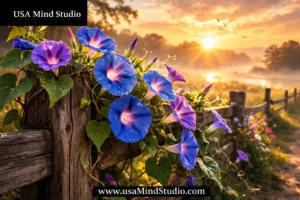
Morning Glory Flower Symbolism of Hope
If there is one word that captures the morning glory more completely than any other, it is hope.
Here is why: the morning glory blooms every single morning without fail. No matter what happened yesterday. No matter how hard the previous day was. No matter what closed down or faded by evening. The next morning, new blooms open. Fresh. Bright. Turned toward the light.
That is hope in its purest, most physical form.
The morning glory’s ability to bloom anew each day signifies resilience and the power of renewal. This theme of rebirth is one of the most consistent threads in morning glory symbolism across every culture that has worked with this flower. In the American tradition of flower gifting, sending morning glories to someone carries an unmistakable message: no matter what you are going through right now, a new morning is coming. The blooms will open again.
There is something else worth noting about the morning glory’s relationship to hope: these flowers are among the easiest plants to grow in America. They thrive in poor soil. They grow in neglected spaces. They push through cracks and climb bare fences and bloom brilliantly where nothing else will. The morning glory does not require perfect conditions to produce beauty. It produces beauty precisely because it does not give up on imperfect conditions.
Think of a cracked sidewalk in a city neighborhood. A single morning glory vine pushing through the concrete, blooming bright purple in the early morning sun. That image says everything about what this flower represents. Hope does not wait for ideal circumstances. It blooms anyway.
For those exploring the deeper spiritual dimension of flowers and plants, the morning glory’s message of hope connects beautifully to the broader world of {INTERNAL_LINK: anchor text = “flower and plant symbolism” | suggested URL = https://usamindstudio.com/flower-symbolism/}.
Morning Glory Flower Symbolism of Luck
Across several Asian traditions — particularly Japanese and Chinese culture — the morning glory is directly and specifically associated with good luck, positive fortune, and protection against misfortune.
In Japan, the morning glory is known as Asagao, which translates beautifully to “morning face.” This flower has been woven into Japanese culture for over a thousand years. According to botanical and cultural historians, the Japanese have been cultivating morning glories since the 9th century and have developed more varieties than any other nation on earth. During the Edo period (1603–1868), morning glory cultivation became a refined art form — rare and unusually beautiful varieties were sought after intensely, with some selling for prices that would seem extraordinary today. The Asagao became a symbol of summer’s beauty, fleeting joy, and good luck.
In Japanese folklore specifically, dreaming of an Asagao flower is considered a symbol of good luck and prosperity. The flower also appears frequently in traditional poetry (haiku), paintings, and kimono designs — always associated with summer, beauty, and the blessings of a new day.
In Chinese tradition, the morning glory carries a uniquely romantic form of luck. The flower is connected to a famous legend about two star-crossed lovers — a boy star named Chien Niu and a girl star named Chih Neu — who were separated by the heavens as punishment for neglecting their duties. They were allowed to meet only once each year. The morning glory, which itself blooms for only one precious day at a time, became the symbol of that rare and lucky meeting — the extraordinary fortune of having even one perfect day with the person you love most.
In many parts of the American South and Midwest, morning glories attract hummingbirds in large numbers. And in numerous folk traditions across these regions, a hummingbird visiting your garden is itself a sign of good luck and positive energy on the way.
Morning Glory Flower Symbolism Across World Cultures
One of the most remarkable things about the morning glory is how widely meaningful it has become across virtually every culture that has ever encountered it. The specific meanings shift — but the emotional core remains strikingly consistent.
In Victorian England and America, as we explored above, the morning glory was a staple of the language of flowers. It appeared in romantic literature, in garden designs, and etched on headstones. The Georgia Department of Natural Resources notes that a blue morning glory blossom in the Victorian tradition represented affection for another, while a red morning glory denoted strong passion. Morning glories on Victorian gravestones symbolized mourning, spirituality, and fleeting mortality — the acknowledgment that beauty passes, but love does not.
In ancient Mesoamerica, the Aztecs called the morning glory tlitlitzin and treated it as a sacred conduit between the human world and the divine. According to researchers in pre-Columbian culture, Aztec priests used morning glory seeds in religious ceremonies to commune with the gods and glimpse the future. The morning glory was not just a flower to the Aztecs — it was a doorway.
In Christianity, some denominations connect the morning glory to the biblical concept of renewal through morning light. Petal Republic, a respected American floral research resource, notes that some Christian groups took up the morning glory as a symbol of renewal and rebirth, drawing a connection to Exodus 16:7, which references the glory of the Lord witnessed in the morning. Each flower, opening with the dawn and fading by nightfall, became a reminder of the finite and precious nature of earthly life.
The morning glory is also the September birth month flower, according to The Old Farmer’s Almanac — making it a natural and meaningful gift for anyone born in September. It carries the message that the person receiving it brings beauty, warmth, and love into the world, blooming brilliantly in their season.
And in the world of American art, morning glories hold a particularly distinguished place. Georgia O’Keeffe — one of the most celebrated American painters in history and widely recognized as the “Mother of American Modernism” — painted one of her most beloved works, Blue Morning Glories, in 1935. O’Keeffe’s flower paintings transformed the way Americans see the natural world, inviting viewers to slow down and look more closely at the beauty that opens and closes in a single day.
[ IMAGE PLACEHOLDER #2 — A rich variety of morning glory colors — blue, purple, pink, white | Alt text: “morning glory flower symbolism across cultures” | Title: Morning Glory Cultural Symbolism | Caption: Morning glories carry rich symbolic meaning across Japanese, Chinese, Victorian, and Native American traditions | Description: A stunning variety of morning glory flowers in blue, purple, pink and white representing diverse cultural meanings | Image Generation Prompt: “A stunning variety of morning glory flowers in blue, purple, pink and white colors, arranged in a flat lay on a rustic wooden surface, soft natural lighting, botanical art style, photorealistic”]
You can explore the broader world of {INTERNAL_LINK: anchor text = “cultural symbolism of flowers and plants” | suggested URL = https://usamindstudio.com/flower-symbolism/} to discover how other blooms carry meaning across traditions.
Morning Glory Color Symbolism
Color adds a rich second layer of meaning to morning glory flower symbolism. The same vine can produce flowers in an extraordinary range of hues — and each one carries its own distinct message.
The Old Farmer’s Almanac provides a particularly detailed breakdown of morning glory color meanings that reflects both Victorian tradition and modern American gifting culture:
Blue morning glory is the most iconic variety and carries the meaning of enduring love, desire, power, and trust. Its deep sky-blue color connects it naturally to clarity, openness, and the freedom of a clear morning sky. In feng shui and Eastern traditions, blue is also associated with the water element — flow, adaptability, and emotional depth.
Purple morning glory symbolizes grace, wealth, and hopefulness. Purple has historically been associated with royalty and spiritual wisdom across both Eastern and Western traditions, and the purple morning glory carries that same energy — elevated, graceful, and aspirational.
Pink morning glory represents gratitude, energy, and gentle affection. Pink is the classic gifting color for morning glories — warm, tender, and full of care. According to the Georgia Department of Natural Resources, pink morning glories are particularly associated with successful accomplishment and prevailing good fortune.
Red morning glory means passion, strength, and bold, fierce love. A red morning glory given to someone carries an unmistakable message of deep intensity and courage.
White morning glory symbolizes purity, innocence, and spiritual clarity. White morning glories are often used in memorial gardens and peaceful spiritual spaces.
Here is a quick reference for all major colors:
| Morning Glory Color | Symbolic Meaning |
|---|---|
| Blue / Purple | Enduring love, trust, spiritual depth, grace |
| White | Purity, innocence, spiritual clarity, new beginnings |
| Pink | Gratitude, gentle affection, good fortune |
| Red | Passion, strength, bold love |
| Magenta / Deep Purple | Spiritual transformation, wisdom, wealth |
| Yellow | Happiness, warm memories, sunny optimism |
Morning Glory Flower Symbolism in Love
Of all the areas of morning glory flower symbolism, love is the richest and most layered — and also the most nuanced. Because the morning glory does not represent just one kind of love. It represents the full, complex range of what love actually feels like in real life.
The Victorian message of “I attach myself to you” captures one dimension: love that clings, that grows toward what it loves, that wraps itself around the life of another person and keeps reaching. That is the love of deep commitment and long partnership.
But the morning glory also represents unrequited love — the love that was real and sincere but was never returned. This is one of its oldest and most consistent symbolic meanings across both Chinese and Victorian tradition. In the Chinese legend of Chien Niu and Chih Neu, the two lovers were separated. Their love was genuine — but circumstances kept them apart. The morning glory blooms for only one day. It gives everything. And then it is gone.
That combination — total love, freely given, in a single day — is both heartbreaking and beautiful. And it is precisely why morning glories have been placed on graves, sent to grieving hearts, and woven into poetry and literature for centuries.
In modern American gifting culture, morning glories are given to express: I am attached to you. You are part of every new beginning I have. A morning glory planted in a shared garden between two people becomes a living, daily symbol of love that renews itself every single morning — no matter what closed down the day before.
Morning glories also represent the 11th wedding anniversary, according to floral tradition. After eleven years of growing together, the morning glory’s message is perfect: a love that keeps putting out new blooms, season after season, year after year.
For more on how flowers carry meaning in relationships and cultural traditions, explore our guide on {INTERNAL_LINK: anchor text = “flower symbolism in love and culture” | suggested URL = https://usamindstudio.com/flower-symbolism/}.
Morning Glory as a Spiritual Symbol
The spiritual dimension of morning glory flower symbolism connects directly and powerfully to its daily cycle — and it speaks to some of the most universal human experiences.
In many Eastern spiritual traditions, the morning glory is a living illustration of impermanence — the deep truth that all things are temporary, and that this temporariness is what makes them precious rather than disappointing. The Japanese concept of mono no aware — the gentle sadness of things passing — is embodied perfectly by a morning glory that blooms brilliantly for a single day and then quietly lets go.
But impermanence in this context is not about loss. It is about the invitation to be fully present with what is here right now. The morning glory does not save itself for later. It does not wait for a better day. It opens completely, right now, with everything it has. That is one of the most profound spiritual teachings available to us — and it comes wrapped in a trumpet-shaped flower on a summer fence.
Christian symbolism also touches the morning glory in a meaningful way. Some Christian traditions connect the flower to Exodus 16:7, where the glory of the Lord is witnessed in the morning. Each morning glory bloom — opening at dawn, fading by dusk — becomes a daily reminder of the precious, finite nature of earthly life and the renewal that comes with every new day.
In the American spiritual tradition, morning glories are also associated with renewal after grief and loss. They are planted in memorial gardens and grief spaces as a symbol of the belief that love does not truly end. That morning always comes. That beauty will open again.
[ IMAGE PLACEHOLDER #3 — A single morning glory bloom opening toward golden sunrise light | Alt text: “morning glory flower spiritual symbolism hope renewal” | Title: Morning Glory Spiritual Symbolism | Caption: The morning glory’s daily cycle of opening and closing makes it a powerful spiritual symbol of renewal and presence | Description: A single luminous morning glory flower opening toward soft golden sunrise light representing spiritual awakening and renewal | Image Generation Prompt: “A single luminous morning glory flower opening toward soft golden sunrise light, bokeh background, dew drops on petals, deeply spiritual and meditative atmosphere, photorealistic, macro shot”]
Morning Glory Flower in Dreams
Dreaming of morning glories is considered one of the most positive and encouraging dream experiences in flower symbolism. These flowers almost always carry an optimistic message when they appear in your sleep.
Morning glories blooming in a dream signal that something fresh and beautiful is opening in your waking life. A new chapter is beginning — perhaps one you have been quietly preparing for without fully realizing it. The dream is saying: it is time to open.
A field of morning glories in a dream represents an abundance of new opportunities surrounding you right now. The challenge the dream may be posing is not whether opportunities exist — but which one to pursue first.
Morning glories closing or wilting in a dream carry a gentler message. Something is completing. A phase of your life is quietly and naturally ending. This is not loss — it is the cycle preparing space for the next bloom. Honor what was, and make room for what comes next.
Planting morning glory seeds in a dream is one of the most encouraging messages of all. You are in the preparation stage of something meaningful and beautiful. The seeds are in the ground. Keep going. The bloom is coming.
In Japanese tradition specifically, dreaming of an Asagao (morning glory) is considered a direct symbol of good luck and prosperity — a sign that fortune is leaning toward you.
Conclusion
Morning glory flower symbolism is a living reminder of some of the most important truths in human experience. Hope that rises every morning without waiting for perfect conditions. Love that gives everything it has in a single day. Luck that comes in the form of one precious, fully present moment. Renewal that happens not despite endings, but because of them.
Whether you are growing morning glories along your fence, gifting them to someone you love, dreaming of them in the quiet hours of the night, or simply pausing to admire them on a summer morning — this flower is always saying the same thing.
Open fully. Turn toward the light. Give everything you have. And trust that tomorrow morning, the blooms will come again.
What new beginning is the morning glory in your life asking you to say yes to?
Call to Action
Do morning glories hold a special meaning in your life? Are you growing them, gifting them, or did one show up unexpectedly in a dream? Share your story in the comments below — we would love to explore the meaning with you.
And if this guide resonated with you, there is so much more to discover. Explore more flower symbolism, plant meanings, and spiritual signs right here on USA Mind Studio.
{INTERNAL_LINK: anchor text = “Explore more flower and plant symbolism” | suggested URL = https://usamindstudio.com/flower-symbolism/}
{INTERNAL_LINK: anchor text = “Discover more spiritual signs and natural symbolism” | suggested URL = https://usamindstudio.com/spiritual-signs/}
FAQ — People Also Ask
Q1: What does the morning glory flower symbolize? The morning glory flower primarily symbolizes love, hope, affection, renewal, and the beauty of the present moment. Its daily bloom cycle — opening at dawn and fading by dusk — makes it a natural symbol of new beginnings and the precious, fleeting nature of beauty. In the Victorian language of flowers, morning glories carried the message “I attach myself to you” — representing deep, tenacious affection.
Q2: What is the symbolism of the morning glory flower in love? In love, the morning glory represents both undying love and unrequited love — depending on cultural context. In Victorian tradition, it symbolized deep, clinging affection. In Chinese folklore, it represents the precious luck of a single day with the person you love. Morning glories also symbolize the 11th wedding anniversary, making them a meaningful gift for long-term partners celebrating enduring love.
Q3: Is the morning glory a symbol of good luck? Yes — particularly in Japanese and Chinese traditions. In Japan, the morning glory (Asagao) is associated with good luck, protection against evil spirits, and positive fortune. Dreaming of a morning glory in Japanese tradition is specifically considered a sign of good luck and coming prosperity. In Chinese folklore, the flower represents the rare and lucky blessing of a perfect day with someone you love.
Q4: What does the morning glory flower symbolize spiritually? Spiritually, the morning glory symbolizes impermanence, renewal, and the invitation to live fully in the present moment. It teaches that beauty and love do not require perfect conditions — they bloom anyway. In Christian tradition, some denominations connect the flower to morning renewal and the glory of God witnessed at dawn. It is also used in memorial and grief gardens as a symbol of love continuing beyond loss.
Q5: What does it mean to dream of morning glory flowers? Dreaming of morning glories is almost always a positive sign. Blooming morning glories in a dream signal a new chapter opening in your life. A field of morning glories suggests an abundance of opportunities around you. Planting morning glory seeds in a dream means something meaningful is being prepared — the bloom is coming. In Japanese tradition, dreaming of a morning glory (Asagao) is specifically interpreted as a symbol of good luck and coming prosperity.
Internal Linking Summary
| Anchor Text | Suggested URL |
|---|---|
| flower and plant symbolism | https://usamindstudio.com/flower-symbolism/ |
| cultural symbolism of flowers and plants | https://usamindstudio.com/flower-symbolism/ |
| flower symbolism in love and culture | https://usamindstudio.com/flower-symbolism/ |
| Explore more flower and plant symbolism | https://usamindstudio.com/flower-symbolism/ |
| Discover more spiritual signs and natural symbolism | https://usamindstudio.com/spiritual-signs/ |
External Links Used (All High-Authority USA Sources)
-
The Old Farmer’s Almanac — September Birth Flowers: Morning Glory | One of America’s oldest and most trusted publications (est. 1792), DA 70+. Used for: color meanings, birth month flower, Georgia O’Keeffe reference, and general morning glory cultural significance.
-
Georgia Department of Natural Resources (georgiawildlife.com) — Out My Backdoor: Misunderstood Morning Glories | Official US state government wildlife resource (.gov-adjacent), DA 70+. Used for: Victorian symbolism detail, color meanings (blue = affection, red = passion), gravestone symbolism, and botanical facts.
-
Wikipedia — Ipomoea (Morning Glory) — https://en.wikipedia.org/wiki/Ipomoea | DA 90+. Used for: botanical overview, cultural history, and species information.
Published on USAMindStudio.com | Category: Flower & Plant Symbolism | Primary Keyword: morning glory flower symbolism