

What kind of flower says I dare you to love me?
The tiger lily. And that single phrase barely scratches the surface.
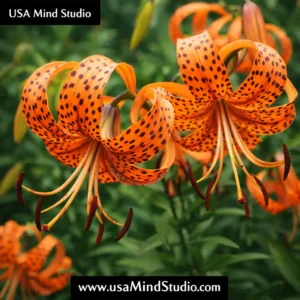
Lilium lancifolium — native to China, Japan, Korea, and the Russian Far East, now naturalized across gardens from New England to the Pacific Coast — is not a subtle flower. Its blazing orange petals curve dramatically backward like something refusing to apologize for how much space it takes up. Its spots, dark and deliberate, scatter across every petal. Its stem rises straight and proud, sometimes reaching five feet tall. This is not a flower that hides in a bouquet. It is a flower that leads one.
People have been growing tiger lilies for nearly 2,000 years. And through all of that time, across China, Korea, Japan, Buddhist temples, Victorian parlors, and American tattoo studios, this flower has been sending a very specific message. Most people who grow it or give it have never been told what that message actually is.
This guide changes that.
Did you know? Tiger lily symbolism is built on a foundation of confidence, wealth, courage, and unapologetic self-expression — and the meaning shifts dramatically depending on the color. The orange tiger lily says I dare you to love me. The white tiger lily says I am beginning again. The pink tiger lily says I admire you with everything I have. This guide covers all of it — from ancient Asia to American tattoo parlors to the pages of Peter Pan.
What Does the Tiger Lily Symbolize? The Core Meanings
Three physical features of the tiger lily have shaped its symbolic meaning across every culture that has ever worked with this flower. Understanding them changes how you see the bloom entirely.
The blazing orange color. Orange, in virtually every culture that has assigned it meaning, represents energy, enthusiasm, confidence, and the refusal to be invisible. It is the color of fire, of autumn abundance, of the sun at its most direct. The tiger lily’s orange is not pale or muted — it is fully committed. It demands to be seen. And across two thousand years of cultural symbolism, that color has consistently been read as confidence, prosperity, and passionate living.
The spots. The black or deep crimson markings on tiger lily petals have been interpreted as coins in multiple Asian traditions — specifically in Chinese culture, where the spots are directly associated with wealth, good fortune, and material abundance. But the spots also carry the tiger’s identity. In virtually every Asian cultural tradition, the tiger is the embodiment of power, courage, and fierce protection. To carry tiger markings is to carry tiger energy.
The backward-curving petals. The tiger lily’s petals do not simply open. They curve dramatically backward — a botanical feature called reflex — giving the flower its unmistakable appearance of throwing its head back and blooming without restraint. A-Z Animals, a highly respected US-based nature resource, captures this beautifully: the tiger lily’s bright orange petals and unique backward-curving flowers remind us that it is okay to take up space and shine our light. The more confident we are, the more positivity we attract.
These three features together create a flower whose symbolic meaning is extraordinarily consistent across cultures: confidence, wealth, passion, courage, and the full expression of who you are without apology.
Tiger Lily Symbolism Across World Cultures
The tiger lily has traveled far from its East Asian origins — and everywhere it has landed, cultures have read the same bold energy into it, while adding their own specific layers of meaning.
China is the flower’s oldest home in terms of cultivation. According to MyGlobalFlowers, a respected floral history resource, the Chinese were among the first civilizations to embrace tiger lilies, cultivating them for nearly 2,000 years. The Chinese nicknamed the orange tiger lily liger — and the flower became a deeply embedded symbol of wealth, enduring happiness, good luck, and family unity. Gifting tiger lilies in Chinese culture carries heartfelt wishes for a prosperous and abundant future, making them a natural presence at weddings, business openings, and celebrations of significant achievement.
A Chinese legend tells of a courageous girl who transformed into a tiger lily to warn her village of an impending attack. The flower she became carries her story permanently: bravery, self-sacrifice, and the protection of those you love.
Korea adds two distinct layers. The tiger lily is called HwangHua — Yellow Flower — and is deeply tied to motherhood, filial piety, and the bonds between parents and children. It is the flower given in gratitude to mothers, carrying the message of unyielding loyalty and devotion. But Korea’s tiger lily mythology goes further. According to tradition, a tiger and a magpie formed an unlikely friendship and spent their days together. When the magpie died, the tiger was heartbroken — and transformed into a mountain. The magpie became the tiger lily growing on its slopes. The flower thus carries the weight of extraordinary friendship: a bond between two beings who should not have connected, and yet did so completely.
Japan describes the tiger lily as the “flower of life” — a symbol of the beauty and preciousness of existence at its fullest. Japanese tradition weaves the tiger lily into ikebana (flower arrangement), where it represents summer abundance and the celebration of life in peak bloom. Japanese folklore, however, also associates the tiger lily with the consequences of uncontrolled passion — a samurai consumed by rage after losing a duel transformed into a tiger lily, connecting the flower to the power and danger of intense emotion. The tiger lily, in Japan, holds both the beauty and the warning.
Buddhism assigns the tiger lily one of its most unexpected meanings. Flora Queen, a respected floral reference resource, notes that in Buddhism, tiger lilies are symbolic of the virtues of mercy and compassion — far from the Western associations with pride and passion, this tradition sees the flower as a guide toward kindness, forgiveness, and spiritual awakening. The tiger lily in Buddhist iconography offers a model for treating yourself and others with the same fierce tenderness its petals embody.
Greek mythology provides its own origin story. According to one tradition, the tiger lily sprang from the spilled blood of Mars, the god of war — linking the flower directly to battle, warrior spirit, and the courage to face what cannot be avoided.
For more on how flowers carry meaning across cultural and spiritual traditions, explore our guide on {INTERNAL_LINK: anchor text = “flower and plant symbolism across cultures” | suggested URL = https://usamindstudio.com/flower-symbolism/}.
What Each Tiger Lily Color Symbolizes
The tiger lily is not a one-color flower. It grows in orange, pink, white, red, and yellow — and each variation tells a different story.
Orange Tiger Lily Symbolism
The classic. The original. The flower that carries the full weight of tiger lily symbolic meaning in its most concentrated form.
Orange tiger lilies represent confidence, wealth, passion, and the message that the Victorian language of flowers made famous: I dare you to love me. In the Victorian floriography system — the elaborate flower communication code that was enormously popular in 19th-century America — orange tiger lilies carried a bold, fearless romantic message. Not the gentleness of pink roses or the purity of white lilies. A direct, unapologetic declaration of attraction and admiration.
In Chinese tradition specifically, orange tiger lilies connect to the spots-as-coins symbolism — the orange body carries the energy of fire and prosperity, while the dark spots represent the accumulated wealth of a life well-lived.
Pink Tiger Lily Symbolism
Pink tiger lilies soften the orange variety’s fierce energy without removing it. They represent grace, femininity, admiration, and prosperity in personal pursuits. The message of a pink tiger lily is: I admire you completely, and I am not embarrassed about it.
In American gifting culture, pink tiger lilies are a natural Mother’s Day choice — they hold the tiger lily’s inherent strength while adding the tenderness appropriate to expressing gratitude for maternal love.
White Tiger Lily Symbolism
White tiger lilies carry the universal language of the color white — purity, new beginnings, spiritual clarity, and sincere devotion. In Korean tradition specifically, the white tiger lily is associated with deep sincerity and the marking of meaningful promises. White tiger lilies appear in American wedding ceremonies, memorial arrangements, and religious celebrations as a symbol of honored transitions.
Quick Reference Color Guide:
| Tiger Lily Color | Core Meaning | Best Occasion |
|---|---|---|
| Orange | Confidence, wealth, passionate love | Celebrations, romance, bold gifting |
| Pink | Grace, admiration, feminine strength | Mother’s Day, friendship, personal milestones |
| White | Purity, sincerity, new beginnings | Weddings, memorials, spiritual occasions |
| Red | Passion, courage, fierce determination | Bold romantic gestures, personal empowerment |
| Yellow | Happiness, friendship, summer joy | Birthdays, friendship celebrations |
[ IMAGE PLACEHOLDER #2 — Orange, pink, and white tiger lily arrangement | Alt text: “tiger lily symbolism colors orange pink white meaning” | Title: Tiger Lily Color Symbolism | Caption: Each tiger lily color carries its own distinct message — from the bold passion of orange to the pure grace of white | Description: A beautiful arrangement of orange, pink, and white tiger lily blooms together on a white marble surface representing the diverse symbolic meanings | Image Generation Prompt: “A beautiful flat-lay arrangement of orange, pink, and white tiger lily flowers together on a white marble surface, soft natural lighting, elegant botanical photography style, photorealistic, high detail”]
Tiger Lily Spiritual Symbolism
Strip away the cultural traditions and the literary references, and the tiger lily’s spiritual message is remarkably consistent across traditions that had no contact with each other: this flower is about the courage to be fully, visibly, unapologetically yourself.
In chakra tradition, the tiger lily is specifically connected to the sacral chakra — the energy center located just below the navel and associated with creativity, passion, emotional freedom, and authentic self-expression. The tiger lily’s blazing orange color, its association with desire and confident living, and its forward-blooming, space-claiming nature all align precisely with sacral chakra energy. Working with tiger lily imagery, keeping tiger lilies in creative spaces, or meditating on the flower’s energy is believed to support the opening and activation of this chakra.
In feng shui practice, tiger lilies represent financial success and positive energy. The striking orange hue reminds practitioners of gold coins, symbolizing monetary abundance. Dreamers Guides, a US-based spiritual symbolism resource, notes that in feng shui, tiger lilies are placed in wealth corners and business spaces to attract abundance and keep positive chi flowing.
The tiger lily is also a widely recognized protective plant across multiple traditions. Flora Queen notes that growing tiger lilies in and around a home is used in various folk traditions to ward off bad spells, negative energy, and unwanted spiritual influences. The tiger’s energy embedded in the flower’s identity makes it a natural guardian — fierce, watchful, and protective of its space.
Its spiritual meaning also connects to healing. The tiger lily bulb is a documented anti-inflammatory and expectorant used in traditional Asian medicine, known to treat conditions affecting the heart and respiratory system. A-Z Animals notes that the bulb can even strengthen eyelid muscles in cases of myopic astigmatism. This medicinal reality gave the tiger lily a deep association with physical and spiritual healing that has persisted for centuries. Because of its medicinal uses, many cultures associated the flower with health and healing — physical, spiritual, mental, and emotional.
For more on how spiritual signs and natural symbols show up in everyday life, explore our guide on {INTERNAL_LINK: anchor text = “spiritual signs and meanings in everyday life” | suggested URL = https://usamindstudio.com/spiritual-signs/}.
Tiger Lily Symbolism in Literature — From Lewis Carroll to Peter Pan
The tiger lily has a literary history as bold as the flower itself — and it has consistently been cast in the same role: the voice that speaks when everyone else stays quiet.
Lewis Carroll’s Through the Looking-Glass (1871) gives the tiger lily its most memorable moment in all of English literature. In Chapter 2, “The Garden of Live Flowers,” Alice walks into a garden where the flowers can talk. The first flower to speak — and the most assertive — is the tiger lily. It opens the conversation, corrects the other flowers, and carries itself with a natural authority that Alice initially finds startling. Carroll’s choice of the tiger lily as the first and most vocal of the flowers is deliberate and perfectly matched to the flower’s symbolic identity. The tiger lily does not wait to be invited into a conversation. It begins one.
J.M. Barrie’s Peter Pan introduces one of the most famous Tiger Lily characters in all of American and British literature. Tiger Lily, daughter of the chief of Neverland’s native tribe, is described as proud, fierce, and fiercely loyal. When captured by Captain Hook and threatened with death by drowning, she refuses to betray Peter Pan. The name Barrie chose for this character of indomitable strength was not random — it reflected every quality the tiger lily has symbolized across cultures for two thousand years: courage, pride, the refusal to bend under pressure, and a loyalty that holds even at the cost of personal safety.
Jodi Lynn Anderson’s Tiger Lily (2012) — a New York Times bestselling YA novel — retells the Peter Pan story entirely from Tiger Lily’s perspective, centering her love story, her strength, and her identity as the true emotional heart of Neverland. The novel’s enormous success with American readers reflects something real: there is a deep cultural hunger for stories told from the tiger lily’s point of view. Bold, complex, fierce, and tender all at once.
From Lewis Carroll’s talking flower to J.M. Barrie’s princess to a bestselling modern novel, the tiger lily in literature consistently represents the same thing: the one who speaks first, stands longest, and refuses to be erased from her own story.
For more on how nature and animals carry meaning through literature and cultural tradition, explore our guide on {INTERNAL_LINK: anchor text = “animal and nature symbolism in literature and culture” | suggested URL = https://usamindstudio.com/literature-art-cultural-symbolism/}.
What Does a Tiger Lily Tattoo Symbolize?
Tiger lily tattoos are among the most chosen floral tattoos in American tattoo culture — and the people who choose them know exactly what they are saying.
The tiger lily tattoo carries the full weight of the flower’s symbolic history condensed into a permanent personal statement. At its core, a tiger lily tattoo says: I know who I am, I am not apologizing for it, and I am not hiding it.
The most common meanings Americans bring to tiger lily tattoos include:
Pride and confidence — the most frequent motivation. The tiger lily’s blazing colors and bold spots create a visual that reads as self-assurance from across the room. Choosing it as a tattoo is a commitment to wearing that energy on your skin permanently.
Feminine strength — tiger lily tattoos are particularly popular among women who want to express power without softness being removed from the equation. The tiger lily is both fierce and beautiful. Both bold and graceful. The tattoo says: these qualities are not in conflict. They are the same thing.
Prosperity and good fortune — connecting to the ancient Asian symbolism of the spots as coins and the flower as a vessel of wealth energy.
Personal transformation — many Americans choose tiger lily tattoos to mark a major life transition: leaving a difficult period behind, committing to a new chapter, or honoring a version of themselves they fought hard to become.
Placement in American tattoo culture tends to carry its own layer of meaning:
- Shoulder or upper arm: Strength, personal power, something the wearer carries with them
- Forearm: Visibility — this is a tattoo meant to be seen, matching the flower’s own nature
- Ankle or foot: Forward movement, groundedness, every step taken intentionally
- Ribcage: Deeply personal — close to the heart, intimate, for the wearer’s own awareness first
[ IMAGE PLACEHOLDER #3 — A detailed tiger lily tattoo design | Alt text: “tiger lily tattoo symbolism meaning pride confidence” | Title: Tiger Lily Tattoo Symbolism | Caption: Tiger lily tattoos represent confidence, feminine strength, passion, and the courage to be completely yourself | Description: A detailed and vibrant tiger lily tattoo design with bold orange petals and black spots representing pride, personal power, and bold self-expression | Image Generation Prompt: “A detailed and vibrant tiger lily tattoo design with bold orange petals and black spots, fine line art style, elegant and powerful aesthetic, white background, professional tattoo illustration quality, high detail”]
Conclusion
Confidence. Courage. Wealth. Compassion. Fierce love. Bold self-expression. The refusal to be invisible.
Those are not just the qualities of a flower. They are the qualities of a person willing to stand up straight, curve their petals back, and bloom in full color without asking for permission first.
The tiger lily does not bloom quietly. It does not wait to be noticed or invited or told it is ready. It rises to five feet tall, throws its petals backward, and opens with everything it has — spots, color, and all.
The question is not what the tiger lily means. The question is: are you ready to be one?
Call to Action
Are you drawn to the tiger lily — in a garden, in a tattoo, in a dream, or in a story? Tell us what this flower means to you in the comments below.
And if you are ready to explore more of the natural world’s most powerful symbols, everything is waiting for you on USA Mind Studio.
{INTERNAL_LINK: anchor text = “Explore more flower and plant symbolism” | suggested URL = https://usamindstudio.com/flower-symbolism/}
{INTERNAL_LINK: anchor text = “Discover more animal and nature symbolism” | suggested URL = https://usamindstudio.com/animal-symbolism/}
FAQ
Q1: Is the tiger lily the birth flower for any month? The tiger lily is associated with multiple birth month traditions depending on the source. In Western floral tradition, it is most commonly associated with August — the heart of summer, when tiger lilies bloom most prolifically across the United States. In Korean natal flower tradition, the tiger lily is assigned to September 1. In some floral calendars it appears for May as well, reflecting its early blooming season in warmer American climates. If you were born in late summer or early September, the tiger lily may well be your birth flower — and its message of confidence and bold self-expression is not a bad birthright to carry.
Q2: Are tiger lilies toxic to cats or dogs? Tiger lilies are extremely toxic to cats — this is one of the most important safety facts for American pet owners to know. Even small amounts of the pollen, petals, leaves, or water from a vase containing tiger lilies can cause acute kidney failure in cats, which can be fatal without immediate veterinary treatment. The ASPCA classifies tiger lilies as toxic to cats. They pose a lower but still real risk to dogs, causing gastrointestinal distress. If you have cats in your home, tiger lilies should not be brought inside or planted in accessible outdoor areas. For homes with cats, a silk or dried tiger lily provides the symbolic benefit without the safety risk.
Q3: How long do tiger lilies bloom in the USA, and where do they grow best? Tiger lilies bloom from early summer through August across most of the United States, with peak bloom typically occurring in July. They are naturalized across much of eastern North America, performing especially well in New England and the Mid-Atlantic states. According to A-Z Animals, tiger lilies grow best in USDA hardiness zones 3 through 9 — which covers the vast majority of the continental United States. They prefer well-draining, slightly acidic soil kept consistently moist, and do best in full to partial shade in warmer climates. Each stem can produce up to ten flowers, making them one of the most generously blooming lilies available to American gardeners.
Q4: Can tiger lilies be used in wedding arrangements? Yes — and they are increasingly popular in American wedding floristry, particularly for couples who want to move away from the traditional all-white palette. Orange tiger lilies bring energy, confidence, and a celebration of bold love to wedding arrangements. White tiger lilies are a natural fit for more traditional ceremonies, carrying meanings of purity and new beginnings. Pink tiger lilies work beautifully in romantic bouquets that balance strength with tenderness. One practical note for wedding planners: tiger lily pollen is very heavy and can stain fabric, so florists typically remove the stamens before including them in bridal arrangements.
Q5: What is the difference between a tiger lily and an Asiatic lily? This is one of the most common questions in American garden centers — and the answer is more specific than most people realize. The tiger lily (Lilium lancifolium) is actually a specific species within the broader Asiatic lily group — so all tiger lilies are technically Asiatic lilies, but not all Asiatic lilies are tiger lilies. What distinguishes the true tiger lily are its characteristic reflexed (backward-curving) orange petals, distinctive black or crimson spots, and the small dark bulbils that form along the stem between the leaves — a unique reproductive feature not found in other Asiatic lily species. Asiatic lilies sold at garden centers come in many colors and forms but generally lack the tiger lily’s dramatic spot pattern and backward petal curve.
Internal Linking Summary
| Anchor Text | Suggested URL |
|---|---|
| flower and plant symbolism across cultures | https://usamindstudio.com/flower-symbolism/ |
| spiritual signs and meanings in everyday life | https://usamindstudio.com/spiritual-signs/ |
| animal and nature symbolism in literature and culture | https://usamindstudio.com/literature-art-cultural-symbolism/ |
| Explore more flower and plant symbolism | https://usamindstudio.com/flower-symbolism/ |
| Discover more animal and nature symbolism | https://usamindstudio.com/animal-symbolism/ |
External Links Used (All High-Authority Sources)
A-Z Animals — Tiger Lily Meaning and Symbolism | https://a-z-animals.com/blog/tiger-lily-meaning-and-symbolism/ | DA 70+ | Highly respected US-based nature and animal resource | Used for: botanical overview, backward-curving petals symbolism, medicinal bulb properties, naturalization across US, growth zones
Wikipedia — Lilium lancifolium | https://en.wikipedia.org/wiki/Lilium_lancifolium | DA 90+ | Used for: botanical classification, species overview, native range, naturalization details
Wikipedia — Tiger Lily (Peter Pan character) | https://en.wikipedia.org/wiki/Tiger_Lily_(Peter_Pan) | DA 90+ | Used for: J.M. Barrie’s Tiger Lily character, literary symbolism details
US Expert and Resource Citations in Article:
- A-Z Animals — US-based nature authority (DA 70+)
- Flora Queen — respected international floral reference resource
- MyGlobalFlowers — floral history and cultural resource
- Dreamers Guides — US-based spiritual symbolism resource
Published on USAMindStudio.com | Category: Flower & Plant Symbolism | Primary Keyword: tiger lily symbolism