
In 1861, the United States Treasury faced a problem.
The nation was at war, money was tight, and counterfeiters were everywhere. Officials needed to print a new paper currency quickly — one that was difficult to photograph and forge. They tested dozens of ink options. The winner was a dark, rich green pigment that resisted the early photographic techniques counterfeiters relied on.
They printed the backs of the new bills in that deep, unmistakable green. Americans nicknamed them “greenbacks.” And in that single practical decision, dark green became permanently embedded in the American imagination as the color of money, authority, and financial power.
But that is one story from one country in one century. Dark green has been carrying meaning for thousands of years before 1861 — in the temples of ancient Egypt, in the sacred texts of Islam, in the poisoned Victorian wallpaper of wealthy American homes, and in the deep forest spaces where healers, druids, and spiritual practitioners have always done their most important work.
This is the full picture of dark green symbolism — including the parts most people never find.
Dark green symbolism carries three parallel stories at once: it is the color of great wealth and the color of dangerous greed; the color of deep healing and the color of hidden poison; the color of ancient forests and the color of every dollar bill in your wallet. This guide covers all three — including world cultures, psychology, flags, branding, spiritual meaning, and the shadow side that most articles skip entirely.
What Does Dark Green Symbolize? The Core Meanings
To understand dark green symbolism, you first have to understand what separates dark green from every other shade of green — and why that difference matters.
Bright green says: new beginning. It is the color of the first shoot pushing through winter soil, the freshness of April, the energy of something that has just started. Lighter greens feel young, open, and full of possibility.
Dark green says something different. It says: I have been growing for a long time. It is the color of the old-growth forest, the ancient pine, the deep moss that has been settling into stone for decades. Where bright green is a sapling, dark green is a tree that has weathered storms and kept its roots.
This distinction shapes everything about what dark green symbolizes.
Kate Smith, an internationally recognized US color expert at SensationalColor.com — The Meaning of Green by Kate Smith who has spent more than two decades researching color with Fortune 500 companies and individual clients, describes how green environments produce measurable physical changes in the human body — stimulating the pituitary gland, relaxing muscles, and increasing blood histamine levels in ways that reduce stress and improve cognitive function. Dark green specifically extends these effects with an added quality: it grounds. It settles. It signals depth and established strength rather than fresh energy.
Here are the five core meanings dark green carries across virtually every tradition:
Wealth and abundance. Deep green appears in nature only where growth is thoroughly established — the dark canopy of a mature forest, the deep fields of a flourishing harvest. Cultures worldwide read this correctly: dark green is not the color of hoping for prosperity, but of having built it.
Stability and endurance. Dark green is the color of the evergreen tree — the one that holds its color through every season, through every storm. It signals the kind of trustworthiness that has been tested by time and held anyway.
Ambition. Not the reckless ambition of someone just starting out, but the sustained drive of someone who has already achieved and refuses to stop growing. As empower-yourself-with-color-psychology.com notes, dark green is often associated with wealthy businessmen who are always striving for more — ambitious, focused, relentlessly forward-moving.
Healing and restoration. The deep forest has been humanity’s oldest recovery space. Long before modern medicine, people went into green, living, breathing spaces to restore what had been depleted. Dark green carries that ancient association with physical and spiritual repair.
Authority and tradition. This is the most overlooked angle of dark green symbolism in America — and it is hiding in plain sight. The US Army dress uniform. National Park Service ranger uniforms. The US Forest Service. The boardrooms of Wall Street’s oldest financial institutions. Dark green has dressed American authority for generations because it communicates a specific message: we have been here a long time, and we know exactly what we are doing.
Dark Green Color Symbolism Across World Cultures
The same color that means financial power in America means something entirely different in a mosque in Saudi Arabia — and something different again in the moss gardens of Kyoto. Here is how dark green symbolism travels across the world.
United States — money, authority, and the land itself. The greenback story is the foundation, but dark green’s American roots go deeper. Green was the favorite color of George Washington, the first President of the United States — a fact that sits quietly at the intersection of American leadership and natural symbolism. In American culture, dark green simultaneously signals financial success, environmental stewardship, and institutional trust. It is the color worn by the people America charges with protecting its most sacred natural spaces.
Islam and the Middle East — paradise and divine favor. Dark green holds a genuinely sacred position in Islamic tradition. According to Wikipedia’s extensively documented article on the color green in Islam, the Quran describes the residents of paradise wearing garments of fine green silk. Authentic hadith describe the Prophet Muhammad wearing green garments. Across the Islamic world, green — and particularly the deep, rich greens used in sacred architecture and national flags — signals paradise, divine blessing, and the lush abundance of the afterlife. This is the reason Saudi Arabia’s flag features a deep green field, and why green appears so prominently throughout Islamic art and architecture.
Ancient Egypt — Osiris and the cycle of rebirth. In ancient Egypt, dark green was the color of Osiris, god of the underworld and resurrection. The Egyptian connection positioned dark green not as death’s opposite but as the force that moves through death and produces new life. Osiris was often depicted with green skin — representing the fertile, regenerating power of the Nile’s annual flood cycle, which brought dark, rich soil to the fields and renewed Egypt’s abundance every year. Dark green in Egyptian symbolism is the color of the cycle itself: endings that become beginnings.
Japan — eternal life and the endurance of the spirit. As noted by ColorsExplained.com, Japan associates the color green with eternal life. Dark green specifically connects to the permanence of the ancient forest — the deep cedar groves of Yakushima, the moss gardens of Kyoto’s Saihoji Temple, spaces that have been growing and deepening for centuries. Japanese aesthetics read dark green as the visual signature of accumulated time and wisdom.
China — wealth, harmony, and the nuances of infidelity. China’s relationship with green has two faces. On one side, dark green connects to wealth, fertility, cleanliness, and harmony — the earned prosperity of a household that has built something lasting. On the other side, wearing a green hat in China carries a highly specific meaning: it signals that a man’s wife has been unfaithful. This cultural nuance — completely invisible to Western eyes — is a powerful reminder that color symbolism always carries local meaning alongside universal meaning.
Celtic tradition — sacred groves and ancestral wisdom. Celtic druids conducted their most important spiritual work in deep forest groves — spaces of dark green canopy where the old wisdom lived. The deep green of ancient forests was not just beautiful to Celtic spiritual tradition. It was a living archive of ancestral knowledge, a space where the boundary between the ordinary world and the otherworld was thinner than anywhere else.
Dark Green in Color Psychology — What It Does to Your Brain
There is a reason hospitals, schools, and financial institutions have reached for dark green for generations — and it is not just aesthetic preference. Dark green produces specific, measurable effects on the human brain and body.
Kate Smith’s research at SensationalColor.com confirms what physiologists have been documenting for decades: time spent in green environments stimulates the pituitary gland, naturally relaxes muscles, increases blood histamine levels to dilate blood vessels, and measurably improves reading ability, creativity, and cognitive function. Research consistently shows that these effects are strongest in dense, dark green environments — old forests, deep garden spaces — rather than in lighter, more open green settings.
But dark green does something in the mind that lighter greens do not. It creates a sense of being established rather than merely growing. Colors Explained describes dark green as dignified, professional, respectable, expensive, and sophisticated. Not the excited energy of bright green — but the settled confidence of something that has already proven itself.
The Scheele’s Green story is dark green’s most haunting psychological chapter — and it is almost entirely absent from competing articles about this color. In 1775, Swedish chemist Carl Wilhelm Scheele developed a brilliant, vivid dark green pigment using copper arsenite — an arsenic-based compound. Scheele’s Green, as it became known, was the most fashionable wallpaper color in Victorian America and Europe. Wealthy homes decorated their parlors and bedrooms in its rich, deep tones. The problem was that in damp conditions, household mold converted the arsenic in the pigment into trimethylarsine — a toxic gas that slowly poisoned the room’s inhabitants.
Families fell mysteriously ill. Physicians blamed the climate, bad air, or constitutional weakness. The wealthy died in fashionably decorated bedrooms, surrounded by the very color that signaled their status. Some historians believe that Napoleon Bonaparte — who died on the damp island of Saint Helena, in a bedroom covered with green wallpaper — may have been slowly poisoned by his own walls. Dark green’s association with wealth and power, in this chapter of history, literally concealed a hidden cost. The color that said prosperity was, in certain homes, delivering something else entirely.
Dark Green Flag with White Symbol — What These Flags Mean
The “dark green flag with white symbol” search gets significant traffic — and no competing article addresses it directly. Here is the full picture.
The world’s most recognizable dark green flags with white symbols carry some of the deepest national and spiritual identity of any flags on earth.
Saudi Arabia features a deep green field bearing the Shahada — the Islamic declaration of faith — in white Arabic script, above a white horizontal sword. The dark green field represents Islam in its most sacred form; the white script expresses the purity and clarity of faith; the sword represents justice, strength, and the readiness to defend what is sacred. According to the World Population Review, the green on the Saudi flag is directly representative of the Islamic religion — making it one of the most explicitly spiritually meaningful flags in the world.
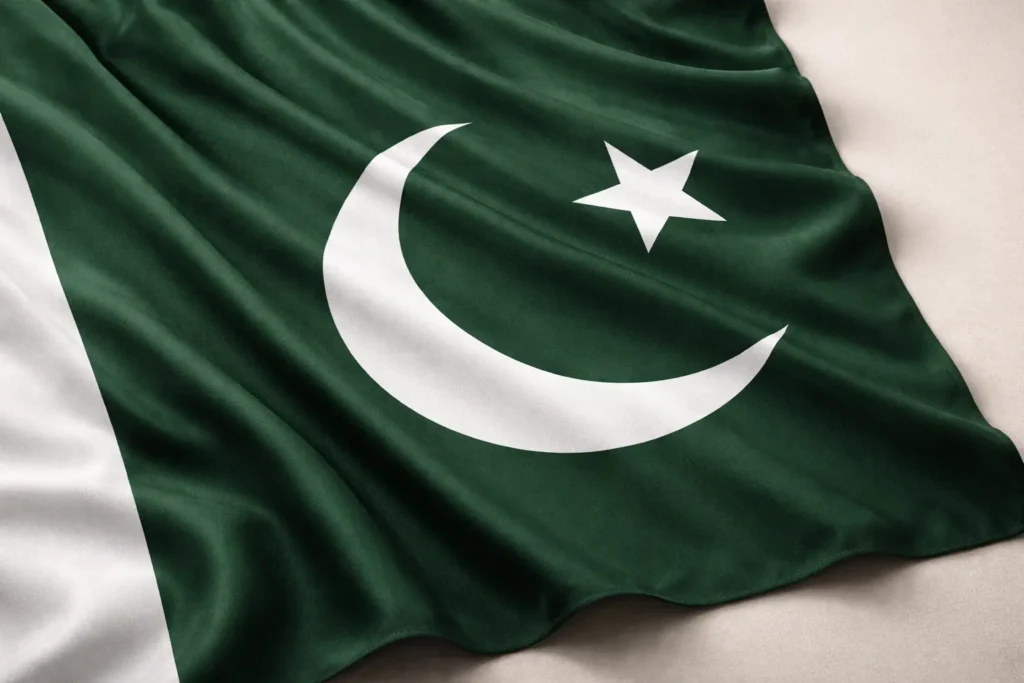
Pakistan features a dark green field with a white vertical stripe along the hoist and a white crescent moon with a five-pointed star. The dark green represents the Muslim-majority population and Pakistan’s Islamic identity and heritage; the white stripe represents religious minorities and the national commitment to their equal rights; the crescent represents progress; the star represents knowledge and light. The pairing of dark green with white on Pakistan’s flag carries a specific symbolic message: ancient, rooted faith expressed with clarity and openness.
Why dark green and white? The symbolic logic of this pairing appears across multiple flag traditions: dark green carries the weight of deep-rooted faith, established tradition, and sacred authority; white provides the contrast of purity, clarity, and honest intention. Together, they read as: what we believe is ancient and certain — and we hold it with clear conscience.
Dark Green Symbolism — The Negative Side
Dark green’s shadow meanings are not separate from its positive ones. They grow directly out of them — and the relationship is worth understanding honestly.
Greed. The same quality that makes dark green the color of wealth makes it the color of the dangerous love of wealth. empower-yourself-with-color-psychology.com notes that dark green is often associated with those who are possessive, materialistic, and devious with money — people who accumulate not out of genuine appreciation for what they have, but out of the compulsive need for more. Greed, in this reading, is ambition without restraint or wisdom.
Envy. Shakespeare gave the world its most enduring dark green symbol in Othello, where Iago describes jealousy as the “green-eyed monster which doth mock the meat it feeds on.” The muddy, darker tones of green have consistently been linked to the specific experience of wanting what someone else has — not honest desire, but the particular bitterness of comparison. ColorPsychology.org confirms that darker hues of green carry more negative connotations than lighter shades, specifically in the territory of envy and resentment.
Stagnation. Too much dark green energy — stability without movement, endurance without growth — tips into something heavier. The great old forest that has grown so dense it no longer allows new light to reach the forest floor. Reliability that has become inflexibility. The ambition that hardened somewhere along the way into the refusal to let anything change.
The institutional green trap. Anyone who has spent time in older American government offices, public schools, or mid-century hospitals knows the exact feeling of institutional dark green used without intention — a color that signals cold authority rather than warm stability, confinement rather than grounding. Dark green, applied without care, creates spaces that feel like being managed rather than supported.
The negative side of dark green symbolism is not a reason to avoid the color. It is a reason to use it thoughtfully — and to notice when the ambition it represents is feeding genuine growth, and when it has crossed into something else.
Dark Green Spiritual Symbolism — Heart Chakra, Healing & the Living World
In spiritual traditions practiced widely across the United States — from yoga and Reiki to energy healing and meditation — dark green is the color of the heart chakra (Anahata): the energy center governing love, compassion, emotional balance, and the bridge between the physical and spiritual dimensions of life.
The heart chakra connection gives dark green one of its most important spiritual meanings: healing through love. Not the passionate, electric love of red — but the steady, reliable, nurturing love that holds through difficulty. The kind of love that keeps showing up, keeps growing, keeps its roots deep in the ground even while its branches are bending in the wind.
In grounding practices — which have grown substantially in popularity across the United States — dark green is a primary color anchor. Walking barefoot on dark green grass, meditating in a forested space, keeping dark green plants in a room: these are all established grounding techniques that use the color’s earth energy to restore equilibrium when modern life has pulled a person away from their center.
Forest bathing (shinrin-yoku) — the Japanese practice of immersive time in forest environments, now documented extensively in scientific literature and popular throughout the United States — is built entirely on the healing energy of dark green spaces. According to Wikipedia’s article on shinrin-yoku, research consistently shows that time in dense forest environments lowers cortisol levels, reduces blood pressure, improves immune function, and elevates mood in measurable ways. The dark green canopy is not incidental to these effects. It is the mechanism.
Dark green also carries a spiritual protection function in multiple traditions. Dreamers Guides, a US-based spiritual symbolism resource, notes that in feng shui, dark green is placed in wealth corners and business spaces to attract abundance and keep positive energy flowing. The striking orange-gold contrast of prosperity symbols against dark green backgrounds is a classic feng shui pairing — the ancient color of the deep forest holding the energy of financial growth.

Dark Green in American Branding, Fashion & Interior Design
Dark green is one of the most strategically deployed colors in American commercial life — and understanding why reveals exactly how deep its symbolic weight runs.
Branding. The institutions that choose dark green are almost always communicating the same message: we have been here long enough to be trusted. Starbucks uses dark green to project a comfortable, consistent, welcoming stability — what Big Ox Printing describes as promoting a peaceful and comfortable atmosphere with reliability and high-quality products. Land Rover, Rolex, John Deere, and many of Wall Street’s oldest financial firms use dark green as a direct signal of established authority. These are not companies trying to look fresh and innovative. They are communicating the exact opposite: permanence, depth, and the confidence of an institution that does not need to shout.
Fashion. In American fashion, dark green — forest green, hunter green, bottle green — is the color of confident maturity. It says: I am not here to be noticed. I am here because I know exactly who I am. Big Ox Printing recommends forest or emerald green specifically for a sophisticated, confident look. Dark green suits, coats, and accessories consistently signal depth and groundedness in the American style lexicon without the aggression of black or the status-signaling of navy.
Interior design. Design experts consistently recommend dark green for spaces where depth, calm, and natural grounding are the goals. Studies, libraries, reading rooms, and master bedrooms benefit from dark green walls because the color creates the psychological sensation of being inside a protected natural space — held, grounded, and away from the pressures of the outside world. Big Ox Printing confirms that darker shades like forest green impart stability and sophistication, ideal for adding depth and elegance.
Conclusion
Dark green has been carrying meaning for thousands of years — and it has never carried just one thing.
It is the color of money and the color of the poison hiding inside fashionable wallpaper. The color of paradise in Islamic tradition and the color of the green-eyed monster in Shakespeare. The color of ancient forests that have been healing people for centuries, and the color of the institutional walls that have made them feel trapped.
All of this lives inside the same rich, deep shade.
What draws you to dark green? Whether it is the stability you are building, the abundance you are reaching toward, the healing you are seeking, or the maturity you have already earned — the colors we are drawn to are rarely accidents. They are mirrors.
Dark green does not ask to be noticed. It asks to be understood.
FAQ
Q1: What is the difference between dark green and forest green? These two terms are often used interchangeably in American design and retail, but they are technically distinct. Forest green is a specific shade — a muted, medium-dark green with slight grey or brown undertones, inspired by the color of pine and fir tree canopies. Dark green is a broader category describing any green that sits significantly deeper and richer than mid-range green — this includes forest green, hunter green, bottle green, and racing green. In symbolic terms, both share the same core meanings, but forest green carries slightly warmer, more natural energy while deeper shades like hunter green carry more formal, institutional weight. For interior design and branding decisions, knowing which specific shade you are working with matters — a hunter green wall reads very differently from a soft forest green one, even though both fall under the dark green umbrella.
Q2: What does the “black man and white woman in a dark green rowboat” symbolize? This is a specific literary symbolism question that appears in American literature and composition courses — most often in the context of analyzing how authors use color to carry thematic weight in a scene. In this type of literary scene, the dark green rowboat functions as a symbolic container: it places two people of contrasting social identities inside the same vessel, held together by the color of the natural world. Dark green in literary symbolism often represents the natural world’s indifference to human social categories — the forest, the river, the earth do not recognize race, class, or social distinction. The dark green boat signals that nature holds both people equally, regardless of what human society says about them. If you are analyzing a specific text, look at what the dark green setting is doing to the power dynamic between the characters — it is almost always functioning as a leveling force.
Q3: What zodiac signs are most connected to dark green? In Western astrology and color symbolism traditions popular across the United States, dark green is most strongly associated with Taurus (April 20 to May 20) and Capricorn (December 22 to January 19). Taurus is an earth sign ruled by Venus — associated with material abundance, stability, sensory pleasure, and loyalty to what has been built. These qualities map directly onto dark green’s core symbolic identity. Capricorn shares the ambition and endurance angle — the slow, determined climb toward established success that never really stops. Virgo, the third earth sign, also connects to dark green through its associations with healing, nature, and precise, patient growth. If you were born under any of these three signs, dark green may feel unusually comfortable and natural to you for reasons that go beyond simple preference.
Q4: Does dark green carry different meaning in tattoo culture? In American tattoo culture, dark green carries more specific meaning than green broadly. Dark green botanical tattoos — ferns, vines, dense foliage, ancient forest scenes — are chosen to represent a deep personal connection to the natural world, growth that has come through sustained effort rather than sudden change, and the endurance to outlast difficult periods. Dark green tattoos are also used to honor Celtic or druidic heritage, given the color’s strong association with ancient forest spirituality. Unlike brighter greens, which signal new beginnings and fresh energy, dark green in tattoo art tends to signal something already established — roots that run deep, identity that has been tested and held. It is a color chosen by people who want their tattoo to say: I did not just start. I stayed.
Q5: What does dark green mean in environmental and sustainability movements? Dark green has become the de facto color of serious environmental commitment in American culture — and there is an important distinction between light green and dark green in this space. “Light green” environmentalism refers to moderate, lifestyle-level changes: recycling, buying organic, reducing plastic use. “Dark green” environmentalism — a term actually used in environmental studies and policy circles in the United States — refers to deeper, more radical commitments to ecological preservation, prioritizing the rights of the natural world over human convenience or economic growth. Organizations like the Sierra Club and the Wilderness Society, which represent America’s deepest conservation commitments, both use dark green in their branding. When you see dark green in an environmental context, it is almost always signaling serious, long-term, non-negotiable commitment — not a trend, but a root system.

I am Azam, and I hold an M.Phil. in Marketing. I have an interest in symbolism, meanings, and interpretation-based topics, and write content in these areas. My goal is to present information in a thoughtful, meaningful, and reader-friendly way. More about me … facebook / linkedin / bigseo.net.