Here is something that sounds impossible. For most of human history, people did not have a word for blue.
This guide to blue color symbolism separates what history and tradition actually record from what the internet likes to repeat.
Not because they could not see it. Their eyes worked exactly like yours. They simply had no name for the color of the sky, because the sky was not a thing they could pick up, and languages tend to name the things people handle. Blue was everywhere and in no one’s hands. In the United States and across the world, blue is now the single most popular color, chosen first in survey after survey.
But it was the last color humans learned to name and the last one we learned to make, and those two facts turn out to be the same fact. This is the story of blue color symbolism, and it starts with an absence.
Summary
- Core meanings: calm, trust, depth, loyalty, distance, sadness, and the divine.
- Blue was named last: ancient languages, including Homer’s Greek, had no word for it, because you cannot dig blue out of the ground the way you can red or yellow.
- Mary wears blue for the same reason emperors wore purple: the pigment cost more than gold, so it went on the most important figure.
- One snail made both: biblical blue and imperial purple came from the same sea creature, separated only by sunlight.
- The stance here is reflection, not prediction.
What Blue Color Symbolism Means
Ask what blue means and the answers come easily. Calm. Trust. Depth. Loyalty. Distance. And, in another mood, sadness. It also carries a strong link to the divine.
Those readings are steady, and blue wins nearly every “favorite color” survey ever run, across most countries. That popularity is worth holding next to two stranger facts: blue is the color humans took the longest to name, and the longest to manufacture. The rest of this article traces how the hardest color to make became the easiest color to love.

No Ancient Language Had a Word for Blue
The Gap
In 1858, William Gladstone, who later became Britain’s prime minister, read all the way through Homer and noticed something missing. There was no blue. The sea is famously “wine-dark.” The sky is described as bronze. Honey is green. Across both the Iliad and the Odyssey, black and white appear constantly, red a handful of times, and blue not once. The word that later meant blue, kyanós, simply meant “dark” for Homer, as in the dark brow of Zeus.
Other scholars then found the same absence in other old texts, from the Vedas of India to the Icelandic sagas. Later research showed that languages tend to add color words in nearly the same order everywhere: dark and light first, then red, then green and yellow. Blue comes last, almost every time.
The ancient Greeks were not colorblind. They had your eyes. They had no word because they had no use for one.
Why There Was No Word
Here is the reason, and it is the spine of this whole article. You cannot make blue.
Think about the other colors. Red is ochre, a clay you dig out of the ground. Yellow is ochre too. Black is charcoal. White is chalk. Every one of those is a thing you can pick up in your hand. Blue is not. There is no blue dirt. There is almost no blue plant you can crush to get blue, and almost no blue animal you can render down.
Languages name what people handle. Blue was the one color that could be seen everywhere and touched nowhere.
Blue Is Almost Never a Substance
It goes further, because most of the blue you see is not even there.
The sky is not blue. It is colorless air scattering the short wavelengths of sunlight. The ocean is not blue either. It is mostly reflecting the sky and absorbing red light. Blue eyes contain no blue pigment at all. The color is scattering, the same trick as the sky. And as the blue jay article on this site explains, a blue jay has no blue pigment in it either. The only pigment in the feather is brown melanin, and the blue is structure and light. Even most blue flowers are running modified red pigments through a chemical workaround to get there.
So blue is the largest thing a person can see and one of the hardest things to hold. It is mostly an event, not a material. That is why it took so long to get a name, and it is why the first people who managed to manufacture it changed everything.
Why Mary Wears Blue
Beyond the Sea
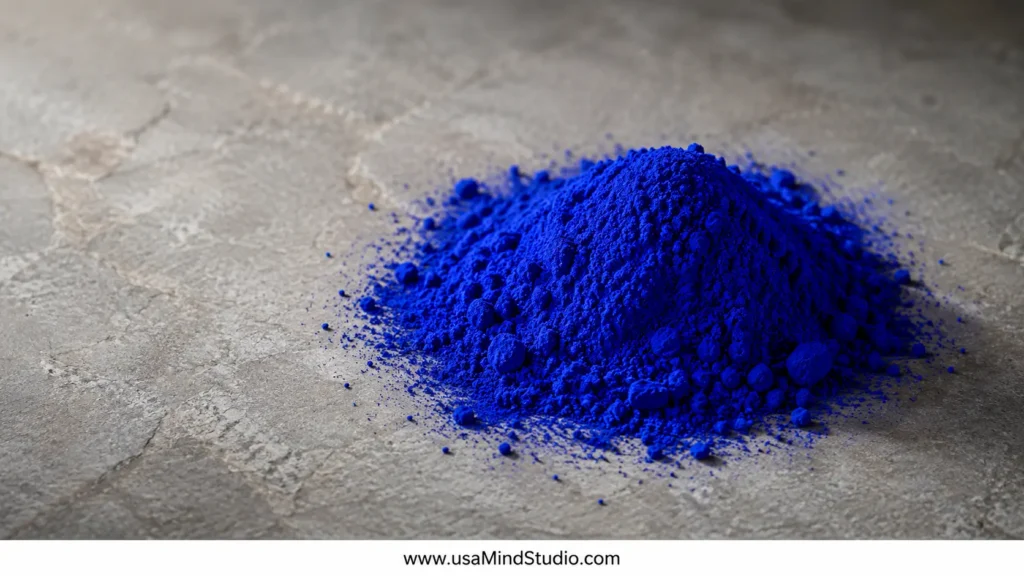
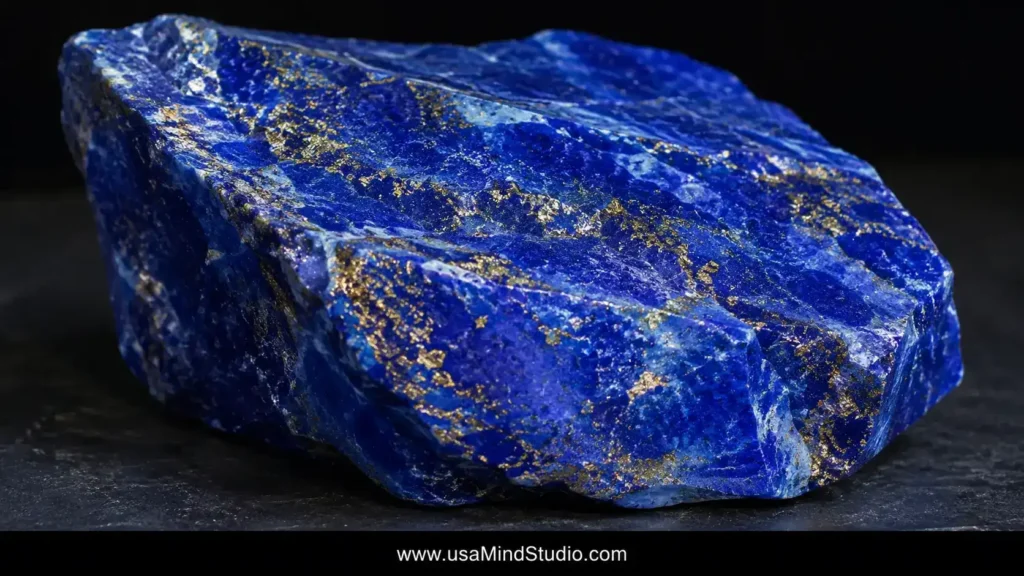
The finest blue paint, ultramarine, came from a single stone: lapis lazuli, mined for thousands of years from essentially one valley in what is now Afghanistan. The name ultramarine means “beyond the sea,” which is where it arrived from, as far as Europe knew.
It cost more than gold. Renaissance and Flemish painting contracts actually specified how much ultramarine a painter had to use, by weight, because the patron was buying the pigment as much as the labor. The blue was a line item in the contract.
So It Went on the Most Important Figure
This is why Mary wears blue, and the reason is the same one that put emperors in purple. Not theology. Price. The most expensive substance in the studio went on the most important person in the painting. After enough centuries of that, blue simply became her color, and the association came to look like it had always been about heaven.
Then It Got Cheap
In the 1820s, a synthetic ultramarine was developed in France, in response to a prize offered for exactly that. The most expensive pigment in the history of art became an industrial product almost overnight.
Notice the timing. Blue was made cheap around 1826. Purple was made cheap in 1856 by an eighteen-year-old cleaning his beakers. As the purple article on this site describes, the two colors that had meant the sacred and the sovereign for three thousand years both collapsed into affordability inside the same thirty years, for the same reason. Chemistry got good. These two articles are really one argument.
What the Color Blue Symbolizes in the Bible
The Blue That Was Commanded
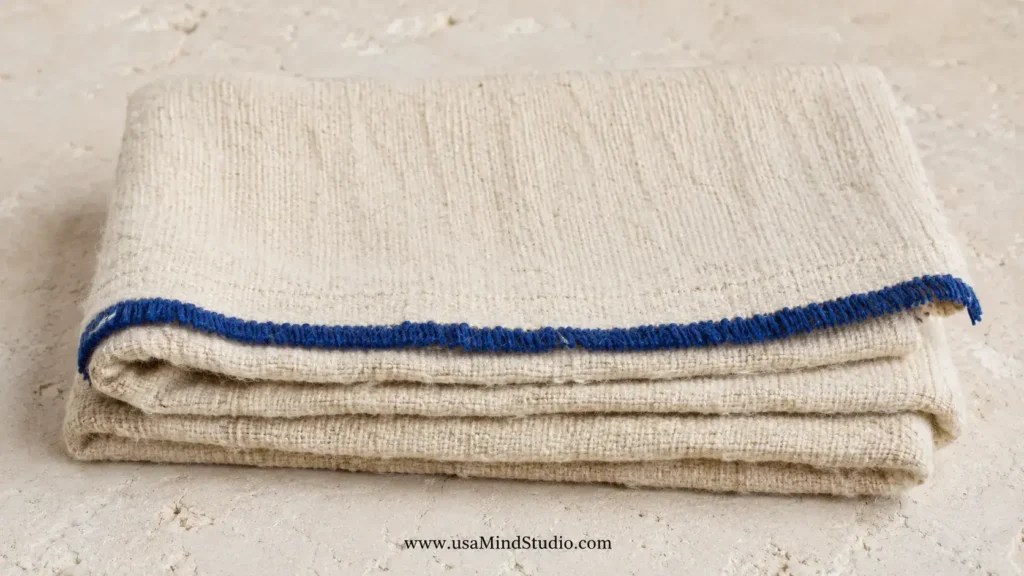
Blue is not incidental in scripture. It is commanded. A specific blue called tekhelet is prescribed for the fringes of garments, and blue appears in the Tabernacle fabrics alongside purple and scarlet. This was an instruction with a required source.
That source was named as a sea creature. And then the knowledge of what the creature was, and how to make the dye, was lost. After the destruction of the Temple and the loss of Mediterranean access, the tradition broke. By the Middle Ages, the scholar Maimonides acknowledged that nobody knew anymore. The color stayed lost for well over a thousand years.
The Same Snail as the Emperors
Here is the connection worth sitting with. Twentieth-century research, including chemical analysis by scientists such as Otto Elsner and Professor Zvi Koren, pointed to a specific murex snail, Hexaplex trunculus, from the very same family that produced Tyrian purple.
The mechanism is the beautiful part. The snail’s dye precursor carries two compounds: an indigo-type blue and a brominated red. Keep both, and you get purple. Strip the bromine away, which exposure to sunlight does, and you get blue.
Biblical blue and imperial purple came out of the same animal. The only difference was sunlight. The color commanded for Jewish ritual fringes and the color reserved for Roman emperors are the same chemistry, processed two ways.
Nobody Knows What Shade It Was
Now the honest part, which almost no page about this will admit. The popular claim is that tekhelet was sky blue. Scholars do not actually agree. The genuine dyed fragments that have been recovered are darker than that. One researcher calls his bluest result midnight blue. Another describes hers as greenish-blue. The old Greek translation rendered the word as “hyacinth,” which points toward violet. And when the King James translators reached for “blue” in 1611, the English word covered a far wider range of shades than it does today.
So a color was commanded, the knowledge of it was lost for a thousand years, and the modern reconstruction is still argued over. That is more honest, and more interesting, than pretending the shade is settled.
Blue Color Symbolism in America
Blue has done specific work in the United States, and it is worth knowing where the color came from.
Start with your jeans. Blue jeans are dyed with indigo, and indigo was a colonial cash crop in South Carolina, grown by enslaved people alongside rice. The most American garment in the world is dyed the color of a plantation crop. That is simply a fact about where the blue came from.
Then there is the political map. The red-state and blue-state convention feels ancient, but it was standardized by television coverage of the 2000 election. Before that, networks swapped the colors around. Half the country now describes its own politics with a color code younger than most of its voters.
There is also the blues, the only major American musical form named after a color, and named for how it feels rather than how it looks.
And there is a quieter one. Blue for boys is only about a century old, and it used to run the other way. Early twentieth-century American retail advice put pink on boys, as a junior shade of martial red, and blue on girls, because blue was Mary’s gentle color. The modern convention did not settle until roughly the 1940s. Nothing in nature assigned it. A store did.
Shades of Blue
Light blue and sky blue are really the same request: openness, calm, and distance. It is worth remembering that “sky blue” names something that is not a pigment at all.
Navy and dark blue are also the same request, and the navy link is literal and recent. It is named after uniforms, and those uniforms were dark because indigo was the durable dye available in quantity. Authority arriving through supply, again.
Royal blue carries the same inheritance the ultramarine story explains. Blue violet sits between this article and the purple one, and belongs to both. Beyond that, the finer shade distinctions are recent and informal, more marketing than tradition.
Put simply, blue color symbolism is layered. It draws on religion, folklore, art, and everyday observation, and no single meaning belongs to every culture or every person. Reading blue color symbolism as a prompt for reflection rather than a prediction keeps the symbol in its proper place. For a general overview of the color blue, see this reference article.
Encountering Blue and What People Make of It
Blue is now the world’s favorite color, on nearly every survey, in most countries. It is also the color humans took the longest to name and the longest to make.
Sit with that sequence. First nobody had a word for it. Then it cost more than gold. Then a chemist made it cheap. And now it is everyone’s favorite, on every logo, every uniform, every pair of jeans.
So when blue catches your eye, you do not need to ask what it is telling you. It is not telling you anything. The more interesting thing to notice is that the sky is not blue, the sea is not blue, and a blue jay is not blue. Blue is what happens between the world and your eye. The most popular color on Earth is a thing almost nobody has ever actually held.
Editorial Reflection Note
USA Mind Studio writes about symbolism as a subject for reflection, not prediction. Nothing here forecasts events or tells anyone what to do. Meanings differ across cultures and people, and we try to say plainly where a meaning came from and where the record runs out. You can read more in our Editorial Policy.
Frequently Asked Questions
What does the color blue symbolize? Calm, trust, depth, loyalty, and the divine. It also carries sadness in another mood. Blue is the most popular color in the world.
What does the color blue symbolize in the Bible? A commanded blue called tekhelet marked ritual fringes, and blue filled the Tabernacle fabrics. The dye’s source was lost for over a thousand years.
What does the color light blue symbolize? Openness, calm, and distance. Light blue and sky blue are the same idea, and sky blue names something that is not even a pigment.
What does the color navy blue symbolize? Authority and formality. The name comes from naval uniforms, which were dark because indigo was the durable dye available in quantity.
What did the color blue symbolize in Flemish painting? Status and the sacred. Blue came from ultramarine, which cost more than gold, so it went on the most important figures, especially Mary.
Why did ancient languages have no word for blue? Because you cannot dig blue out of the ground. Languages name what people handle, and blue was seen everywhere but held almost nowhere.
Why is the sky blue if there is no blue in it? The air scatters the short blue wavelengths of sunlight more than the others. The blue is an effect of scattering, not a material in the sky.
What is the core idea behind blue color symbolism? Blue color symbolism is built from layered history and culture rather than one fixed rule, which is why the sections above separate the documented sources from later popular claims.
Does blue color symbolism mean the same thing everywhere? No. Blue color symbolism changes from one culture, era, and personal experience to the next, and this article notes where a meaning is well documented and where it is not.
Should blue color symbolism be treated as a prediction? No. Blue color symbolism is a subject for reflection. Nothing on this site forecasts events or replaces professional advice.
Where does blue color symbolism come from? Blue color symbolism comes from a mix of religion, folklore, art, and everyday observation, and the sections above trace the main sources one by one.
Why do people search for blue color symbolism? People look up blue color symbolism when they notice the subject in a dream, a memory, or an ordinary moment and want context rather than a verdict.
Keep Reading
- Green Color Symbolism: How the Color of Life Became the Color of Death
- Orange Color Symbolism: The Color That Had No Name Until a Fruit Arrived
- Rose Color Meanings: The Flower Whose Messages Keep Changing
- 1010 Angel Number: What 10:10 Symbolizes and the Real Reason You Notice It
- Lily Flower Symbolism: Purity, Easter, and a Warning for Cat Owners