

Here is something strange about the blue jay. It is not blue.
This guide to blue jay symbolism separates what history and tradition actually record from what the internet likes to repeat.
There is no blue pigment anywhere in the bird. Not a trace. If you found a blue jay feather on the ground in your yard, which happens all over the United States, and you crushed it, the powder would come out brown. The blue you see is not a color the bird contains. It is a trick of light and structure, and your eye finishes the job.
That makes the blue jay the sharpest example on this whole site of how meaning gets made. Blue jay symbolism is a story people tell about a bold, loud, clever bird. But the color itself, the very first thing anyone notices, is already a story your eye is telling you. There is nothing blue there at all. Let us start with the bird everyone thinks they know, and then get to what is actually going on.
Summary
Blue jays symbolize boldness, intelligence, and loud, fearless communication, and all of that is grounded in how the bird actually behaves. But two of the most basic beliefs about it are wrong. The blue is not real, since the bird has no blue pigment and the color is pure structure and light. And the “bully” reputation is mostly unearned, because blue jays rarely raid nests and, through sheer forgetful acorn-hoarding, helped plant the oak forests of eastern America.
What Blue Jays Commonly Symbolize
The usual readings are boldness, intelligence, communication, and protectiveness. And unlike a lot of symbolism, these are not a stretch. They come straight from watching the bird.
Blue jays are corvids, the same family as crows and ravens, which are some of the smartest birds alive. Jays are loud on purpose. They are bold at the feeder, quick to scold anything they do not like, and fiercely protective of their own. When people talk about the blue jay’s spiritual meaning or its spiritual symbolism, they usually land on the same cluster: speak up, be seen, defend your own, do not apologize for taking up space. That reading sits right on top of the bird’s real behavior.
There is an honest split worth naming, because Americans hold both halves at once. In the abstract, people admire the blue jay as bold and clever. At the actual feeder, the same people call it a bully that chases everyone else off. Both are true, and the gap between them is where the interesting part lives.
The Blue Is Not There
There Are No Blue Pigments in Birds
This is not a rare-case thing. It is all of them. There is no true blue pigment in North American birds, and that holds across every blue bird you can name: bluebirds, indigo buntings, and blue jays. Not one of them contains any blue pigment at all.
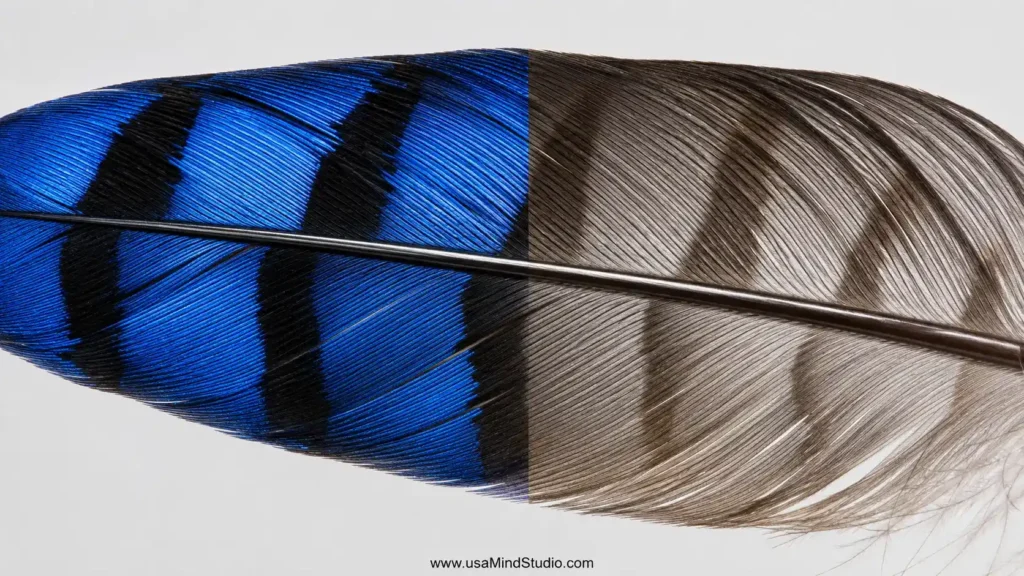
The only pigment in a blue jay feather is melanin, and as the American Bird Conservancy explains, that melanin is brown. The same pigment that makes your hair brown is the only real color in the bird.
So where does the blue come from? Structure. A blue jay feather is built with microscopic pockets of air and keratin, the same protein in your fingernails. When light hits those pockets, every wavelength gets absorbed except blue, which bounces back to your eye. The Cornell Lab of Ornithology describes it as light scattering through modified cells on the surface of the feather barbs. The blue is not in the bird. It happens in the air between the feather and your eye.
What a Blue Jay Feather Actually Is
Here is the part you can test yourself, which is the whole point.
Hold a blue jay feather up with light behind it, and the blue vanishes. It goes grey-brown, because there is no prism effect from behind, so you are looking straight at the melanin. Grind the feather to powder and the powder is brown. The blue is gone because you destroyed the structure that made it, and structure was all it ever was.
Now compare it to the bird at the next perch. Grind a cardinal‘s red feather and the powder is red, because a cardinal’s red is a real pigment it ate and stored. Grind a blue jay’s feather and it is brown. Two birds at the same feeder on the same winter morning, and only one is actually the color you think it is.
There is even a weather tell. Blue jays look greyer and duller on overcast days, because structural color needs strong, direct light. The bird’s color depends on the sky.
One practical note, since a lot of people reach this page after picking a feather up off the ground. Blue jays are protected under federal law in the United States, and keeping feathers from protected native birds without a permit is not legal. It is worth knowing plainly, without any drama. Enjoy the feather where it lies, then leave it there.
The Name Says It Twice and Is Wrong Twice
The scientific name is Cyanocitta cristata, from Greek words meaning blue and chattering bird. The chattering half is accurate. Anyone who has heard a jay knows it earned that.
The blue half is a description of an illusion.
That is what makes this the cleanest case on the entire site. Usually, symbolism is a human meaning laid on top of an animal. With the blue jay, the color itself is a human meaning laid on top of an animal. There is nothing blue in the bird. Blue is what happens when light meets a structure and a brain agrees to call it blue.
The Bully That Planted the Forests
The Nest-Raiding Reputation Is Mostly Wrong
Everyone knows blue jays as feeder bullies and nest raiders that eat other birds’ eggs and babies. The bullying at feeders is real enough. The nest-raiding, the thing that gives the bird its bad name, is mostly not.
The Cornell Lab’s account of the blue jay diet puts insects at around a fifth of what the bird eats over a year, with acorns, nuts, seeds, fruits, and grains making up nearly all of the rest. Eggs and nestlings do get taken, but rarely. The blue jay’s whole reputation was built on the loudest, most dramatic thing it occasionally does, rather than the ordinary thing it does all day. That is a pattern this site keeps running into. The noisy exception becomes the reputation.
The Oaks
Now the fact that turns the whole reputation on its head.
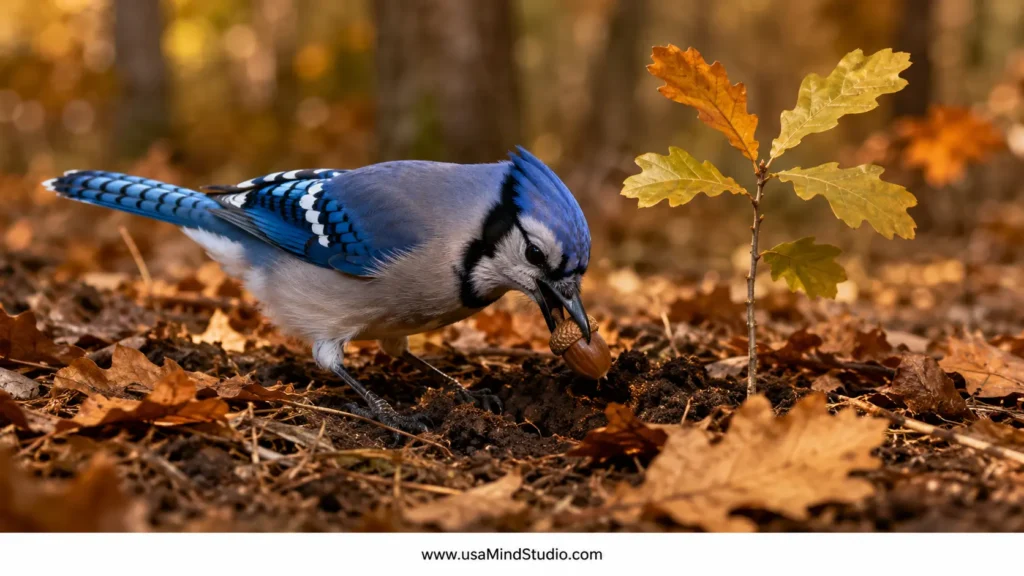
A single blue jay can hide an enormous number of acorns in one autumn. It carries several at a time in its throat and crop, flies off, sometimes for miles, and buries them one by one to dig up later in winter. Its memory for these hiding spots is very good, which is a corvid trait. But it is not perfect. And the acorns it forgets do what buried acorns do. They grow.
The Cornell Lab credits the blue jay’s appetite for acorns with helping spread oak trees north after the last ice age. This matters more than it sounds, because acorns are heavy. They do not blow on the wind like maple seeds. Squirrels move them, but only across a few acres. A blue jay crosses miles.
So the eastern oak forest is, in real part, a hundred centuries of blue jays losing track of their groceries.
Sit with the inversion. The bird Americans call a bully and a thief is one of the great planters of the American forest. It never meant to be. It was hoarding food for winter, it was forgetful, and the forests grew out of its mistakes. There may be no better example of a reputation getting a bird exactly backward.
Blue Jay Symbolism in Indigenous North American Traditions
This section needs a caution at the front. There is no single “Native American” meaning for the blue jay. There are many nations, each with its own language and traditions, and lumping them together erases the actual content.
Where jay figures do appear, they often show up as tricksters, which fits the bird well. Blue jays are known to mimic the calls of hawks, and they are reasonably suspected of doing it on purpose to scare other birds away from a feeder. A clever troublemaker is a fair read of the animal.
But there is a precision problem most websites get wrong. Blue jays live in eastern and central North America. They are not a Pacific Northwest bird. A lot of widely repeated “Native American blue jay” stories actually come from Northwest Coast traditions, where the jay in the story is almost certainly the Steller’s jay, a different species entirely. Content farms blur those two birds together. This site will not, and where the sourced material is thin, the honest move is to keep this short rather than invent depth that is not there.
Are Blue Jays in the Bible?
No. And the reason is the same one the hummingbird runs into. Blue jays live only in eastern and central North America and nowhere else on Earth. Nobody who wrote any part of the Bible had ever seen one, or could have. The bird was on the wrong continent by several thousand miles.
That is the honest answer, and it is more interesting than the padding most pages add. There is no ancient scriptural blue jay because there was no blue jay anywhere near the people writing scripture. The hummingbird article makes this same point at more length, since it runs into the exact same wall.
Put simply, blue jay symbolism is layered. It draws on religion, folklore, art, and everyday observation, and no single meaning belongs to every culture or every person. Reading blue jay symbolism as a prompt for reflection rather than a prediction keeps the symbol in its proper place.
Encountering a Blue Jay and What People Make of It
Blue jays announce themselves. You rarely sneak up on a jay, and you rarely just happen upon one quietly. It sees you first and tells the whole yard about it. Which means most encounters with a blue jay are the bird’s decision, not yours. If a jay turns up loudly in your morning, or shows up in a dream and stays with you afterward, the pull to make something of it is natural. It is the same impulse behind any vivid, sudden appearance.
This site is not going to hand you an omen. What it will offer is a better way to look at the noise. When a blue jay sounds the alarm, it is often mobbing a hawk or a cat, and every other creature in the yard, birds, squirrels, and you, gets the warning for free. The racket everyone finds annoying is a security system nobody installed and everybody benefits from.
So the next time a jay blows up the quiet of your backyard, you can be irritated, which is fair. Or you can notice what it is really doing, which is standing watch. What you make of that is yours. The bird is just being exactly, loudly, honestly itself.
Editorial Reflection Note
USA Mind Studio writes about symbolism as a subject for reflection, not prediction. Nothing here forecasts events or tells anyone what to do. Meanings differ across cultures and people, and we try to say plainly where a meaning came from and where the record runs out. You can read more in our Editorial Policy.
Frequently Asked Questions
What does a blue jay feather symbolize? People read it as boldness, protection, and clear communication. Worth knowing: keeping feathers of protected native birds without a permit is not legal in the US.
Are blue jays really blue? No. There is no blue pigment in the bird. The only pigment is brown melanin, and the blue is a structural trick of light.
Is it legal to keep a blue jay feather? Generally no. Blue jays are federally protected, and possessing their feathers without a permit is not allowed. Best to admire it and leave it.
What do blue jays symbolize in the Bible? Nothing. Blue jays live only in North America, so no biblical writer ever saw one. They appear nowhere in scripture.
What is the myth about the blue jay? Mostly that it is a vicious nest raider. In truth, eggs and nestlings are a rare part of its diet, which is mainly acorns and nuts.
Are blue jays a good omen? No tradition settles that. People admire their boldness, but this site reads a jay as a bird being itself, not as a sign of things to come.
What is the message of the blue jay? If it has one, it is practical: the loud bird standing watch is warning the whole yard about a predator, and everyone benefits from the noise.
What is the core idea behind blue jay symbolism? Blue jay symbolism is built from layered history and culture rather than one fixed rule, which is why the sections above separate the documented sources from later popular claims.
Does blue jay symbolism mean the same thing everywhere? No. Blue jay symbolism changes from one culture, era, and personal experience to the next, and this article notes where a meaning is well documented and where it is not.
Should blue jay symbolism be treated as a prediction? No. Blue jay symbolism is a subject for reflection. Nothing on this site forecasts events or replaces professional advice.
Where does blue jay symbolism come from? Blue jay symbolism comes from a mix of religion, folklore, art, and everyday observation, and the sections above trace the main sources one by one.
Why do people search for blue jay symbolism? People look up blue jay symbolism when they notice the subject in a dream, a memory, or an ordinary moment and want context rather than a verdict.
Keep Reading
- Eagle Symbol: Why Five Countries Chose the Same Bird
- Hummingbird Symbolism Meaning: How a Bird of War Became a Bird of Grace
- Cardinal Bird Symbolism: What the Red Bird Means and Why It Feels Personal
- 1111 Angel Number: What It Means and Why You Wish on 11:11
- Hibiscus Flower Symbolism: The Meaning Behind a One-Day Flower


