Yellow roses mean friendship. They also used to mean “I know you are cheating on me.” Both are true, about a hundred years apart, and which one is correct depends entirely on when you ask. That is the strange thing about rose colors. The flower did not change. We did. Here in the United States, most people reach for rose colors without knowing that a few of them once said the exact opposite of what they say now. Here is what each color means today, followed by where those meanings actually came from.
This guide to rose color meanings separates what history and tradition actually record from what the internet likes to repeat.
Rose Color Meanings: Quick Answers
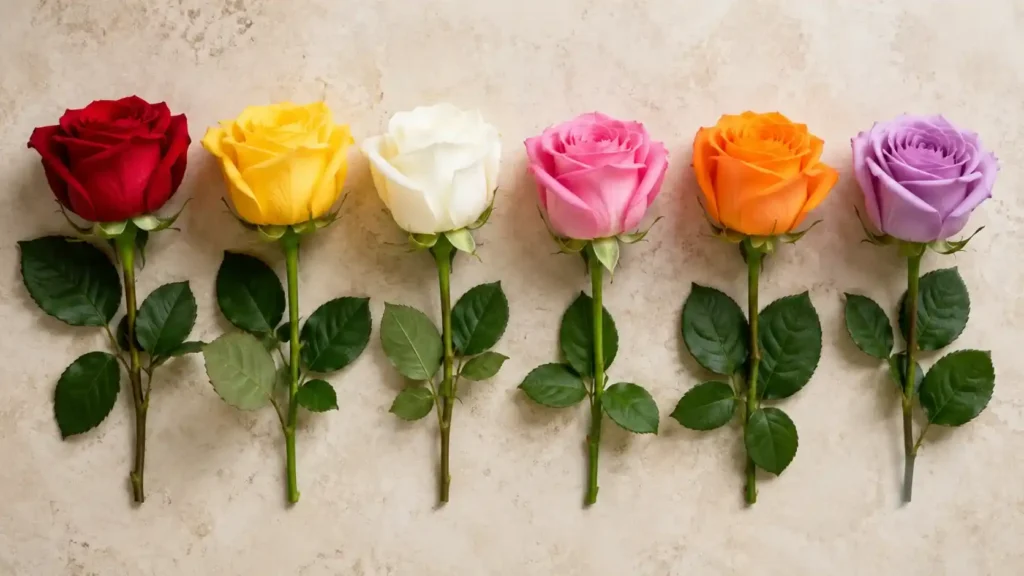
- Red: love, passion, romance.
- Yellow: friendship, joy, warmth. (Once meant jealousy and infidelity.)
- White: purity, honor, new beginnings, remembrance.
- Pink: gratitude, admiration, gentleness.
- Orange: enthusiasm, energy, desire.
- Lavender/purple: enchantment, love at first sight.
- Blue: the impossible or unattainable. (No natural blue rose exists.)
- Black: endings, farewell, mourning. (Not a true black; a very dark red.)
Summary
Every rose color carries a meaning, and most of those meanings are steadier in memory than in fact. Red has meant love for a very long time. Yellow flipped completely, from an accusation of cheating in the Victorian era to friendship today. Blue and black roses do not exist in nature at all, which is exactly why they mean the impossible and the final. The meanings are real, but almost none of them are permanent, and the rose has quietly outlasted every one of them.
Red Roses: The Meaning That Actually Held
Start with the one color that did not change much. Red roses mean love, passion, and romance, and they have meant something close to that for a very long time.
The old thread runs back to classical myth, where the red rose was tied to the goddess of love, and it stayed roughly on that track for centuries. By the time Shakespeare has Juliet muse that a rose by any other name would smell as sweet, the flower is already firmly the flower of love, and the play only works because the audience already feels that.
But even red’s steadiness has a modern engine under it. A deep red rose became the fixed symbol of Valentine’s Day partly because the flower industry needed a single, reliable, giftable image, and red roses filled that slot. The meaning is old and genuine. The universal red-rose Valentine, delivered to your door, is a business arrangement built on top of it.
Yellow Roses: The Meaning That Completely Flipped
This is the color that brings most people to this page, and it has the best story, because the meaning did not just drift. It reversed.
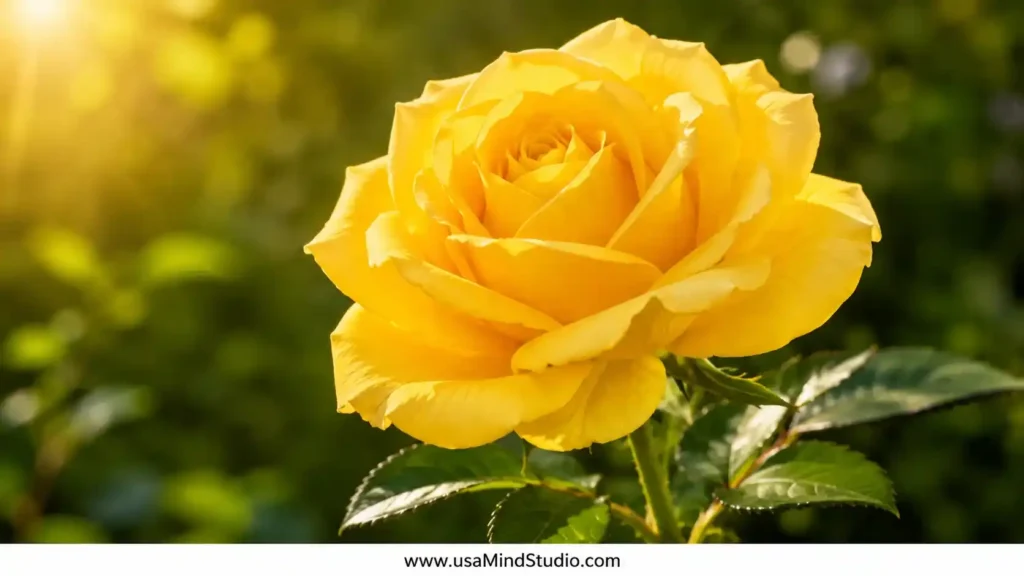
Today a yellow rose means friendship, joy, and warmth. It is the flower you send a friend in the hospital, a coworker on their last day, someone you care about with nothing romantic attached. That reading is cheerful and completely modern.
In the Victorian era, a yellow rose meant something ugly. In the language of flowers that gripped the 1800s, when a whole bouquet could be a coded message, yellow roses meant jealousy, a dying love, and infidelity. Handing someone yellow roses could carry the accusation that they were cheating. The same flower that now says “I’m glad we’re friends” once said “I know what you did.”
Where did that come from? The trail runs back through much older ideas about the color yellow itself, where yellow was long tied to bile, sickness, and envy. The rose did not invent that meaning. It inherited it from the color, and then, over about a century, shed it completely. So the honest answer to “what does a yellow rose mean” is that it depends which century you are standing in. This is the clearest proof anywhere that flower meanings are not fixed truths. They are fashions, and fashions turn over.
White Roses: Purity, and Also Grief
White roses carry purity, honor, and new beginnings. They are a traditional wedding flower for exactly that reason, standing for a clean start and honest devotion.
But white roses do double duty, and the second job is quieter. They are also a flower of remembrance and mourning, common at funerals and memorials. That is not a contradiction so much as a range. White stands for the beginning of a life together and for the honoring of a life that has ended, which are closer to each other than they first appear. Both are about something pure and set apart from ordinary time.
Pink Roses: The Gentle Middle
Pink roses sit between red and white, and their meaning sits there too. They mean gratitude, admiration, and gentleness, a softer and less intense affection than red’s full romantic charge.
That makes pink the safe, warm, non-pressuring rose. It is the one you give to say thank you, to show respect, to express care that is real but calm. Deeper pink leans toward gratitude and appreciation, while lighter pink leans toward grace and sweetness, but both stay in the same gentle register. If red is a declaration, pink is a kindness.
The Colors That Cannot Exist: Blue and Black
Here is where rose meanings get genuinely interesting, because two of the most searched rose colors are not real.
Blue Roses
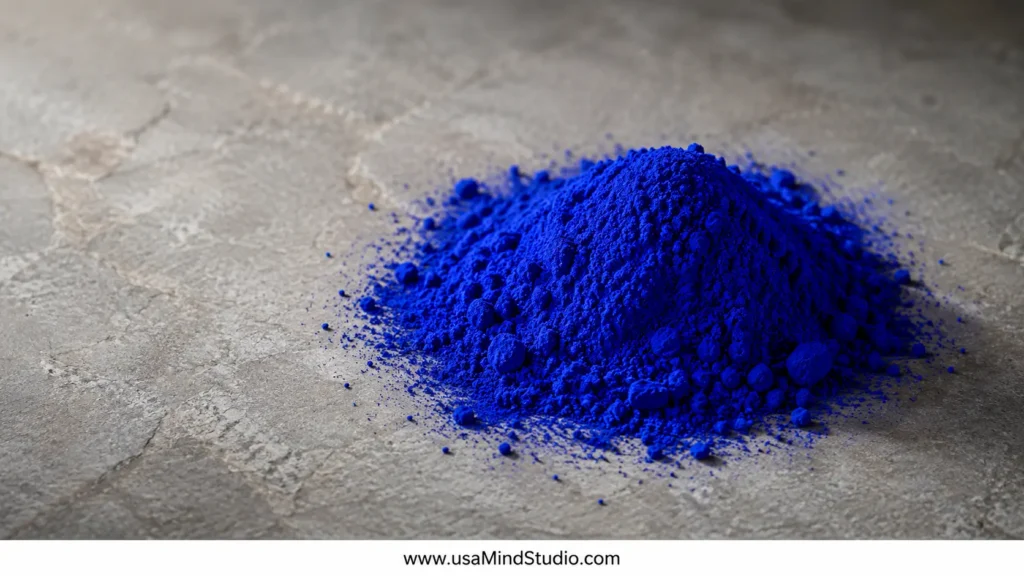
There is no natural blue rose. Roses simply do not have the gene to make blue pigment, which is a fact that connects this flower to a bigger story. As the blue article on this site explains, blue is one of the hardest colors in all of nature to produce, and the rose is one more thing on the long list of living things that cannot make it.
Because a blue rose could not exist, it came to mean exactly that: the impossible, the unattainable, the thing you cannot have. And then technology tried to call the bluff. A Japanese company spent years and a great deal of money genetically engineering a “blue” rose, and in 2004 they unveiled it. It came out lavender. Even with the blue pigment gene inserted, the flower refused to turn truly blue. The impossible rose stayed impossible, which is almost too fitting. Any “blue rose” you can actually buy today is either dyed or that lavender-ish engineered one.
Black Roses
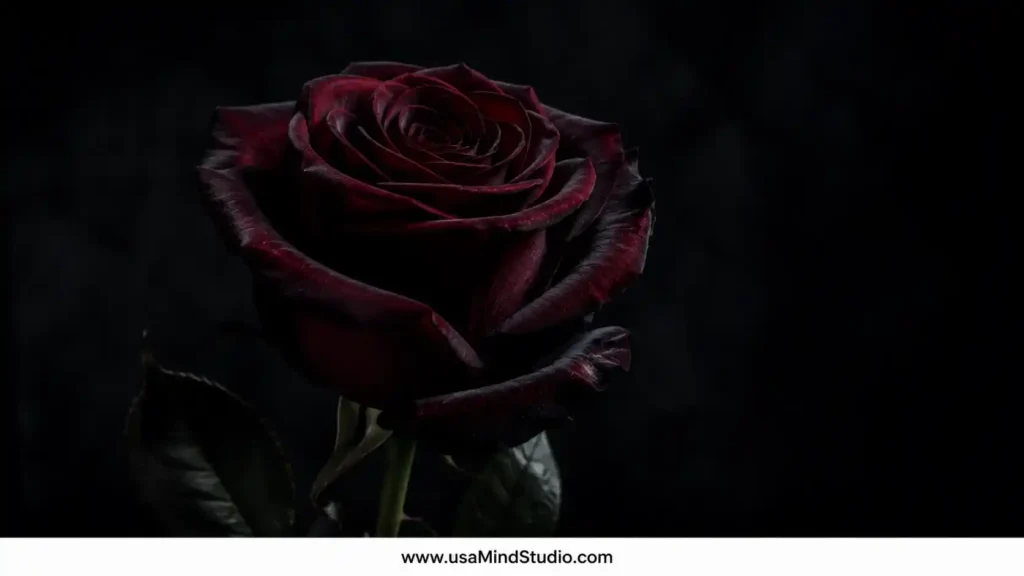
There is no true black rose either. The flowers sold as black roses are a very deep, dark red, or else white roses dyed black. Nothing in nature produces a truly black bloom.
That has not stopped the black rose from carrying weight. It means endings, farewell, mourning, and sometimes rebellion or mystery. It shows up in death imagery and in gothic style precisely because it looks like it should not be alive. A flower is a living, growing thing, and black reads as the color of the opposite. The tension between those two is the entire meaning.
Lavender and Orange: The Quick Two
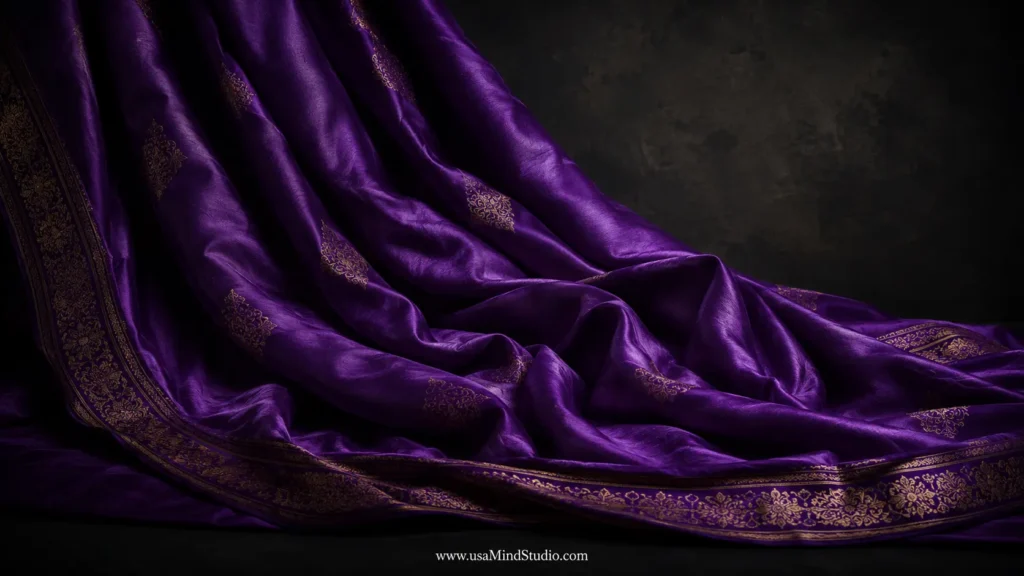
Lavender and purple roses mean enchantment and love at first sight. That “love at first sight” reading is worth pausing on, because it likely comes straight from rarity. Purple was historically the hardest and most expensive color to produce, as the purple article on this site describes, so a purple rose read as something rare, royal, and almost magical. The meaning followed the cost.
Orange roses, which appeared through breeding relatively recently, sit between red and yellow and mean what that blend suggests: enthusiasm, energy, desire, and fascination. They are passion with the heat turned toward excitement rather than romance.
The Rose in America
The rose has done real work in the United States, and one moment stands out.
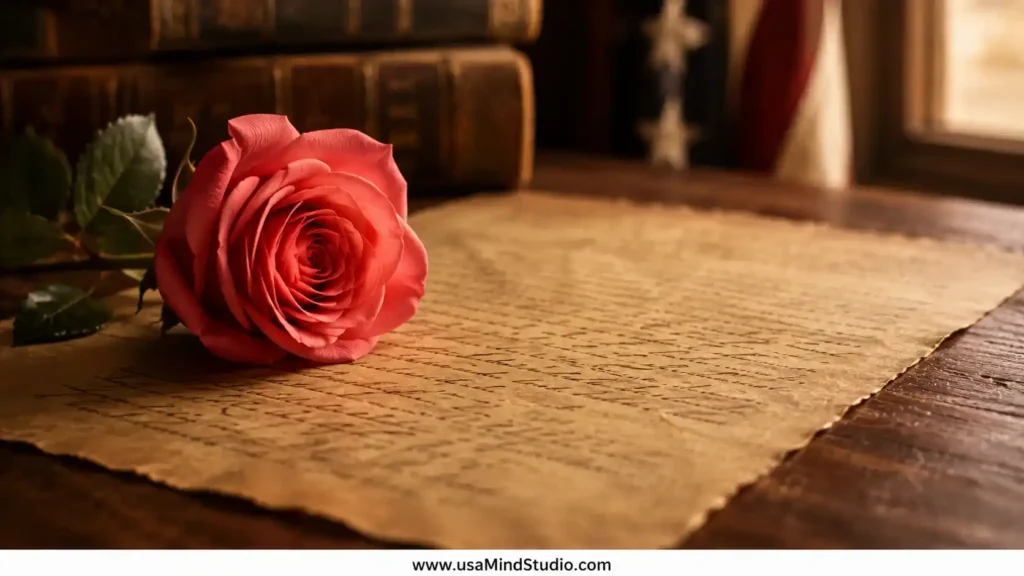
The rose is the official national flower of the United States, signed into that role in 1986. That part is tidy. The better story is from 1920, and it turned rose colors into a vote count.
That summer, the whole question of whether American women would get the right to vote came down to a single state. The Nineteenth Amendment needed one more state to ratify, and it landed in Tennessee. In the state legislature, the two sides marked themselves with roses. Lawmakers against giving women the vote wore red roses. Lawmakers in favor wore yellow roses. The papers called it the War of the Roses, and the count was so close it looked set to fail.
A twenty-four-year-old legislator named Harry Burn sat there wearing a red rose, on the side against the amendment. But in his pocket was a letter from his mother telling him to do the right thing and vote for it. When his moment came, he voted yes. The amendment passed by that one vote, and millions of American women could vote because of it.
Sit with the colors for a second. Red roses, the flower of love, were worn by the side trying to keep women from voting. Yellow roses, then still shaking off their old meaning of jealousy, were worn by the side that won. The rose colors in that room did not carry their usual meanings at all. They meant yes and no. That is this whole site’s point, dressed in flowers: a color means whatever a particular group of people, in a particular room, decides it means.
Put simply, rose color meanings is layered. It draws on religion, folklore, art, and everyday observation, and no single meaning belongs to every culture or every person. Reading rose color meanings as a prompt for reflection rather than a prediction keeps the symbol in its proper place.
Encountering Roses and What People Make of It
Roses are so common in American life that they have become a kind of shorthand you can send without saying a word. Red for the anniversary. White for the wedding. Yellow for the friend. A whole quiet language you were never formally taught.
So if you are choosing roses and worrying about sending the wrong message, here is the reassuring part. The person receiving them is reading today’s meanings, not the Victorian ones. Nobody in the United States now takes yellow roses as an accusation. The old codes have faded, and the flower gets a fresh set of meanings in every era.
And that is the thing to leave with. The rose has outlived every meaning we have ever handed it. It was love to the Romans, a coded accusation to the Victorians, a vote count in Tennessee, and a Valentine’s marketing engine to us. Through all of it, the flower just kept being a flower. We are the ones who keep changing our minds about what it says.
Rose meanings belong to a wider language of flowers and colors. To follow that thread further, read about the carnation, another flower people tried to give a fixed meaning, and the deep red shade covered in burgundy.
Editorial Reflection Note
USA Mind Studio writes about symbolism as a subject for reflection, not prediction. Nothing here forecasts events or tells anyone what to do. Meanings differ across cultures and people, and we try to say plainly where a meaning came from and where the record runs out. You can read more in our Editorial Policy.
Frequently Asked Questions
What does a yellow rose mean? Today, friendship, joy, and warmth. In the Victorian era it meant the opposite: jealousy, fading love, and infidelity. The meaning fully reversed.
What do the different rose colors mean? Red is love, white is purity, pink is gratitude, orange is enthusiasm, lavender is enchantment. Yellow is friendship now, though it once meant jealousy.
Are blue roses real? Not in nature. Roses cannot make blue pigment. Engineered “blue” roses came out lavender, and any bright blue rose you see was dyed.
What does a black rose mean? Endings, farewell, mourning, and sometimes rebellion. True black roses do not exist; they are very dark red or dyed blooms.
What is the rarest rose color? True blue and true black, because neither occurs in nature at all. Both are either dyed or the product of difficult genetic engineering.
What does a white rose mean? Purity, honor, and new beginnings, which is why they suit weddings. They also stand for remembrance, which is why they suit funerals.
What is the national flower of the United States? The rose. It was signed into that role in 1986, representing the country across all its colors and varieties.
What is the core idea behind rose color meanings? Rose color meanings is built from layered history and culture rather than one fixed rule, which is why the sections above separate the documented sources from later popular claims.
Does rose color meanings mean the same thing everywhere? No. Rose color meanings changes from one culture, era, and personal experience to the next, and this article notes where a meaning is well documented and where it is not.
Should rose color meanings be treated as a prediction? No. Rose color meanings is a subject for reflection. Nothing on this site forecasts events or replaces professional advice.
Where does rose color meanings come from? Rose color meanings comes from a mix of religion, folklore, art, and everyday observation, and the sections above trace the main sources one by one.
Why do people search for rose color meanings? People look up rose color meanings when they notice the subject in a dream, a memory, or an ordinary moment and want context rather than a verdict.
Keep Reading
- Burgundy Color Meaning: The Color Named After a Swedish Tribe
- Purple Color Symbolism: How Snails Made It the Color of Kings
- Blue Color Symbolism: Why the World’s Favorite Color Is Barely There
- Lotus Flower Symbolism: What the Mud Actually Teaches
- Bat Animal Symbolism: How One Animal Ended Up Meaning Two Opposite Things