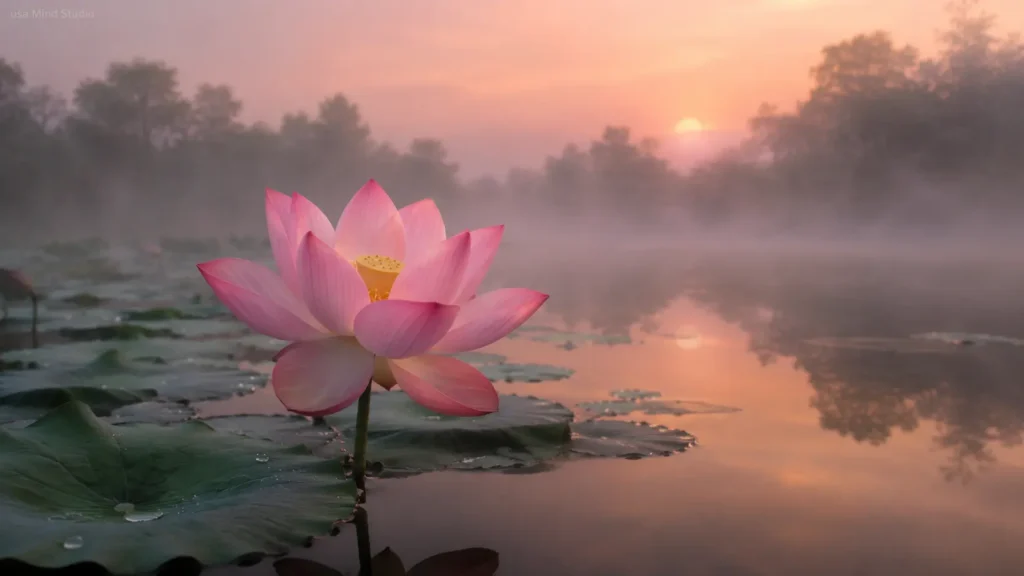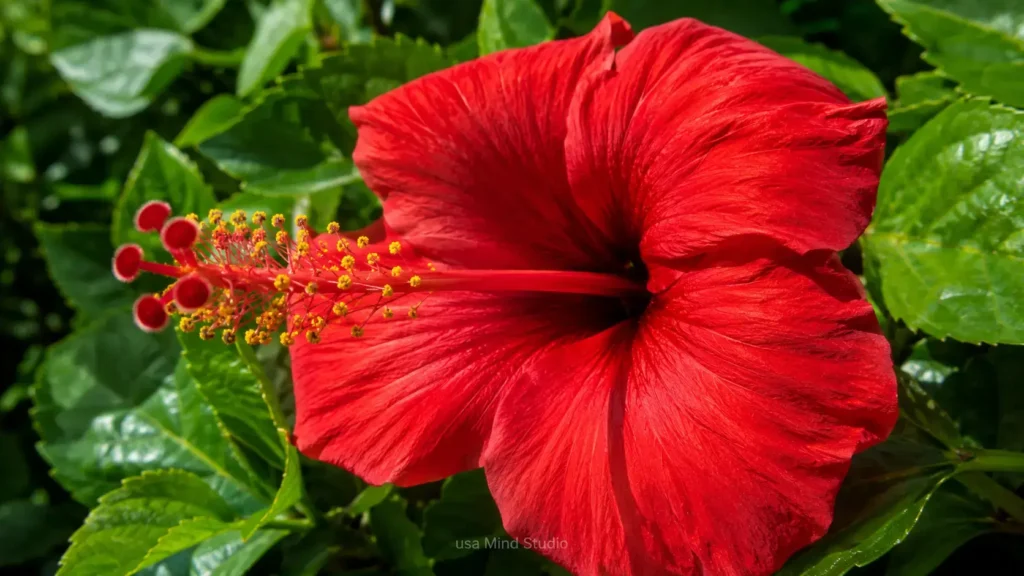
A hibiscus opens in the morning. By dark, it is done. Not wilting, not fading over a week. Finished, on the same day it started.
This guide to hibiscus flower symbolism separates what history and tradition actually record from what the internet likes to repeat.
Then the bush puts out another one tomorrow, and another the day after, so the whole plant looks permanent while not one flower on it lasts.
For as long as people have written about this plant, they have called it a symbol of beauty that will not last. Across the United States you can find that line on garden blogs, tattoo pages, and gift cards. Most of us read it as a nice sentiment.
It is not a sentiment. It is a measurement. When you ask what the hibiscus flower symbolizes, the honest answer starts with a clock.
TL;DR
The hibiscus means fleeting beauty because the flower genuinely lasts about one day. And the hibiscus that means “Hawaii” to most Americans is a Chinese import. The real state flower is a native yellow one, and it is federally endangered.
The Short Version
- Core meanings: delicate beauty, the fleeting, hospitality, and being present.
- The spine of it: a hibiscus blossom opens and closes inside a day. Nearly every meaning traces back to that.
- Hawaii’s state flower is not the red one. It is a native yellow hibiscus. The red one on the postcards came from China.
- The state flower is endangered. It is illegal to pick, and there are few left in the wild.
- In Hindu tradition the red hibiscus belongs to Kali, a goddess of destruction and time. Americans read the same flower as a mild tropical decoration.
What Hibiscus Flower Symbolism Means
The usual list is short and consistent. Delicate beauty. The fleeting. Hospitality and welcome. Femininity. Being here now.
Victorian flower dictionaries settled on delicate beauty, and those dictionaries were usually making things up. Whole books of flower meanings were printed in the 1800s and they contradicted each other constantly. Most of what they assigned was decoration.
This one is different. Delicate beauty happens to be an accurate description of the plant, and the Victorians did not know why they were right.
Hospitality is worth a second too, because it also has a physical cause. A hibiscus is a big, open, unmissable flower on a bush that makes them constantly. It is the easiest thing in the yard to hand somebody. Cultures with hibiscus growing nearby ended up using it for greeting. Cultures without it did not. There is no mystery there. Convenience does more symbolic work than anyone likes to admit.
Because underneath every meaning on that list sits the same fact, and it is the one thing about this flower nobody has to interpret.
The Flower That Lasts One Day
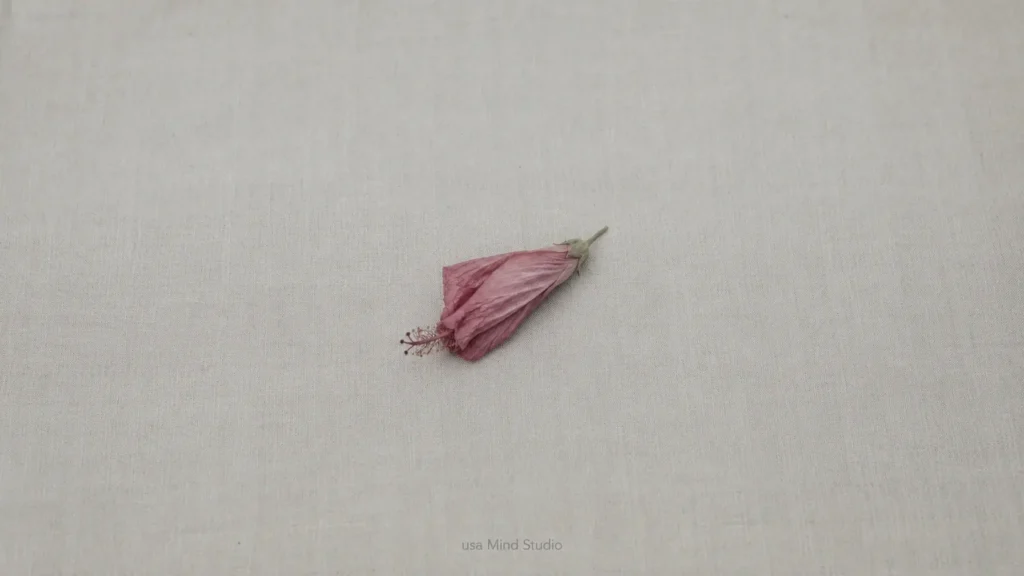
Open in the morning, closed by evening. That is the whole life of a hibiscus flower.
The plant does not fight this. It has no interest in keeping a flower alive. Its whole approach is volume. Lose one, make another, do it again tomorrow, do it for months. A hibiscus bush is a machine for producing temporary things.
Here is the detail that makes it land. Hawaiians made hibiscus leis. Those leis wilt within a day, for exactly the reason above. Everybody knew that. They made them anyway.
Think about what that means. A garland that will be dead by the same evening it is handed to you is not a mistake. It is a choice. You are not being given something to keep. You are being given the day.
This is the same pattern that turns up again and again once you start checking. A turtle‘s shell is not a house it carries, it is the animal’s actual skeleton. A lotus leaf really does refuse to hold dirt. And a hibiscus really does last one day.
The symbolism was not laid on top of the plant. Somebody watched the plant and wrote down what it did, and a few centuries later we call that a symbol.
The Hibiscus in Hawaii
the Flower Everyone Pictures Is the Wrong One
Say “hibiscus” to an American and they picture a red one, on a shirt, behind somebody’s ear, on a postcard from Maui.
That flower is Hibiscus rosa-sinensis. The Chinese hibiscus. It was brought in. It is not native to Hawaii and it is not the state flower.
Hawaii has around seven native hibiscus species, and several grow nowhere else on the planet. Nearly half of the native species and subspecies are in trouble.
Sixty-Five Years of Ambiguity
In 1923 the Territory of Hawaii made the hibiscus its official flower. It did not say which hibiscus.
So people guessed. Most assumed it meant the red one, which usually meant the imported Chinese one. That went on for decades. Old photographs are still labeled that way.
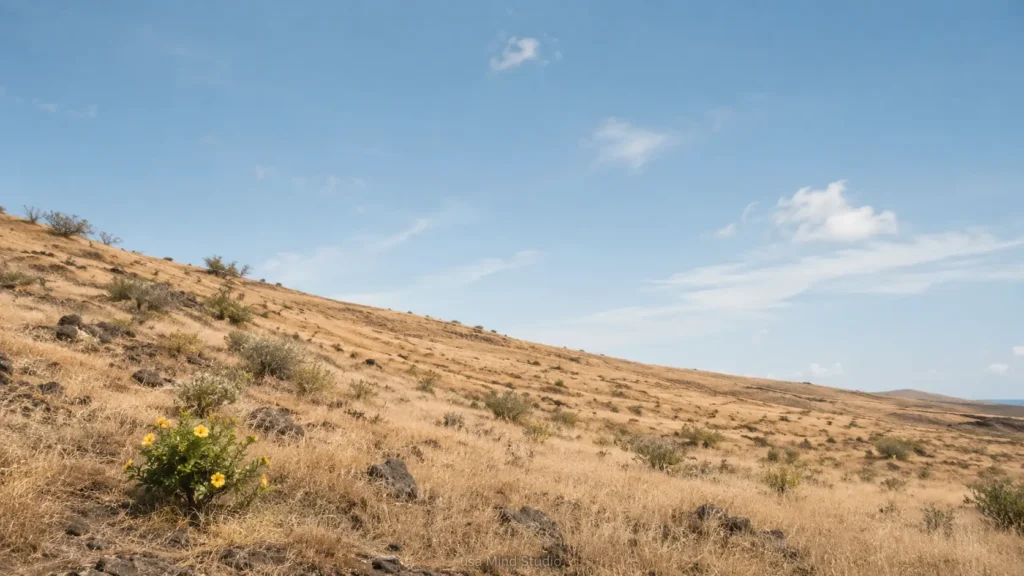
In 1988 the state legislature finally settled it. The state flower is Hibiscus brackenridgei, the native yellow hibiscus, called maʻo hau hele or pua aloalo in Hawaiian.
That is a rare thing to be able to point at. A symbol drifted for sixty-five years, and a legislature reached out and corrected it.
The State Flower Is Endangered
Maʻo hau hele is listed as endangered by the U.S. Fish and Wildlife Service and by the state. Few are left in the wild. Feral goats, cattle, pigs, invasive plants, development, and fire have taken most of them, and Hawaii’s Division of Forestry and Wildlife tracks the remaining subspecies closely.
It is illegal to pick one. The flower that officially stands for Hawaii is a flower Hawaii has to protect from being picked.
The plant seems to agree. It grows sharp prickles around the base of its flowers, which does a fair job of discouraging hands.
The Hawaiian name is usually read as something close to traveling green hibiscus, possibly because the yellow petals turn green as they dry and fall.
That last part is a small thing worth keeping. Hawaiians extracted a blue-grey dye from these flowers for kapa cloth. So the bright yellow bloom that Hawaii chose as its emblem is a flower people used to get blue-grey out of. The color you see is not the color it gives.
So here is where it lands. The hibiscus means Hawaii to nearly every American. The hibiscus most Americans picture is from China. The real Hawaiian one is rare, protected, and going. The symbol is doing great. The thing it stands for is not.
The Hibiscus and Kali
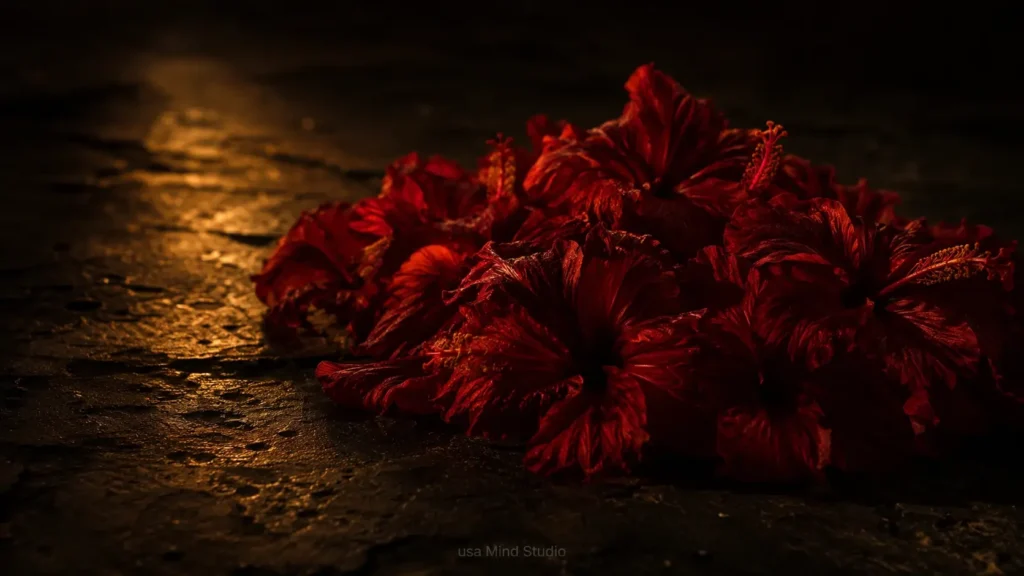
In Hindu tradition, the red hibiscus is offered to Kali. She is often shown with it. The flower carries an association with Ganesha as well.
Note what the association is not. It is not gentle. Kali is a goddess of destruction and of time running out. The red hibiscus belongs to her, and the connection is with intensity.
Now hold that next to a Hawaiian shirt.
Same flower. In one place it means welcome, softness, a nice week off. In another it sits in front of a goddess who ends things.
Those two readings do not overlap anywhere. Not at one point. And neither one is wrong, and neither one borrowed from the other. Two sets of people looked at a red flower that dies the same day it opens, and one group thought about hospitality and the other thought about time.
That is worth sitting with longer than it takes to read.
Hibiscus Flower Symbolism by Color
Red is the color with real weight behind it, and the article has already spent it. Hawaii on one side, Kali on the other, disagreeing completely.
Yellow carries Hawaii’s state flower and everything that goes with it. That meaning is genuine, recent, and passed by a legislature, which is an unusual thing to be able to say about a flower.
Pink, white, and purple are the honest thin spots. The meanings floating around for them are recent and informal, and purple hibiscus barely exists as a natural color at all. If you came looking for a purple one, you are looking for something that does not really grow.
And there is a bigger point underneath, which is why this section stays short instead of stretching.
Most of the hibiscus colors Americans see are hybrids. Growers made them, on purpose, over the last hundred years or so, chasing whatever the market wanted that decade. Those colors did not come down from anywhere. They came out of a breeding program.
So assigning ancient meaning to a shade a nursery invented in 1950 is not research. It is filling space. Plenty of pages will happily tell you what a peach hibiscus means. Nobody knew what a peach hibiscus was until somebody made one.
Red and yellow have histories. The rest have marketing.
Put simply, hibiscus flower symbolism is layered. It draws on religion, folklore, art, and everyday observation, and no single meaning belongs to every culture or every person. Reading hibiscus flower symbolism as a prompt for reflection rather than a prediction keeps the symbol in its proper place.
Encountering a Hibiscus and What People Make of It
Most Americans meet this flower on vacation, on a shirt, or in a glass of iced tea. There is no reason to pretend otherwise.
The tea is worth a second, actually. The drink made from roselle turns up as agua de Jamaica in Mexico, karkade in Egypt and Sudan, bissap in West Africa, and sorrel in the Caribbean. The same plant family shows up at Christmas in Trinidad and at breakfast in Cairo. Nobody planned that.
So if a hibiscus stops you somewhere, the useful question is not what it is telling you. It is not telling you anything. The useful question is which of those inheritances you are standing in, and whether you knew.
The flower opens in the morning and is gone by dark, and it does it again tomorrow. Whatever you make of that is yours.
Frequently Asked Questions
Are hibiscus flowers lucky? Not traditionally. Hawaiian and Hindu readings run toward welcome and devotion, not luck. The luck association is modern, informal, and has no tradition behind it.
What is the folklore of the hibiscus flower? The best known is the ear custom: worn on the left means taken, on the right means available. It is widely repeated, though its origins are unclear.
Is hibiscus a romantic flower? It can be used that way. But its older readings are welcome and devotion rather than romance. The romantic meaning is recent and mostly Western.
What is the magical use of hibiscus? Some folk traditions have used it in love and attraction practices. That is a record of what people believed, not a claim that anything works.
What flower means “I’ll wait for you”? Not the hibiscus. Victorian flower dictionaries contradicted each other constantly, and no reliable one assigns that meaning to this plant.
What is the rarest color of hibiscus? True blue does not occur in hibiscus at all. Plants sold as blue hibiscus belong to a different genus entirely.
What is hibiscus called in Pakistan? Commonly gurhal in Urdu. In Sanskrit tradition it is japa, the same flower offered to Kali across the subcontinent.
What is the core idea behind hibiscus flower symbolism? Hibiscus flower symbolism is built from layered history and culture rather than one fixed rule, which is why the sections above separate the documented sources from later popular claims.
Does hibiscus flower symbolism mean the same thing everywhere? No. Hibiscus flower symbolism changes from one culture, era, and personal experience to the next, and this article notes where a meaning is well documented and where it is not.
Should hibiscus flower symbolism be treated as a prediction? No. Hibiscus flower symbolism is a subject for reflection. Nothing on this site forecasts events or replaces professional advice.
Where does hibiscus flower symbolism come from? Hibiscus flower symbolism comes from a mix of religion, folklore, art, and everyday observation, and the sections above trace the main sources one by one.
Why do people search for hibiscus flower symbolism? People look up hibiscus flower symbolism when they notice the subject in a dream, a memory, or an ordinary moment and want context rather than a verdict.
Editorial Reflection Note
USA Mind Studio writes about symbolism as a subject for reflection, not prediction. Nothing here forecasts events or tells anyone what to do. Meanings differ across cultures and people, and we try to say plainly where a meaning came from and where the record runs out. You can read more in our Editorial Policy.
Item #1
Item #2
Item #3
Keep Reading
- Magnolia Flower Symbolism: The Meaning Behind the South’s Signature Flower
- Lily Flower Symbolism: Purity, Easter, and a Warning for Cat Owners
- Lotus Flower Symbolism: What the Mud Actually Teaches
- Turtle Symbolism: The Animal That Carries a Calendar on Its Back
- Blue Jay Symbolism: The Bird That Is Not Actually Blue