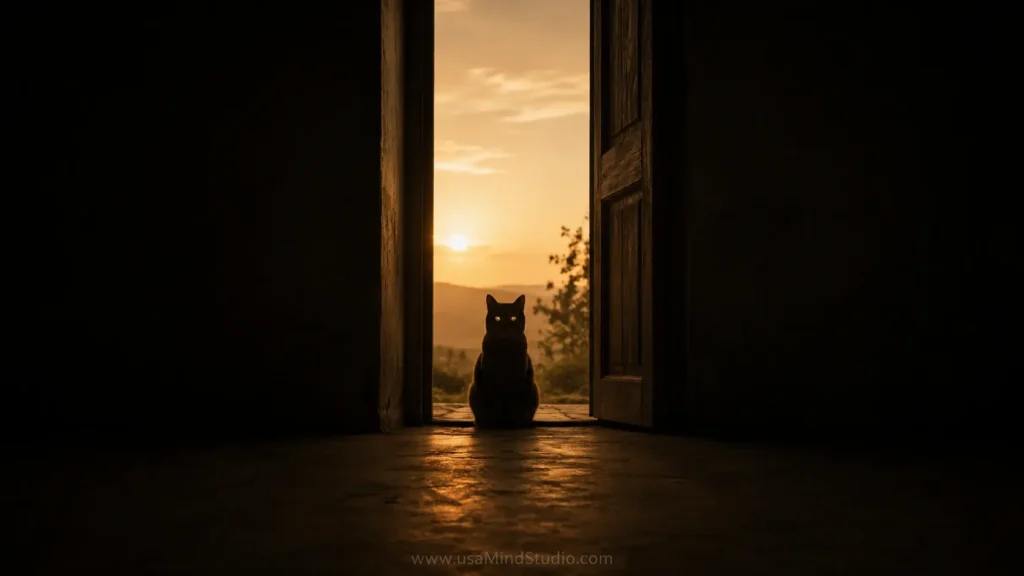
Right now, somewhere in the United States, a cat is asleep on a laptop keyboard, and its owner is working around it.
This guide to cat as a symbol separates what history and tradition actually record from what the internet likes to repeat.
Four thousand years ago, that same animal was buried with honors in Egypt. A thousand years ago in Europe, it was being hunted as an accomplice to witches. Today it has 900 million views of itself falling off things.
No other animal has swung that far. The cat as a symbol has meant divine protection, evil, luck, bad luck, independence, and comfort, sometimes in the same century, always depending on who was doing the looking.
This piece is about how that happened. Not what your cat is telling you, because it is telling you it wants breakfast.
Summary
Cats symbolize independence, intuition, and self-possession, and those readings come straight off how cats actually behave. The famous split is black cats: unlucky in America, lucky in Britain, and the difference is pure historical accident. The reverence came first, in Egypt, and the suspicion was a later European invention that the Pilgrims carried over on ships. Coat color, meanwhile, explains less than people think and more than they expect. It is genetics, not a message.
What Cat as a Symbol Commonly Means
Independence. Intuition. Mystery. Self-possession.
That list is short and it barely changes across cultures, which is unusual. Most animal symbolism wanders. This one holds.
There is a reason. Those four things are not assignments somebody handed the cat. They are descriptions of what a cat does in a room. A dog checks in. A cat does not. A dog wants to know what you want. A cat has already decided. Nobody had to invent independence for this animal. They just wrote down what was in front of them.
The writer Ted Andrews, in Animal-Speak, anchors much of the modern American reading of cats around exactly this: independence and intuition, treated as qualities a person might recognize in themselves.
Which is worth pausing on, because that is what people usually mean by cat symbolism spiritually. Not that the cat is sending a message. That the cat is doing something they would like to be better at. Holding a boundary. Not explaining themselves. Leaving the room.
Black Cat Symbolism
How the Reputation Turned in Medieval Europe
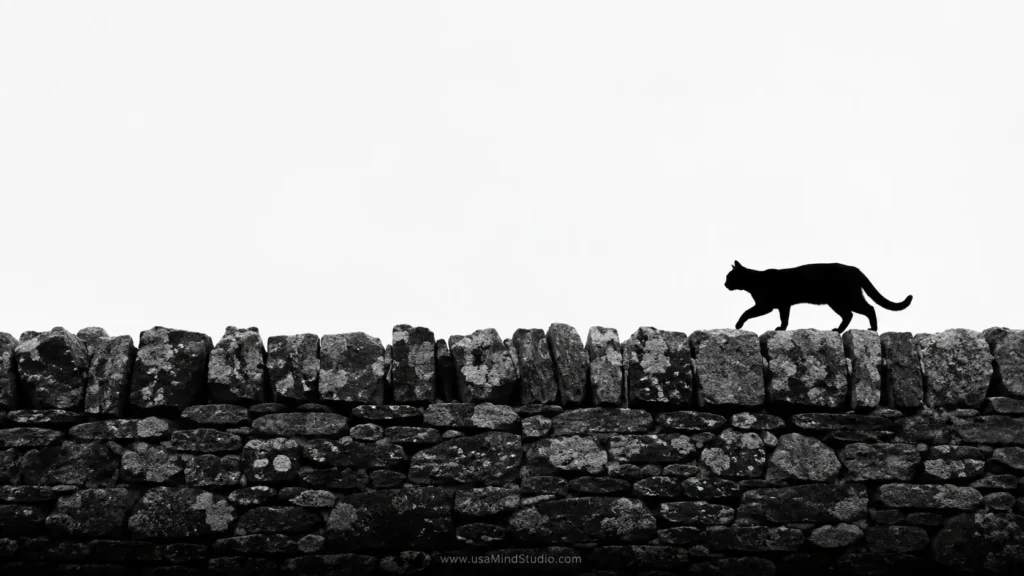
Cats were not always suspect. The turn happened in medieval Europe, where cats got tied to witchcraft and heresy in the popular mind and in official rhetoric.
The details are grim and well documented, and there is no need to dwell on them here. What matters is the mechanism. A nocturnal animal that moves silently, appears at night, and does not obey is going to attract stories in a culture already looking for accomplices.
How the Superstition Reached America
Then it got on a boat.
The Pilgrims brought their beliefs with them, and cat superstition came along with everything else in the hold. That is the whole reason American black cat folklore skews unlucky. Not because anything happened here. Because of what was already in somebody’s head in England in 1620.
The Same Cat, the Opposite Omen
Here is the part that should stop you.
In Britain and Ireland, a black cat crossing your path is often considered good luck. Sailors’ wives kept them. In America, the same event means the opposite.
Same animal. Same behavior. Two countries that share a language and a great deal of history. Opposite conclusions.
Neither one is right, because there is nothing to be right about. The cat is going somewhere. What you feel when it crosses in front of you was installed by geography and inheritance, and it arrived long before you did.
You can watch the American version doing live work every October. And you can watch it costing real animals something in shelters, where black cats have historically been harder to place. A superstition from medieval Europe is still, in a small way, deciding which cats go home.
White Cat Symbolism
White cats get the opposite treatment almost everywhere: purity, calm, good fortune. They read as gentle and slightly unearthly, and people have said so for a long time.
That impression has a physical cause, and it is a good one.
According to the Cornell Feline Health Center, somewhere between 65 and 85 percent of all-white cats with two blue eyes are deaf. With one blue eye, it is around 40 percent. With no blue eyes, 17 to 22 percent.
The reason is a single gene. The same one that makes the coat white also affects the eyes and the inner ear. It is one instruction doing three jobs.
And then there is the detail that stays with you. If a white cat has one blue eye and is deaf in only one ear, Cornell notes that the deaf ear is invariably on the same side of the head as the blue eye.
One gene, one side, two effects.
So the calm, faraway quality people read as otherworldly is sometimes a cat that cannot hear you. The symbolism was doing its best with the information available.
Worth adding, since Cornell addresses it directly: the widespread belief that blue-eyed white cats go blind young is not true. Deafness, yes. Blindness, no.
The Egyptian Cat Symbol
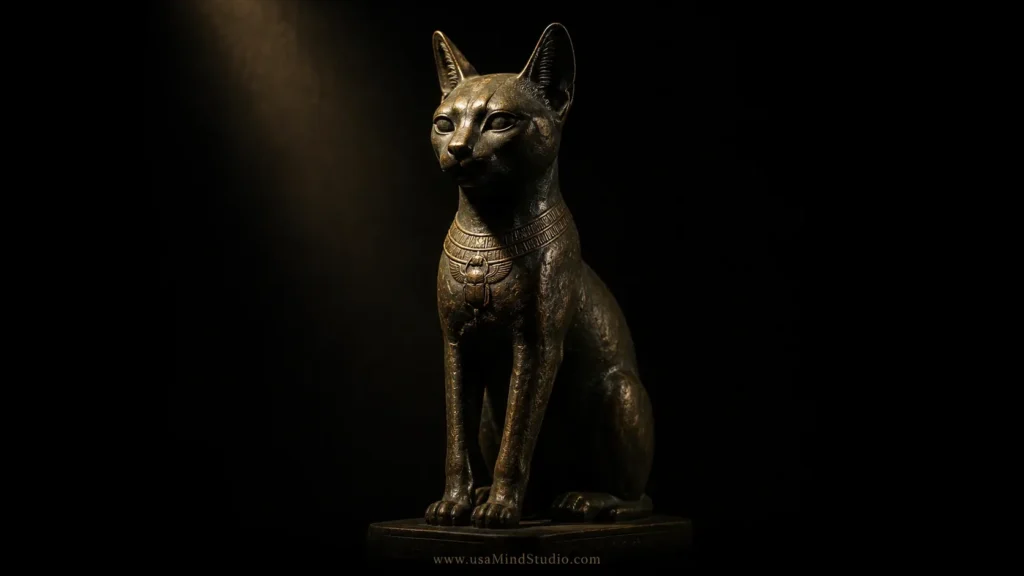
In Egypt, the cat was bound up with Bastet, and the associations were domestic and protective: the home, fertility, safety. Cats show up in tomb art. They were mummified in enormous numbers.
And the bond is older than Egypt. On Cyprus, archaeologists found a cat buried alongside a human roughly 9,500 years ago. Not eaten. Not discarded. Buried with someone, deliberately, before anyone had built a pyramid.
That is the point of this section, and it reorganizes the rest of the article.
Reverence came first. It came first by thousands of years. The suspicion, the witchcraft, the black cat crossing your path, all of that is a late European development that arrived long after humans and cats had already been living together, and dying together, for ninety centuries.
The cat did not change. Europe did.
Orange Cat Symbolism
There is folklore. The M marking on a tabby’s forehead has competing legends attached: an Islamic tradition in which Muhammad blessed a cat, and a Christian version involving Mary. Both are folk explanations for a marking that genetics explains without any help.
But the genetics are the better story.
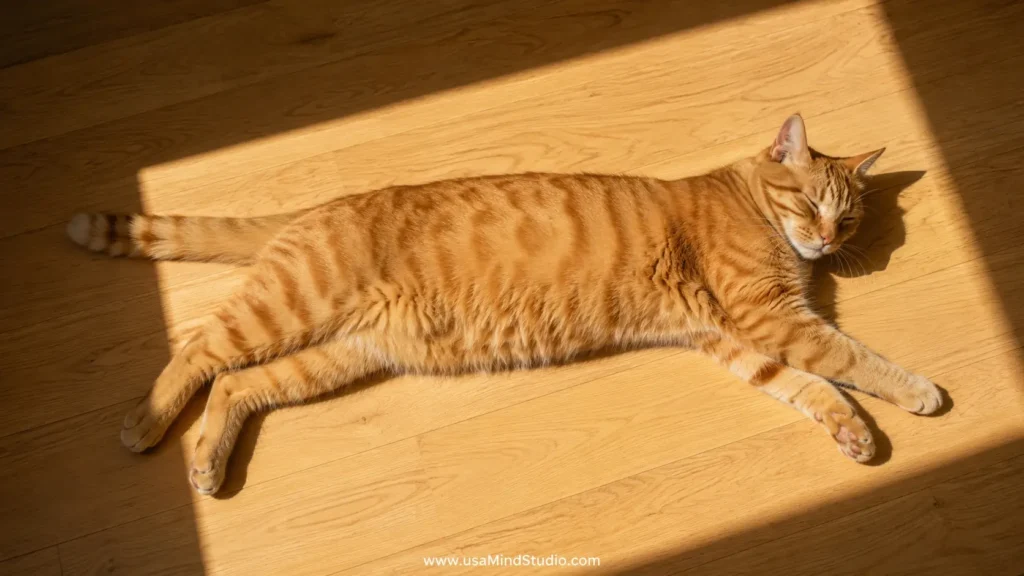
Roughly 80 percent of orange cats are male. People noticed that pattern more than a century ago and worked out it had to be sitting on the X chromosome, because that is the only thing that produces a lopsided split like that. A male needs one copy. A female needs two, which is far less likely, and a female with one copy comes out tortoiseshell or calico instead.
They knew the shape of the answer. They could not find the gene.
It took until November 2024. Two teams, one at Stanford and one at Kyushu University in Japan, announced the same finding within a day of each other. The gene is called ARHGAP36, and the mutation is a small deletion that switches it on in pigment cells where it has no business being.
Nobody saw it coming, because ARHGAP36 was a cancer biology gene. It had never been connected to color in anything. And as far as anyone can tell, this mutation exists in no other mammal on earth. Orange cats are orange in a way nothing else is.
Which brings us to the part that is happening right now.
Americans currently believe orange cats have a personality. You have heard the jokes. There is no strong evidence for it. The likeliest explanation is unglamorous: orange cats are mostly male, and male cats tend to be more outgoing.
That is a folk belief, forming in public, in our lifetime, with a mundane cause sitting right underneath it. In two hundred years somebody will write that Americans of the early twenty-first century held the orange cat to be a trickster figure.
They will be right. And it will have started with a shared X chromosome.
Grey Cats and the Colors With No Story
Grey cats are a good place to be honest.
Black, white, and orange all have something behind them. A tradition, a genetics story, a documented history. Grey has none. The meanings circulating online are recent, informal, and mostly invented to fill a page.
There is no old tradition to report, so this article is not going to report one. The color has real history in other contexts, which belongs in Color Symbolism rather than here.
Why Cats Read as Mysterious
The mystery is not a mood. It is anatomy.
Cats are crepuscular. They are most active at dawn and dusk, which is exactly when humans see worst and feel least sure of things.
Their pupils are vertical slits, which open enormously in low light and let them work in conditions we cannot. They move almost silently.
And their faces are built differently from a dog’s. A dog has expressive facial muscles and uses them at you constantly. A cat’s face gives you far less to read. It is not withholding. There is simply less machinery.
So the animal shows up at the hour you cannot see, moves without sound, watches you with eyes built for the dark, and gives you a face you cannot decode.
Of course people wrote stories. The mystique has a physical cause, and knowing the cause makes it better rather than smaller.
Put simply, cat as a symbol is layered. It draws on religion, folklore, art, and everyday observation, and no single meaning belongs to every culture or every person. Reading cat as a symbol as a prompt for reflection rather than a prediction keeps the symbol in its proper place.
Encountering a Cat and What People Make of It
A cat crossing your path in America still does something to you. It is a small flinch, and most people never examine it.
Worth knowing: that flinch is not about the cat. The cat is crossing a path. It has somewhere to be.
The reaction was installed. It came out of medieval Europe, got on a ship in the 1600s, and has been sitting in the American nervous system ever since, waiting for a black cat to walk past a driveway.
The useful question is not what it means. It is why you felt anything at all, and who put that there, and whether you would have felt it in Dublin.
Few animals hold as many conflicting meanings at once as the cat. Two other creatures people read very differently from culture to culture are the bat and the spider, and both are worth comparing with the cat.
Editorial Reflection Note
USA Mind Studio writes about symbolism as a subject for reflection, not prediction. Nothing here forecasts events or tells anyone what to do. Meanings differ across cultures and people, and we try to say plainly where a meaning came from and where the record runs out. You can read more in our Editorial Policy.
Frequently Asked Questions
What does a cat symbolize in terms of personality? Independence, boundaries, and self-possession. Those readings come from watching cats rather than from tradition. They describe behavior people recognize and often admire.
What is a cat trying to tell you? Usually that it wants food, warmth, or space. Cats communicate constantly and clearly. None of it is a message about your life.
When a stray cat chooses you, what does it mean in Islam? Islamic tradition regards cats highly and treats kindness to them as a virtue. There is no doctrine about a cat choosing a particular person.
What does psychology say about cat people? Studies have looked. The differences found are small and inconsistent. Nothing solid enough to build a personality type on.
What does God say about cats? Almost nothing. Cats are essentially absent from the Bible, despite being everywhere in Egypt at the time. No scripture addresses them.
What is the 3-3-3 cat rule? A shelter guideline, not symbolism. Roughly three days to decompress, three weeks to settle in, three months to feel at home.
What do cats see spiritually? Nothing established. Cats see well in low light and catch movement people miss. That is biology, occasionally mistaken for perception.
What is the core idea behind cat as a symbol? Cat as a symbol is built from layered history and culture rather than one fixed rule, which is why the sections above separate the documented sources from later popular claims.
Does cat as a symbol mean the same thing everywhere? No. Cat as a symbol changes from one culture, era, and personal experience to the next, and this article notes where a meaning is well documented and where it is not.
Should cat as a symbol be treated as a prediction? No. Cat as a symbol is a subject for reflection. Nothing on this site forecasts events or replaces professional advice.
Where does cat as a symbol come from? Cat as a symbol comes from a mix of religion, folklore, art, and everyday observation, and the sections above trace the main sources one by one.
Why do people search for cat as a symbol? People look up cat as a symbol when they notice the subject in a dream, a memory, or an ordinary moment and want context rather than a verdict.
Keep Reading
- Bear Animal Symbolism: The Only Predator We Call Grandmother
- Bat Animal Symbolism: How One Animal Ended Up Meaning Two Opposite Things
- Dragonfly Symbolism: The Insect Japan Put on Armor and Europe Named After the Devil
- Eagle Symbol: Why Five Countries Chose the Same Bird
- Green Color Symbolism: How the Color of Life Became the Color of Death