
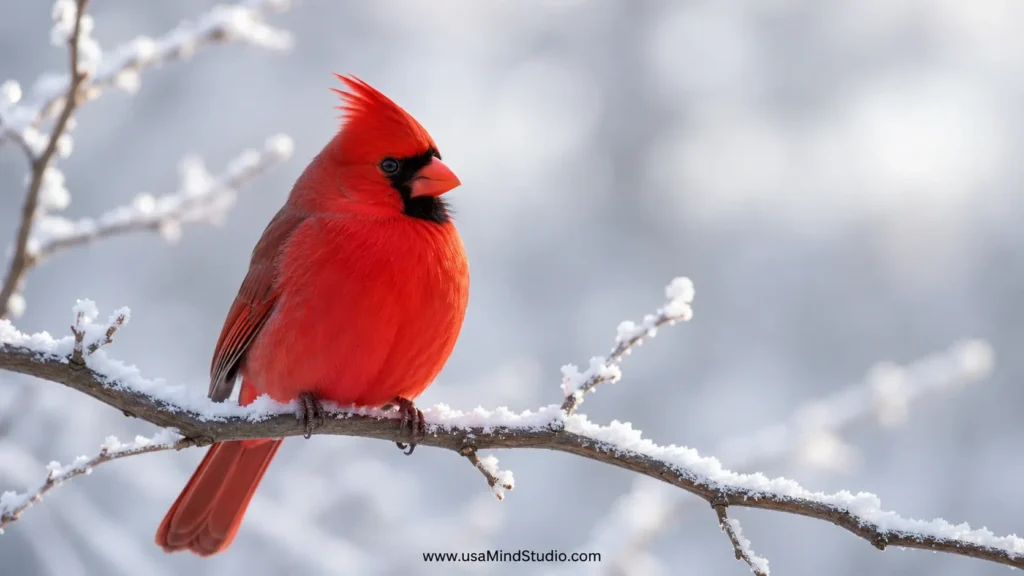
A cardinal does not leave in winter. When most birds head south and the yard goes quiet, the cardinal stays. It is the only red crested bird in the United States, so there is nothing else it could be. Against fresh snow, it is the most visible living thing for as far as you can see. And it comes to feeders, which means it arrives just a few feet from the window, in the months when people spend the most time sitting at that window, looking out.
If you are reading this because a cardinal appeared and it made you think of someone, you are in good company, and this page is not going to talk you out of anything. Cardinal symbolism is real and widely felt in this country. What follows is gentler, and I think more interesting, than a simple yes or no. It is an honest look at why it became this bird.
This guide to cardinal symbolism separates what history and tradition actually record from what the internet likes to repeat.
Summary
Cardinals have come to mean presence, remembrance, and the sense of a familiar thing returning. Many Americans connect a cardinal’s arrival to someone they have lost. This meaning is young, mostly formed here within the last century, and there are plain reasons it landed on this bird: cardinals stay all winter, they are impossible to mistake, and they come close to the house. The name itself came from Catholic priests, not the bird. And while yellow cardinals are real, blue ones are not.
What Cardinal Symbolism Commonly Means
Ask around and the meanings are consistent. Presence. Remembrance. Vitality. Continuity. The feeling of something familiar coming back.
Those readings run together, and they point at the same thing: a sense of being visited, or accompanied, by something still here when a lot has gone. When people talk about the red cardinal’s spiritual meaning, or the spiritual significance of seeing one, they are describing that same feeling in different words. It is one idea, not several.
Here is something worth saying early, because most pages skip it. The cardinal’s meaning in America is young. This is not an ancient tradition handed down from some old civilization. There is no cardinal in Greek myth or medieval Europe, because the bird lives only in the Americas. This meaning formed here, mostly within living memory. That does not make the feeling any less real. It makes it ours.

Why Seeing a Cardinal Feels Like a Message
Across the United States, a lot of people hold the same belief: that a cardinal showing up is a visit, or a sign, from someone who has died. If that is why you are here, this section is for you, and it is not going to tell you that you are right or that you are wrong. That is not this site’s place.
Instead, it is going to answer a question you may not have thought to ask. Why this bird? Out of every bird in North America, why did the cardinal become the one that carries this? The answer is quietly beautiful, and it takes nothing away.
The Bird That Stays
Cardinals do not migrate. Most birds you see in summer are gone by November, off to warmer places. The cardinal stays put all winter, in the same yard, all year long.
It is also unmistakable. It is the only bright red bird with a crest in the country. You cannot confuse it with anything else, even from a distance.
And red against snow is the single highest-contrast thing in an American winter. When the whole world outside the window has gone white and grey and bare, a cardinal is the one spot of vivid color in it. Your eye goes straight to it because it has nowhere else to go.
The Bird That Comes Close
Cardinals feed low, on the ground and at low feeders, which puts them right up near the house, often just a few feet from the glass.
And this part is remarkable. The cardinal used to be a mostly southern bird. According to Audubon, it began spreading north in the early 1900s and now lives as far up as southeastern Canada. Ornithologists credit a warming climate and the growth of suburbs full of backyard feeders stocked with sunflower seed. Americans drew this bird toward their houses on purpose, over more than a century, one feeder at a time. The cardinal is at your window in winter partly because generations of people fed it until it came.
The Season That Overlaps
Now put it together. Winter is when the cardinal is most visible against the snow. It is also when people are most likely to be inside, sitting still, looking out at a bare yard, thinking about who is not there anymore.
So here is the whole thing, gently. The cardinal is the bird most likely to appear at the window at the exact moment a person is most likely to be sitting at it, missing someone. That does not explain the feeling away. It explains why, out of all the birds in the country, this is the one that ended up carrying it. Some people also read a cardinal as simple good luck, a lighter version of the same thing: a welcome bit of color arriving when you needed it.
The Cardinal Is Named for a Priest
The bird’s name has nothing to do with the sky or with spirits. It comes from the Roman Catholic Church.
When early European settlers saw a bright red crested bird, it reminded them of the red robes and caps worn by cardinals, the senior priests of the Church. So that is what they called it. Its scientific name, Cardinalis cardinalis, says it twice. The church title traces to the Latin word cardo, meaning a hinge, because so many important decisions once turned on these officials.
There is a small joke in the language, too. A group of cardinals, the bird, can be called a college, a conclave, or a Vatican, borrowing the words used for the priests. Settlers also called it the Virginia nightingale, comparing its song to a European bird it is not even related to.
Here is the point. An American bird got a Catholic name because homesick Europeans looked at it and saw a priest. The religious feeling now wrapped around the cardinal did not start with the bird, and it did not start with grief. It was sitting inside the name centuries before anyone was watching a feeder and thinking of someone gone. It is the same thing that happened with the ladybug, which is named for Our Lady, the Virgin Mary.
Cardinal Colors: Yellow, Blue, and What Is Actually Out There
Yellow Cardinals Are Real
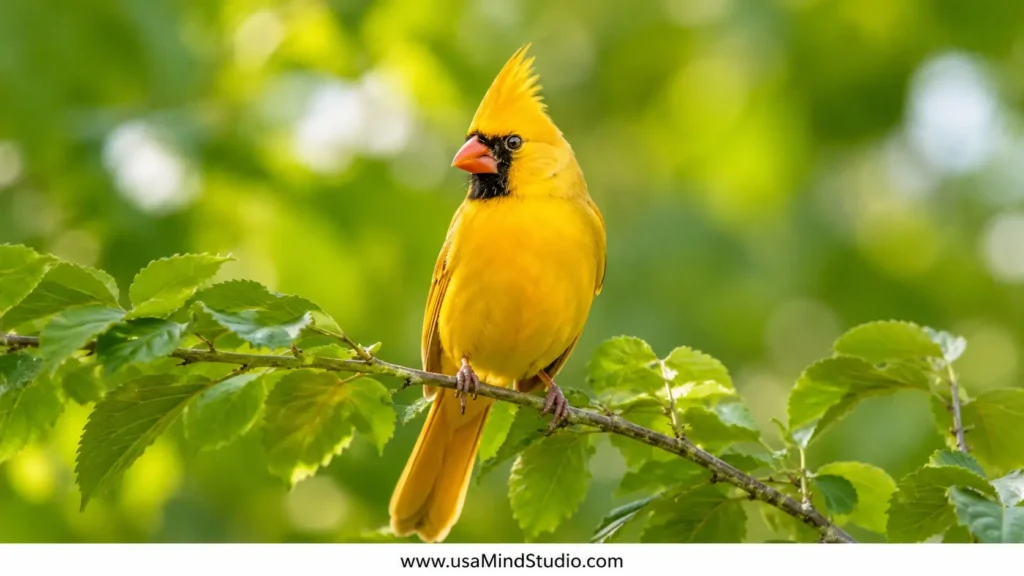
They exist, and they are close to a once-in-a-lifetime sight. A normal cardinal turns the yellow pigments in its food into red using a specific enzyme. In a very rare genetic mutation, that enzyme is missing, so the bird stays bright yellow. Estimates put it at roughly one in a million, and each new one tends to make the local news.
One thing to clear up: there is also a separate South American species literally called the yellow cardinal, Gubernatrix cristata, which is a different bird from the rare yellow version of ours. So a yellow cardinal is a real and genuinely rare thing to see. It is a quirk of pigment chemistry, not a message. Both can be true at once.
Blue Cardinals Are Not
There is no such thing as a blue cardinal. Not a rare one. Not a mutation. It simply does not exist.
If you searched for this, you almost certainly saw a blue jay, an indigo bunting, or a blue grosbeak. This is worth saying kindly, because several websites have invented a spiritual meaning for a blue cardinal, assigning significance to a bird that has never existed. That is the opposite of what this site tries to do.
A Blue Jay and a Cardinal Together
Seeing a blue jay and a cardinal at the same feeder is not a rare alignment. It is the expected outcome. Both stay put year-round, both visit feeders, both are common across the eastern United States, and both like the same seed. It is a nice sight, but not a coded one.
What Cardinals Actually Do
They Eat Their Red
A cardinal cannot make its own red. The color comes from carotenoids, pigments in the berries and fruit it eats. A brighter red male is, in plain terms, a bird that has been eating well on good territory.
So here is a quiet inversion. The red that many people read as a visit from someone they loved is, to another cardinal, closer to a nutrition label. Same red, completely different reader. It is the same lesson the ladybug teaches, where the red that means luck to us means “do not eat me” to a bird. The meaning was never in the color. It was in who was looking.
The Female Sings
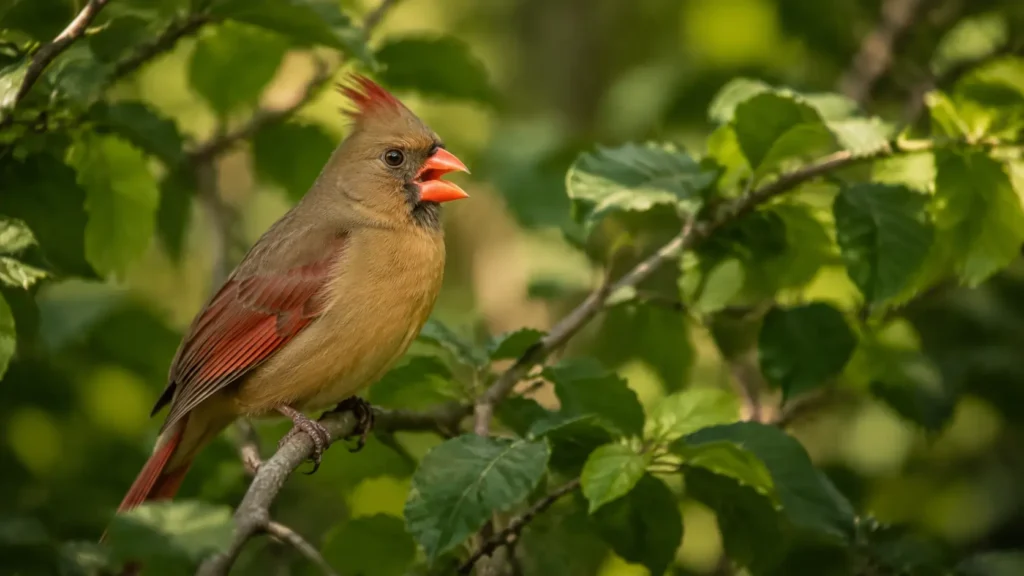
The bird everyone notices is the male. But female cardinals sing too, which is unusual among North American songbirds, where usually only the male does. She often sings from the nest, and her song can signal to the male when it is safe to approach with food and when to hold back, so his bright color does not draw a predator to the nest.
The flashy red bird everyone photographs is the one that has to be careful, because he is so easy to see. The plain brown bird nobody notices runs the whole operation.
One Bird, Two Halves
There is one more thing, and it is stranger than any symbolism. Cardinals have been documented split straight down the middle, bright red male feathers on one side, olive female feathers on the other. Several states have recorded them, and biologists explain it through unusual events in how the egg develops. It is a real animal, more surprising than anything folklore invented for this bird.
Put simply, cardinal symbolism is layered. It draws on religion, folklore, art, and everyday observation, and no single meaning belongs to every culture or every person. Reading cardinal symbolism as a prompt for reflection rather than a prediction keeps the symbol in its proper place.
Encountering a Cardinal and What People Make of It
The cardinal is the official state bird of seven states, more than any other bird in the country, and it lands on Christmas cards across America every December. Without ever quite deciding to, Americans have spent a hundred years building the meaning this bird now carries. So if a cardinal appears at your window, the useful question is not really what it is telling you. It is what you brought to the moment when you saw it. That is where the meaning lives, and it belongs to you, not to this article.
Whatever you make of a red bird at the window on a grey February morning is yours to keep. All this article set out to do was explain why, out of every bird in North America, it was that one, at that window, in that month. The rest is yours.
Editorial Reflection Note
USA Mind Studio writes about symbolism as a subject for reflection, not prediction. Nothing here forecasts events or tells anyone what to do. Meanings differ across cultures and people, and we try to say plainly where a meaning came from and where the record runs out. You can read more in our Editorial Policy.
Frequently Asked Questions
What does seeing a cardinal mean? Many Americans read it as a visit or sign from someone who died. That meaning is heartfelt and recent, and this site neither confirms nor corrects it.
What do cardinals represent? Presence, remembrance, and continuity, the sense of something familiar staying close. The reading formed in the United States mostly within the last century.
Are cardinals good luck? In folklore, often yes. It is a lighter version of the same feeling: a welcome spot of color arriving when the season is bleak.
What is a cardinal in the Catholic Church, and is the bird named after them? A cardinal is a senior Church priest who wears red robes. Yes, the bird was named after them, for its matching red color.
What does a yellow cardinal symbolize? No traditional meaning. It is an extraordinarily rare genetic variant, roughly one in a million, not a sign. It is simply a beautiful, unusual bird.
Is there such a thing as a blue cardinal? No. Blue cardinals do not exist. People who think they saw one likely saw a blue jay, indigo bunting, or blue grosbeak.
Are cardinals a symbol of angels? Some people feel that way, and that feeling is theirs to hold. There is no old tradition behind it, and this site does not claim it as fact.
What is the core idea behind cardinal symbolism? Cardinal symbolism is built from layered history and culture rather than one fixed rule, which is why the sections above separate the documented sources from later popular claims.
Does cardinal symbolism mean the same thing everywhere? No. Cardinal symbolism changes from one culture, era, and personal experience to the next, and this article notes where a meaning is well documented and where it is not.
Should cardinal symbolism be treated as a prediction? No. Cardinal symbolism is a subject for reflection. Nothing on this site forecasts events or replaces professional advice.
Where does cardinal symbolism come from? Cardinal symbolism comes from a mix of religion, folklore, art, and everyday observation, and the sections above trace the main sources one by one.
Why do people search for cardinal symbolism? People look up cardinal symbolism when they notice the subject in a dream, a memory, or an ordinary moment and want context rather than a verdict.
Keep Reading
- Blue Jay Symbolism: The Bird That Is Not Actually Blue
- Eagle Symbol: Why Five Countries Chose the Same Bird
- Hummingbird Symbolism Meaning: How a Bird of War Became a Bird of Grace
- Burgundy Color Meaning: The Color Named After a Swedish Tribe
- Carnation Flower Symbolism: The Woman Who Tried to Own a Flower


