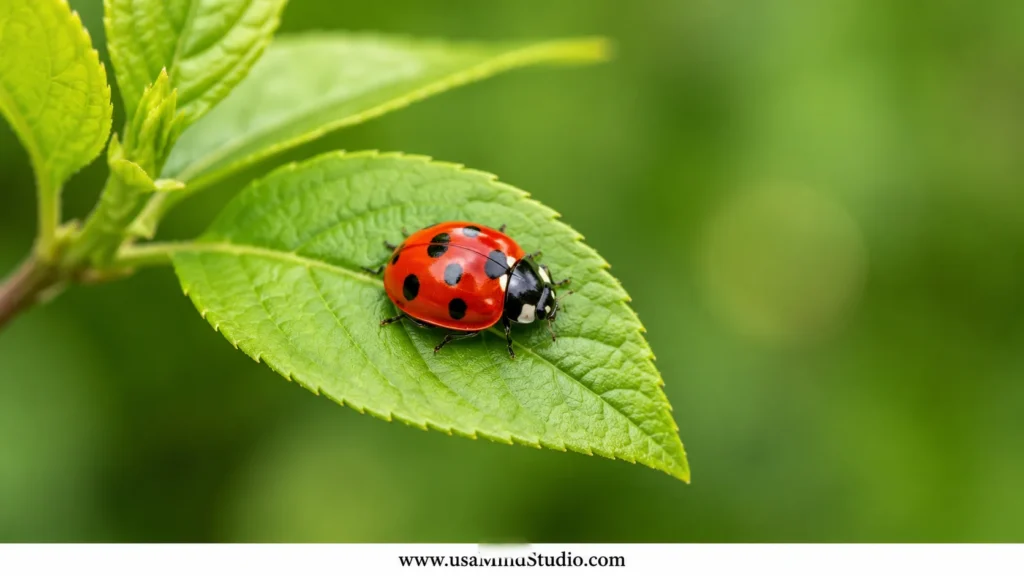
Here is something you have said your whole life without noticing. The lady in ladybug is the Virgin Mary.
This guide to ladybug symbolism separates what history and tradition actually record from what the internet likes to repeat.
Not a lady. Not a soft word for something feminine. Mary, the mother of Jesus. The name is a small piece of medieval devotion that English speakers have been repeating for centuries, and almost nobody knows it is there.
Once you see that, the rest of ladybug symbolism falls into place fast. Across the United States, people treat this little beetle as a sign of luck, and they are not wrong to feel something when one lands on them. But the meaning did not come from magic. It came from farming, from a name, and from the color red doing one job for humans and the exact opposite job for birds. Let us walk through where it all actually comes from.
Summary
Ladybugs symbolize luck, protection, and good timing, and every part of that traces to one plain fact: the beetle eats the pests that destroy crops. The “lady” in the name is the Virgin Mary, a piece of medieval Christian devotion baked into the English word. The luck is agricultural, not mystical. And the bright red that reads as lucky to us is actually a warning to birds that the beetle tastes foul. Same color, opposite meaning, depending on who is looking.
What Ladybug Symbolism Commonly Means
The common readings are gentle and consistent. Luck. Protection. Small mercies. Help arriving at the right moment.
Here is the thing that ties all of them together. Every one of those meanings traces back to a single fact about the beetle: it shows up and eats the thing that is destroying your crop. A ladybug in a field of aphids is not a mystery. It is relief. When you understand that, the symbolism stops being random and starts making complete sense.
That is also what most people mean when they ask about the ladybug’s spiritual meaning. The idea of a small, welcome helper arriving just when things look bad. It is a comforting image, and it is rooted in something real that farmers watched happen for centuries.
There is a thinner thread worth mentioning too. In some old European folklore, a ladybug landing on an unmarried woman meant she would marry within the year. That is where the faint “love” association comes from. It is charming, but it is folklore, not anything deeper, and it never had the weight the luck reading did.
The Lady in Ladybug
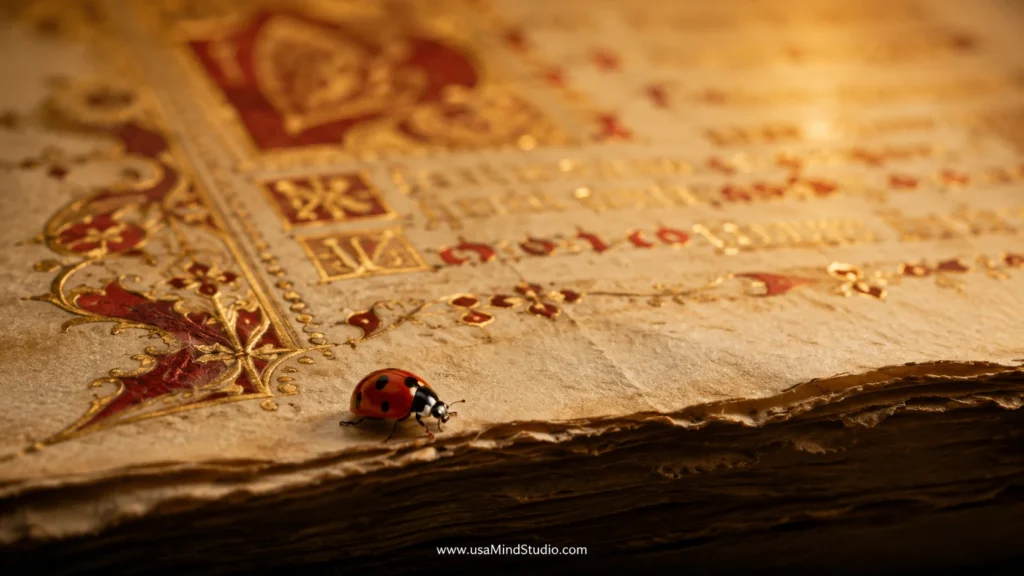
Our Lady’s Beetle
The name is not a guess. The Oxford English Dictionary traces it to the Virgin Mary, and the beetle that first carried it was the seven-spotted European ladybird, Coccinella septempunctata.
And this was not one country’s quirk. The pattern holds right across Europe. In German the beetle is Marienkäfer, Mary’s beetle. In Croatian it is bubamara. Dutch, Swedish, and French names all point in the same direction. A whole continent looked at this bug and thought of the same holy figure.
Even the scientific name leans in. Coccinella comes from the Latin coccineus, meaning scarlet. In medieval art, Mary is painted in a red cloak. The color was doing part of the work.
The Seven Spots
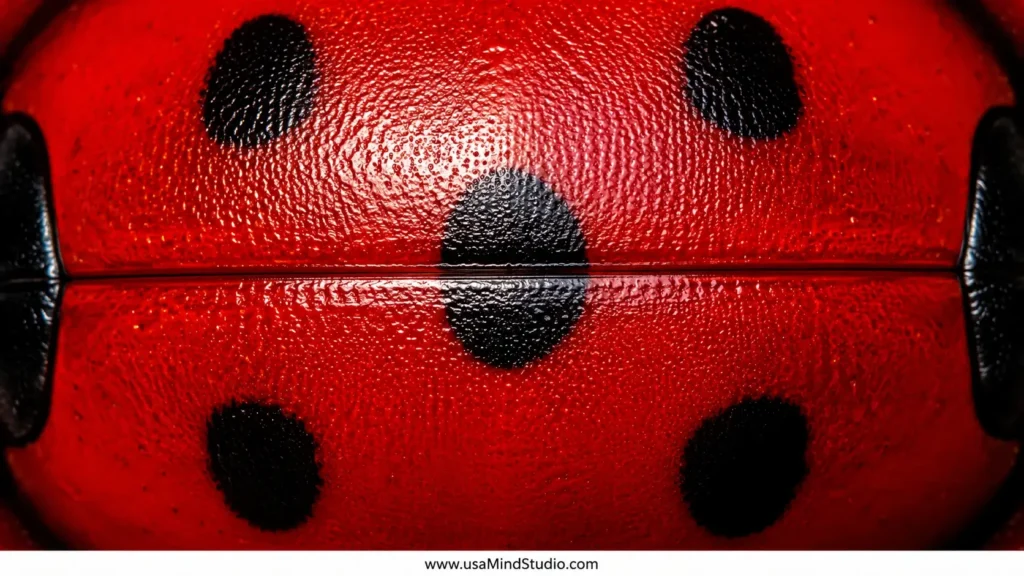
The classic ladybug has seven spots, and those were not ignored. They were read as the Seven Sorrows of Mary, and in some traditions her Seven Joys. Scholars at the Marian Library at the University of Dayton place the link to Mary in the twelfth and thirteenth centuries, with the Seven Sorrows reading arriving a bit later, around the fourteenth and fifteenth.
So the beetle did not just get a lady’s name. It got a specific piece of Christian devotion, spots and all.
So Is the Ladybug in the Bible?
The short answer is no. And this time the honest answer is more interesting than a dodge.
The ladybug is not in scripture. But its English name is a small act of devotion. The beetle got Christianized on its way into the language. So people searching for a biblical ladybug meaning are closer to something real than they realize. They are just looking in the wrong book. The Christianity is in the dictionary, not in the Bible.
A lot of pages ranking for this question string together unrelated verses about small creatures and hope no one checks. The real answer was sitting inside the word the whole time.
Are Ladybugs a Symbol of Good Luck?
Yes. And the reason is farming, not fortune.
The old story goes like this. Medieval farmers watched aphids destroy their crops, prayed to Mary for help, and then ladybugs arrived and ate the pests. Whether any single harvest went that way, the pattern repeated enough that people named the beetle after the answer to their prayers.
From that root grew a broad, gentle folklore: a ladybug landing on you was a good sign, killing one was bad luck, and their arrival meant fair weather. All of it comes back to one source. This beetle was good news for anyone growing food.
Here is the part almost nobody covering this topic mentions, and it is the best chapter in the whole story. It happened in the United States.
In the 1880s, California’s citrus industry was collapsing. An invasive pest called cottony cushion scale was killing orange groves, and growers were pulling out their trees and burning them. So the government sent someone to Australia to find a natural predator, and brought back a ladybug called the vedalia beetle. According to Cornell University’s biological control program, just 514 beetles were imported over the winter of 1888 to 1889. They bred so fast that by the following June, officials handed out over 10,000 of them to more than 200 growers. Within about a year, the pest was under control and the citrus industry was saved.
Sit with that. The luck symbolism did not stay a symbol. California bet an entire industry on this beetle actually showing up and eating the problem, and it won.
Ladybug Colors and Spots
There are two beliefs here worth clearing up, gently, because they are almost universal and almost entirely wrong.
First, the spots. People believe the number of spots tells you a ladybug’s age, or how many lucky months are coming. It does not. The spots tell you the species. There are roughly 5,000 species of ladybug, and both color and spot count vary between them. A two-spotted ladybug is not a young seven-spotted one. It is a different beetle. Counting spots for age or luck is folklore, not biology.
Same goes for color. Yellow, orange, grey, spotless, these are mostly species differences. Some of it is also timing, because a freshly emerged ladybug has not developed its full color and markings yet and will darken as it matures.
The orange note is genuinely useful, especially in autumn. Many Americans searching for orange ladybug meaning are actually looking at an introduced species, not the classic red seven-spot, and it has only been here a few decades. There is no old tradition attached to it, because there was no time for one to form. The symbol is European and centuries old. The bug on your window in October may be neither. It is worth adding that even the familiar red seven-spot is an introduction to North America, brought over in the mid-twentieth century for pest control.
You will find lists online assigning a meaning to every color. Report those as what they are: recent and informal. The deep history belongs to red, and red is its own subject in color symbolism.
What Ladybugs Actually Do
The Red Is a Warning
Here is the sharpest twist in the whole article, and it fits on a beetle the size of your fingernail.
That bright red is not decoration. Scientists call it aposematic coloring, which is a fancy way of saying it is a warning label. The red exists to tell birds one thing: do not eat me, I taste terrible. And ladybugs back it up. When threatened, they leak a foul fluid from their leg joints, and they will play dead to avoid being eaten.
So look at what that same red does. To a human, it means luck, protection, and the red cloak of Our Lady. To a bird, it means poison. Same exact signal. Opposite meaning. The only thing that changed is who is reading it.
That is this entire site’s argument, compressed into one beetle. Meaning is not sitting inside the color. It depends on who is looking.
The Appetite
Underneath the name, the luck, and the devotion is one plain fact: ladybugs and their larvae eat aphids in huge numbers over their lives. A single ladybug can go through hundreds of them.
That one fact generated all of it. The name from grateful farmers. The luck. The prayers to Mary. The California citrus rescue. This symbol has exactly one root, and the root is hunger.
Ladybug Tattoo Symbolism
People choose ladybug tattoos for the reasons you would expect: luck, protection, remembrance, and the simple fact that a ladybug is small, recognizable, and looks good on skin.
Worth being honest here, though. Unlike the turtle or the dragonfly, there is no deep, ancient tattoo tradition behind the ladybug. It is a modern, personal choice. That is not a knock against it. It just means the meaning comes from the person wearing it rather than from any inherited code, and there is nothing wrong with saying so plainly.
Put simply, ladybug symbolism is layered. It draws on religion, folklore, art, and everyday observation, and no single meaning belongs to every culture or every person. Reading ladybug symbolism as a prompt for reflection rather than a prediction keeps the symbol in its proper place.
Encountering a Ladybug and What People Make of It
A ladybug landing on you is one of the very few insect encounters most people actually welcome. Think about how unusual that is. We swat almost everything else. But six centuries of farmers being glad to see this particular beetle built a warmth toward it that we inherited without noticing.
So if one lands on your hand and you feel a small lift, that feeling is real, and now you know where it came from. Not from the beetle deciding to bless you. From a very long human history of this bug meaning good news.
There is a quieter note to end on. The old nursery rhyme, “ladybug, ladybug, fly away home, your house is on fire,” appears to trace back to the practice of burning hop vines after harvest, which killed the beetles living in them. A children’s rhyme about the bug everyone loves is, underneath, about the bug in danger. It is a small thing, but it is a good reminder that the meanings we carry are often older and stranger than we assume.
Editorial Reflection Note
USA Mind Studio writes about symbolism as a subject for reflection, not prediction. Nothing here forecasts events or tells anyone what to do. Meanings differ across cultures and people, and we try to say plainly where a meaning came from and where the record runs out. You can read more in our Editorial Policy.
Frequently Asked Questions
What do ladybugs symbolize? Luck, protection, and help arriving at the right time. Every reading traces to one fact: ladybugs eat the pests that destroy crops.
What do ladybugs symbolize spiritually? The idea of a small, welcome helper showing up just when things look worst. It is a comforting image rooted in real farming history.
What does a ladybug tattoo symbolize? Usually luck, protection, or remembrance. There is no ancient tattoo tradition behind it, so the meaning comes from the wearer.
Are ladybugs a symbol of good luck? Yes, and the reason is farming. The beetle arrives and eats crop-destroying aphids, which made it very good news for growers.
What does a ladybug symbolize in the Bible? It is not in scripture. But its name, “beetle of Our Lady,” is a medieval dedication to the Virgin Mary baked into the word.
Do ladybug spots show how old it is? No. Spots indicate the species, not the age. A two-spotted ladybug is simply a different beetle from a seven-spotted one.
What color ladybugs are good luck? The classic red seven-spot carries the old European luck tradition. Yellow and orange ones are often introduced species with no inherited meaning.
What is the core idea behind ladybug symbolism? Ladybug symbolism is built from layered history and culture rather than one fixed rule, which is why the sections above separate the documented sources from later popular claims.
Does ladybug symbolism mean the same thing everywhere? No. Ladybug symbolism changes from one culture, era, and personal experience to the next, and this article notes where a meaning is well documented and where it is not.
Should ladybug symbolism be treated as a prediction? No. Ladybug symbolism is a subject for reflection. Nothing on this site forecasts events or replaces professional advice.
Where does ladybug symbolism come from? Ladybug symbolism comes from a mix of religion, folklore, art, and everyday observation, and the sections above trace the main sources one by one.
Why do people search for ladybug symbolism? People look up ladybug symbolism when they notice the subject in a dream, a memory, or an ordinary moment and want context rather than a verdict.
Keep Reading
- Cat as a Symbol: Why Black Cats Mean Opposite Things in Two Countries
- Bear Animal Symbolism: The Only Predator We Call Grandmother
- Bat Animal Symbolism: How One Animal Ended Up Meaning Two Opposite Things
- Rose Color Meanings: The Flower Whose Messages Keep Changing
- Lotus Flower Symbolism: What the Mud Actually Teaches