
This is the thing most people get wrong about it. The shell is not a mobile home the turtle backs into, like a hermit crab. It is part of the animal’s skeleton. The ribs and the spine are fused into it. A turtle is built into its shell the way your ribcage is built into you, and it can no more step out of it than you could step out of your own bones.
This guide to turtle symbolism separates what history and tradition actually record from what the internet likes to repeat.
Hold onto that, because it changes everything that follows. All the turtle symbolism about carrying your home with you, about being safe and self-contained wherever you go, is not a poetic idea somebody decided to attach to the animal. It is a plain description of how the animal is built. In the United States and far beyond, the turtle has meant home for thousands of years, and the reason is anatomy.
Summary
Turtles symbolize patience, protection, longevity, and being at home anywhere, and every one of those readings comes from something the animal actually does or is. The shell is a fused skeleton, not a carried house. Many Indigenous nations call North America “Turtle Island,” and some read the plates on a turtle’s back as a working lunar calendar. The meaning was not invented. It was observed.
What Turtles Commonly Symbolize
The common readings are steady and old: patience, longevity, protection, steadiness, and being at home wherever you happen to be.
None of them are arbitrary. A turtle is slow, so it reads as patient. It lives a long time, often longer than the person watching it, so it reads as a symbol of long life. It withdraws into a hard shell when threatened, so it reads as protection. These are not ideas laid on top of the turtle. They are the turtle, described.
When people talk about the turtle’s spiritual meaning, they usually land in the same place. Slow down. Protect your peace. Do not rush what takes time. That is the same material as the core meanings, just in a gentler register. There is no separate mystical turtle hiding behind the ordinary one. The animal that teaches patience by being slow is the same animal in both cases.
The most familiar Western version comes from Aesop. The tortoise beats the hare because it does not stop. That single fable is most of why “slow and steady wins the race” is the reflexive association for so many Americans. It is worth knowing that a good part of what you feel about turtles came from one Greek story about persistence, retold to schoolchildren for a couple of thousand years.
Turtle Tattoo Symbolism
The turtle is one of the more popular symbolic tattoos, and most articles about it skip the part that actually matters.
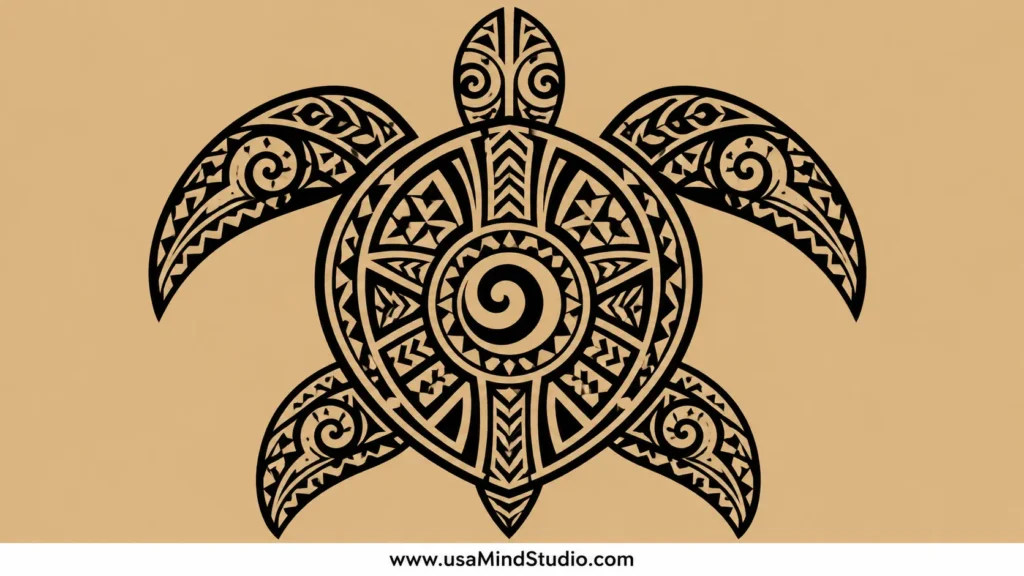
People choose it for protection, for longevity, and to mark having lasted through a long, hard stretch. All of that is real. But there is a specific living tradition here that most turtle tattoo content ignores completely, and it belongs to American readers in Hawaii.
The honu, the green sea turtle, is a longstanding motif in Hawaiian and broader Polynesian tattooing. In that tradition, turtle designs carry meanings around guidance, protection, and family, and the geometric styling is a craft with real history behind it. This is not a generic “turtles mean wisdom” claim pulled off a listicle. It is an actual tradition with actual rules, still practiced.
If a turtle tattoo means something to you, that is yours to decide. But if you want the design to carry real cultural weight rather than a vague good feeling, the honu is where the depth is.
Sea Turtle Symbolism
Sea turtles carry their own set of associations: navigation, endurance, and return. And these might be the most literal readings in the whole article.
A sea turtle crosses enormous stretches of open ocean. And a female, when it is time to lay eggs, returns to nest on the same beach where she herself hatched, years earlier, after a lifetime away. She finds it across thousands of miles of water that all looks the same.
So when people say the sea turtle symbolizes finding your way home, understand what that is built on. It is not a wish. It is documented behavior. The animal genuinely does navigate back to where it started, and scientists are still working out exactly how.
The Hawaiian honu connects here too, which keeps this close to home for American readers. The green sea turtle is not a distant, exotic reference. It is a real presence in Hawaiian waters and Hawaiian tradition, and the two threads, the tattoo and the animal, are the same turtle.
Turtle Island and Indigenous North American Traditions
The Turtle Island Creation Story
A version of this story is told among the Haudenosaunee, the Anishinaabe, the Lenape, and other peoples. Sky Woman falls from the world above. The water animals dive down, one after another, trying to bring up earth from the bottom. Most fail. Finally the muskrat surfaces with a small paw full of mud. The mud is placed on the back of a great turtle, and it grows, and it becomes the land.
That land is North America. And many Indigenous people call this continent Turtle Island right now, today. This is not a quaint historical footnote. It is a name in current use for the ground that this site’s readers are standing on.
The Calendar on a Turtle’s Back
Here is the detail that stops people, and you can check it yourself.
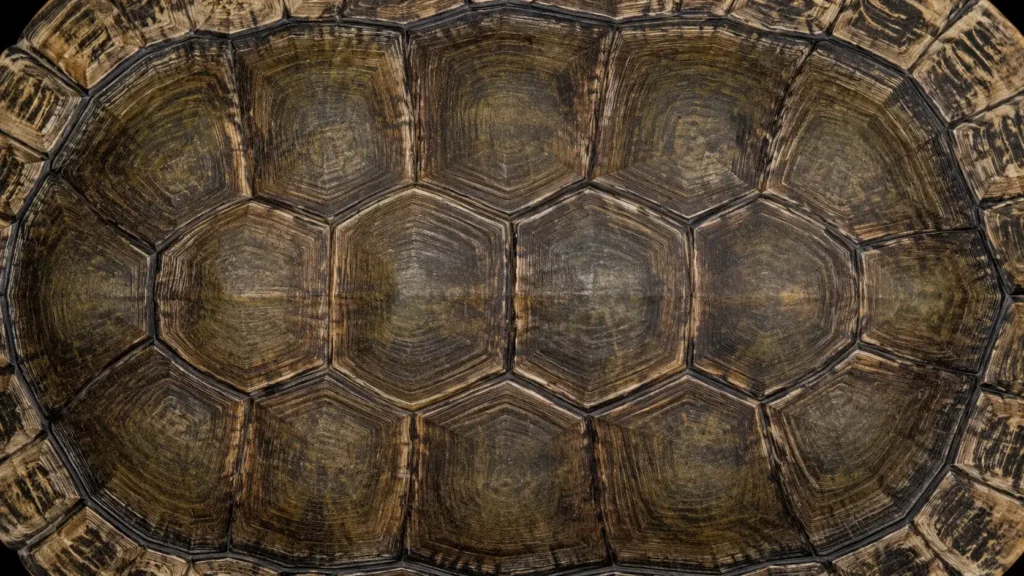
Look at the top of a turtle’s shell. Most turtles have thirteen large plates, called scutes, across the center of the carapace. Around the edge, there is a ring of smaller plates. Count those, and on many turtles you get twenty-eight.
Thirteen. Twenty-eight.
Anishinaabe and Haudenosaunee traditions read the shell as a calendar. Thirteen large plates for the thirteen moons in a lunar year. Twenty-eight small plates for the twenty-eight days in a lunar cycle. The animal that so many traditions tie to time and permanence turns out to have a calendar printed on its back, and it lines up.
The moon names change from nation to nation, because each name describes what is happening on the land in that place during that moon. That variation is not a flaw in the system. It is the point. The calendar is local by design.
The clearest introduction to this is the Abenaki author Joseph Bruchac’s book Thirteen Moons on Turtle’s Back, which gathers a moon from thirteen different nations. It is an Indigenous voice on Indigenous material, which is the right way to meet it.
The Turtle in Asian Traditions
The turtle carries deep meaning well beyond North America, and one detail is too good to leave out.
In China, the turtle has long been tied to longevity and endurance, and it appears among the classical directional figures that organize the old cosmology. That much is expected.
Here is the part that is not. The earliest known Chinese writing was carved onto turtle shells. During the Shang dynasty, more than three thousand years ago, diviners inscribed questions onto the flat underside of turtle shells, heated them until they cracked, and read the cracks. Those inscriptions, called oracle bones, are the oldest form of Chinese writing anyone has found.
Sit with that for a second. The animal associated with time, memory, and permanence is literally the surface that the earliest writing survived on. The turtle did not just symbolize the keeping of records. It physically kept them.
In Hindu tradition, a turtle appears among the forms that support and sustain the world. That is the same broad idea as Turtle Island, arrived at on the other side of the planet, by people who had never heard of it. Two traditions, no contact, both putting the world on a turtle’s back. When an image shows up that many times independently, it is usually because the animal itself suggested it.

What Turtles Actually Do
The shell is fused ribs and vertebrae. It is not armor the turtle puts on. It is the turtle’s own skeleton, turned partly inside out, and the animal is permanently part of it. That single fact grounds the entire “home” reading. You do not carry your home with you if your home is your spine.
Turtles are an old lineage. They were here before a great many familiar animals, and the basic body plan has worked, more or less unchanged, for a very long time. That is where the sense of them as ancient and enduring comes from. They actually are.
And many species live a long time, sometimes longer than the humans watching them. Longevity, protection, home. None of these were imposed on the turtle. They are the animal, read accurately.
Put simply, turtle symbolism is layered. It draws on religion, folklore, art, and everyday observation, and no single meaning belongs to every culture or every person. Reading turtle symbolism as a prompt for reflection rather than a prediction keeps the symbol in its proper place.
Encountering a Turtle and What People Make of It
Turtles show up at the edges of things. On the shoulder of a road. At the rim of a pond. In the gap between the yard and the woods.
If you meet one, there is a more useful thing to notice than any omen. Many North American turtle species are in decline, and road crossings during nesting season are a genuine cause. A female turtle on the pavement is usually trying to reach a place to lay eggs, and she is exposed and slow while she does it.
So the honest reading of a turtle crossing your path is not a message about your future. It is a small chance to help an old, slow, declining animal get across the road in the direction it was already heading. If you take anything from the encounter, let it be that.
Beyond that, the useful question is the one this site always comes back to. Not what the turtle is telling you, because it is not telling you anything. Just what you noticed, and why an animal built into its own bones, carrying a calendar on its back, is one that people have reached for, over and over, to think about home and time.
The turtle appears in many Native American traditions, and so do other animals covered here. For two more, read about bear symbolism and wolf symbolism.
Editorial Reflection Note
USA Mind Studio writes about symbolism as a subject for reflection, not prediction. Nothing here forecasts events or tells anyone what to do. Meanings differ across cultures and people, and we try to say plainly where a meaning came from and where the record runs out. You can read more in our Editorial Policy.
Frequently Asked Questions
Is a turtle a good omen? No tradition establishes that as a fact. Across cultures the turtle reads as steady, protective, and long-lived, which people tend to receive warmly.
What does a turtle crossing your path mean? Most likely that a nesting female is trying to reach her laying site. The kind thing is to help her across, in her direction.
Is a turtle lucky or unlucky? Neither, as a fact. In China it signals longevity, and in many traditions it is welcomed, but that is culture, not a property of the animal.
Do turtles symbolize life? Often, yes. In several creation stories the world itself rests on a turtle’s back, which ties the animal closely to life and the earth.
Does a turtle attract money? That idea comes mostly from feng shui, where the turtle is tied to stability and support. It is a modern belief, not an ancient turtle tradition.
What does it mean when a turtle visits your house? Practically, that a turtle wandered in while looking for water or a nesting spot. No documented tradition assigns a fixed message to it.
Should I get one turtle or two? That is a pet-care question, not a symbolic one. Many turtles do fine alone, and housing two can cause conflict. Ask a vet, not a symbol.
What is the core idea behind turtle symbolism? Turtle symbolism is built from layered history and culture rather than one fixed rule, which is why the sections above separate the documented sources from later popular claims.
Does turtle symbolism mean the same thing everywhere? No. Turtle symbolism changes from one culture, era, and personal experience to the next, and this article notes where a meaning is well documented and where it is not.
Should turtle symbolism be treated as a prediction? No. Turtle symbolism is a subject for reflection. Nothing on this site forecasts events or replaces professional advice.
Where does turtle symbolism come from? Turtle symbolism comes from a mix of religion, folklore, art, and everyday observation, and the sections above trace the main sources one by one.
Why do people search for turtle symbolism? People look up turtle symbolism when they notice the subject in a dream, a memory, or an ordinary moment and want context rather than a verdict.
Keep Reading
- Wolf Symbolism: The Alpha Wolf Was Never Real, and Here Is What Is
- Spider Symbolism: What the Spider Means and Why It Depends on Who Is Looking
- Ladybug Symbolism: Luck, Our Lady, and a Warning in Red
- Blue Jay Symbolism: The Bird That Is Not Actually Blue
- 1111 Angel Number: What It Means and Why You Wish on 11:11