Here is a fact that changes how you read everything else about this bird.
This guide to hummingbird symbolism separates what history and tradition actually record from what the internet likes to repeat.
No one in Europe, Africa, or Asia had ever seen a hummingbird until the 1500s. The bird does not live there. It never has. Hummingbirds exist only in the Americas, from Alaska down to the southern tip of Chile, and nowhere else on Earth.
That means every tradition about this bird, every myth, every meaning, came from this hemisphere. There is no ancient Greek hummingbird. No Chinese hummingbird. No hummingbird in the Bible. For readers in the United States, that makes hummingbird symbolism one of the very few things on this site that is genuinely, entirely ours. And the oldest meaning attached to it is not what most Americans would guess.
Summary
The hummingbird means joy, lightness, and resilience today, but its deepest documented tradition is about war. The Aztecs tied it to their sun-and-war god and believed dead warriors came back as hummingbirds. That belief was not invented out of nothing. Hummingbirds go cold and still every night, then revive at dawn, so people were watching a bird appear to die and return. The symbolism and the biology are the same observation.
What Hummingbirds Commonly Symbolize
Ask most people in the United States what a hummingbird means, and you get a gentle list. Joy. Lightness. Living in the moment. Resilience in a small package. The fleeting made briefly visible.
None of those are wrong, and none are arbitrary. They come from watching the bird. It is tiny, it is fast, it seems to run on pure energy, and it is gone before you finish looking at it. A creature like that naturally reads as a symbol of the bright, quick, passing moment.
That is also what people usually mean by the hummingbird’s spiritual meaning. Not that the bird carries a message, but that it stands for a quality they would like more of: presence, lightness, the ability to be fully in one moment before moving to the next.
But hold onto something before we go further. That soft, delicate reading is the newest one. It is mostly modern and mostly North American. The oldest and deepest tradition about this bird is not gentle at all. It is about war.
The Hummingbird in Aztec Tradition
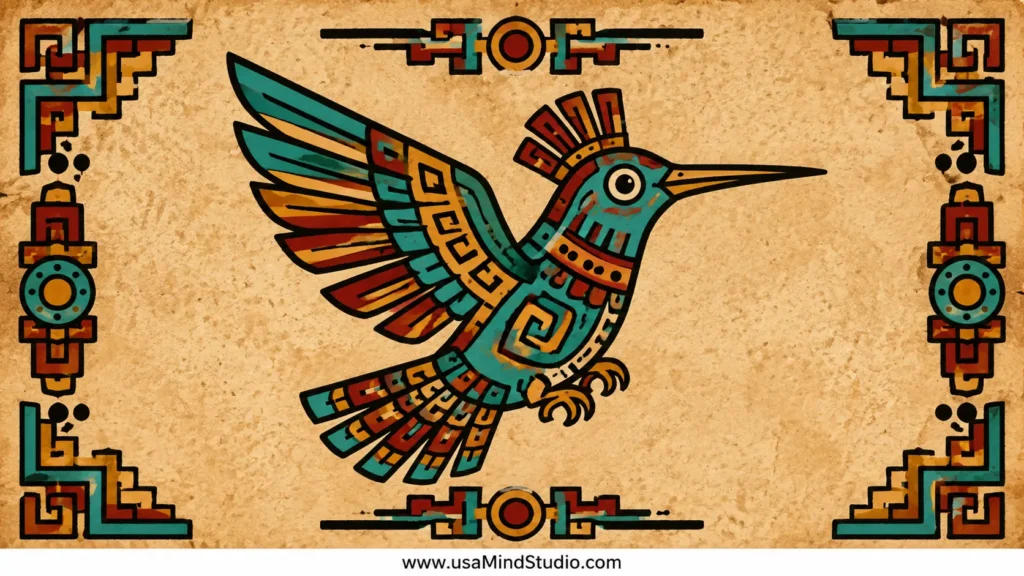
No people took this bird more seriously than the Aztecs, and their reading of it is the opposite of the modern one.
Hummingbird of the South
One of the two chief Aztec gods was Huitzilopochtli, a god of the sun and of war. His name is built from two words: huitzilin, meaning hummingbird, and opochtli, meaning left, or south. In the Aztec picture of the world, the south was the left-hand side. So his name means, roughly, hummingbird of the south.
In the birth story, his mother Coatlicue becomes pregnant after a ball of hummingbird feathers falls from the sky. This is not a minor god with a bird nickname. This is one of the central figures of the entire Aztec world, and the hummingbird is stitched into his name.
Warriors Return as Hummingbirds
The Aztecs believed that warriors who died in battle, and women who died in childbirth, did not simply vanish. They came back as hummingbirds and butterflies, and they accompanied the sun on its climb across the morning sky.
It is worth pausing on where this leads. Tenochtitlan, the Aztec capital, was founded in 1325 on a spot chosen at Huitzilopochtli’s direction. That city is now Mexico City, one of the largest in the world. The hummingbird sits at the founding of it.
Why a Tiny Bird Meant War
This all sounds strange until you actually watch a hummingbird. They are astonishingly aggressive. A hummingbird will dive at, chase, and outfly birds many times its size to defend a single flowering bush. Their long bills are effectively lances, a fact preserved in real species names like the Sword-billed Hummingbird and the sabrewings.
The Aztecs were not projecting a fantasy onto a sweet little bird. They were describing, accurately, an intensely territorial fighter that happens to be small and beautiful. And for millions of Mexican Americans, this is not a distant museum curiosity. It is a living cultural inheritance.
Hummingbird Symbolism in Indigenous North American Traditions
There is no single “Native American” meaning for the hummingbird. There are many nations, with distinct languages and traditions, and flattening them into one belief throws away what is actually interesting.
With that said, the documented specifics tend to point in a consistent direction: water and rain. Among the Hopi and Zuni peoples of the arid Southwest, the hummingbird appears as a figure tied to rain and, in some stories, to relief during famine, and it features in kachina traditions. The logic is grounded. In dry country, a bird that follows the flowers is a bird that follows the water, so it becomes a natural go-between for people asking the land for rain.
Further south, the tradition runs deep into the physical ground itself. The Nazca Lines in Peru, the enormous figures scratched into the desert floor around fifteen hundred years ago, include a hummingbird among the largest and most famous of them. From that desert in Peru to the mesas of the Southwest, people were watching this bird closely for a very long time.
Are Hummingbirds in the Bible?
The short answer is no. And for once, the reason is genuinely interesting instead of a dodge.
Hummingbirds live only in the Americas. No one who wrote any part of the Bible had ever seen one, or ever could have. The same is true of Greek myth, European folklore, Chinese tradition, and every other source from the other side of the world. The bird was simply not there.
This is not a gap to apologize for. It is the cleanest example on this whole site of the thing we keep coming back to. Symbols are not floating universal truths. They come from specific people looking at specific things in front of them. No hummingbirds in the Old World meant no hummingbird symbolism in the Old World. It is that direct.
What is true is smaller and worth stating plainly. Some Christian readers, seeing a bird that appears to revive each morning, connect it to themes of resurrection and new life. That is a reader bringing their own framework to the bird, which is a fair and human thing to do. It is just not the same as the bird appearing in scripture, and the honest version is better than padding the page with unrelated verses about birds in general.
What Hummingbirds Actually Do
Here is where the symbolism stops being symbolism and turns into biology.
They Die Every Night and Come Back
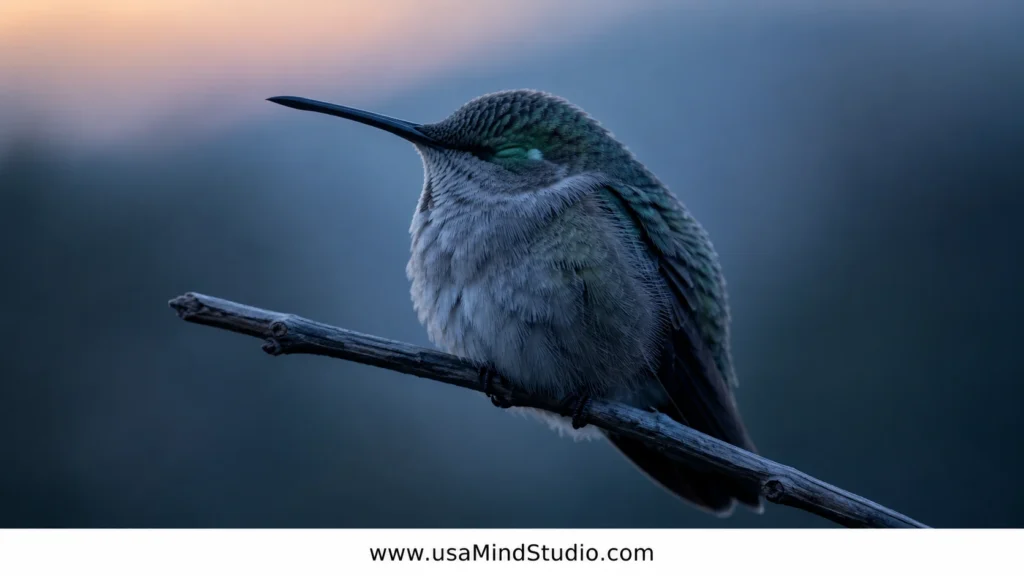
A hummingbird burns energy at a rate almost no other animal can match. Its metabolism runs so hot that a night without food could kill it. So every night, it does something remarkable: it enters a state called torpor. Its body temperature drops steeply, its heart rate collapses, and it becomes cold, motionless, and unresponsive. One physiologist who studies them put it plainly: you would not even know it was alive if you picked it up. Then, at dawn, it warms itself back up and flies away.
Now connect that to the Aztecs. They believed dead warriors returned as hummingbirds. And they were living alongside a bird that visibly appeared to die each night and come back each morning. Fray Bernardino de Sahagún, the Spanish friar who compiled the fullest early record of Aztec life, wrote down the Aztec observation that this bird revives itself.
So the belief was not mystical invention laid over an ordinary animal. It was a conclusion drawn from watching the animal carefully. The symbolism and the natural history are the same observation, separated only by the language used to describe it.
The Flying
The rest of what this bird does is nearly as strange. Hummingbirds are the only birds that can fly backward for any sustained stretch. Their wings beat dozens of times every second. In flight, their hearts can race into the hundreds of beats per minute and beyond.
And they are tougher than they look. The ruby-throated hummingbird, the common one east of the Mississippi, crosses the Gulf of Mexico in a single nonstop flight. A bird that weighs about as much as a nickel covers hundreds of miles of open water without landing.
The Color Is Not There
One last fact, and it quietly undoes the usual reading. A hummingbird’s dazzling throat color is not pigment. It is structure. The feathers are built with microscopic layers that bend light, and the color you see depends entirely on the angle. Turn the bird a few degrees and that brilliant ruby throat goes flat black.
So the bird we call “the fleeting made visible” has a color that is literally an effect of angle and light, here one second and gone the next. Nobody imposed that metaphor. The bird is built out of it.
Put simply, hummingbird symbolism is layered. It draws on religion, folklore, art, and everyday observation, and no single meaning belongs to every culture or every person. Reading hummingbird symbolism as a prompt for reflection rather than a prediction keeps the symbol in its proper place.
Encountering a Hummingbird and What People Make of It
Most people in the United States meet hummingbirds at a feeder or in a garden, which means these encounters usually happen at home, in ordinary moments, close up.
A lot of people attach significance to those moments, and this is where care matters. Many people connect a hummingbird sighting to someone they have lost. If a hummingbird appears in a dream, or hovers at the window on a hard day, and it brings a particular person to mind, that experience is real and it is yours.
This site is not going to tell you the bird is a message, and it is not going to tell you it is not. Both of those would be overstepping. What can be said is gentler and truer: the hummingbird is vivid, sudden, and brief, exactly the kind of appearance a human mind reaches to fill with meaning. What you bring to that moment is the meaningful part.
The bird itself is just doing what it has always done here, for far longer than anyone has been watching. Feeding, fighting, crossing water, going cold at night, and coming back at dawn.
Small birds often feel personal to the people who see them. The cardinal and the blue jay are two more birds whose meanings are tied to everyday encounters.
Editorial Reflection Note
USA Mind Studio writes about symbolism as a subject for reflection, not prediction. Nothing here forecasts events or tells anyone what to do. Meanings differ across cultures and people, and we try to say plainly where a meaning came from and where the record runs out. You can read more in our Editorial Policy.
Frequently Asked Questions
What is the spiritual meaning of a hummingbird? Today, joy, lightness, and resilience. Among the Aztecs, it meant war and the return of fallen warriors. The gentle reading is the newer one.
What does it mean when a hummingbird visits you? Practically, it found your feeder or flowers. Any deeper meaning is what you bring to a brief, vivid moment, not something the bird carries.
Are hummingbirds good omens? No tradition settles that as fact. People feel warmth toward them, but this site does not read sightings as predictions of what is coming.
What does God say about hummingbirds? Nothing. Hummingbirds live only in the Americas, so no biblical writer ever saw one. They appear nowhere in scripture.
What is the hummingbird’s worst enemy? Larger birds, praying mantises, and even large spiders and frogs. For their size, a great deal in the natural world can threaten them.
What is the mythology of the hummingbird? The deepest is Aztec: the god Huitzilopochtli, whose name means “hummingbird of the south,” and the belief that dead warriors returned as hummingbirds.
What is the metaphor of a hummingbird? Usually the fleeting made visible, a bright quick moment that is gone fast. Fittingly, even its color is a passing trick of light and angle.
What is the core idea behind hummingbird symbolism? Hummingbird symbolism is built from layered history and culture rather than one fixed rule, which is why the sections above separate the documented sources from later popular claims.
Does hummingbird symbolism mean the same thing everywhere? No. Hummingbird symbolism changes from one culture, era, and personal experience to the next, and this article notes where a meaning is well documented and where it is not.
Should hummingbird symbolism be treated as a prediction? No. Hummingbird symbolism is a subject for reflection. Nothing on this site forecasts events or replaces professional advice.
Where does hummingbird symbolism come from? Hummingbird symbolism comes from a mix of religion, folklore, art, and everyday observation, and the sections above trace the main sources one by one.
Why do people search for hummingbird symbolism? People look up hummingbird symbolism when they notice the subject in a dream, a memory, or an ordinary moment and want context rather than a verdict.
Keep Reading
- Cardinal Bird Symbolism: What the Red Bird Means and Why It Feels Personal
- Blue Jay Symbolism: The Bird That Is Not Actually Blue
- Eagle Symbol: Why Five Countries Chose the Same Bird
- Orange Color Symbolism: The Color That Had No Name Until a Fruit Arrived
- 111 Angel Number: What Triple One Symbolizes and Where It Comes From