Here is a fact that reorganizes everything people say about this insect.
This guide to dragonfly symbolism separates what history and tradition actually record from what the internet likes to repeat.
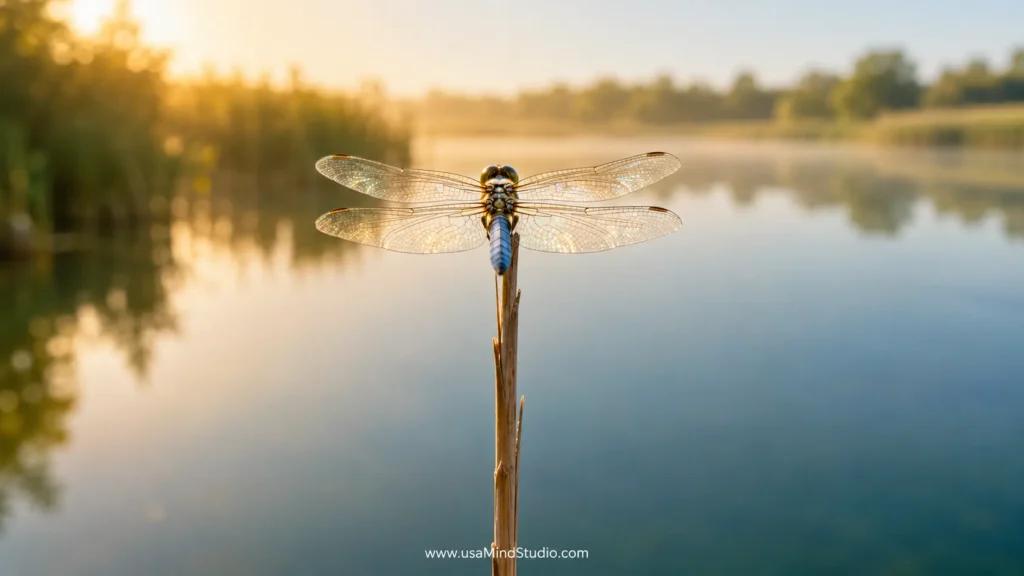
A dragonfly spends most of its life underwater. Not as the darting, jeweled thing you know. As a squat, brown, wingless creature crawling around the bottom of a pond, sometimes for years.
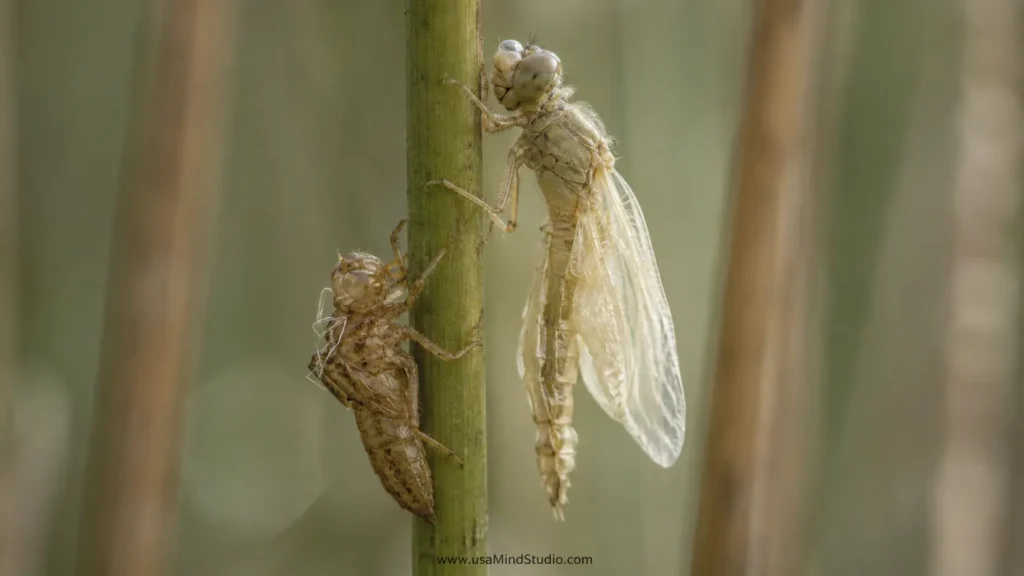
Then one day it climbs up a reed, out of the water, into the air. Its skin splits down the back. And out of that split husk it pulls itself, unfolds four wings, and flies.
So when you read that the dragonfly means transformation, understand what that is. Nobody sat down and decided to assign it that idea. Dragonfly symbolism is a report. People watched an animal crawl out of the water as one thing and leave as another, and they wrote down what they saw. The metaphor and the biology are the same event.
Summary
The dragonfly means transformation because it literally transforms, climbing out of the water and splitting its own skin to fly. Almost every reading traces back to something the animal actually does. Japan built its deepest symbolism around it and even named the country after it. Parts of Europe named it after the devil. Both were looking at the same insect, and the difference tells you more about people than about dragonflies.
What the Dragonfly Commonly Symbolizes
The associations turn up again and again: transformation, adaptability, lightness, living in the moment, and seeing clearly.
None of those are arbitrary. Each one points at something real.
Transformation is the life cycle. Lightness and living in the moment come from the adult’s short, fast, airborne life. Adaptability comes from an animal that lives in two different worlds, water and air, across one lifetime. And seeing clearly is the most literal of all, which the next section gets to.
That is the pattern worth watching in this whole piece. The dragonfly is one of the cleanest cases anywhere of symbolism that is just accurate observation wearing nicer clothes.
The Life Cycle Behind the Symbol
It hatches underwater and lives there as a nymph, a stocky wingless hunter, for anywhere from a few months to several years depending on the species. It eats constantly, and it is very good at it.
Then it climbs out, its skin splits, and the adult pulls free and flies. Here is the part people find hard to believe: the flying, jeweled adult most of us picture only lasts a few weeks. The insect spends years underwater and a matter of weeks in the air. The version we think of as the dragonfly is the short final chapter.
Two more things the animal does, because they explain the rest of the symbolism.
Its eyes are extraordinary. A dragonfly’s compound eyes can hold close to 30,000 separate lenses each and wrap most of the way around its head, giving it nearly full-circle vision. According to a University of Michigan researcher writing on dragonfly vision, those eyes cover so much of the head they look like a motorcycle helmet. That is where “seeing clearly” comes from. It is not poetry. It is anatomy.
And it flies like almost nothing else. Dragonflies move each of their four wings independently. They hover, change direction instantly, and catch prey in midair with a success rate that embarrasses most predators. What they do not do, and this matters for the next section, is fly backward.
Japan and the Dragonfly
Dragonfly Island
Japan’s oldest poetic name for itself is Akitsushima, which means roughly Dragonfly Island. The name appears in the Nihon Shoki, the chronicle of Japan compiled in 720 CE. The story goes that an early emperor stood on a mountain, looked out over the land, and said it was shaped like a dragonfly.
Sit with that. An entire country named itself after this insect, in writing, thirteen hundred years ago. No other insect in world history gave its name to a nation.
The Victory Insect
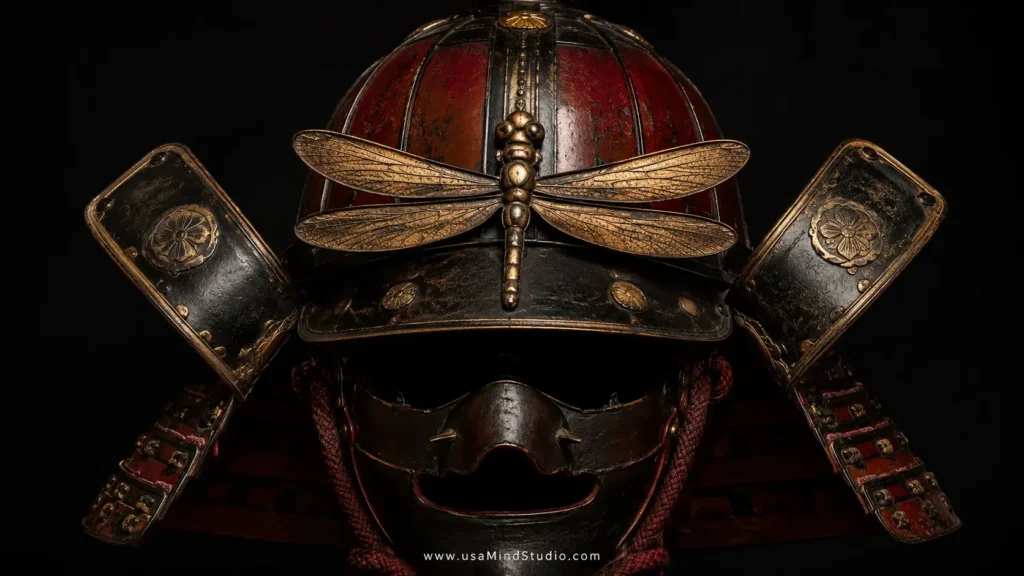
Samurai called the dragonfly kachimushi, the victory insect.
The reason is the flying. A dragonfly goes forward, fast, and does not retreat. For a warrior, an animal that only ever advances is close to a perfect emblem. From roughly the seventeenth century, dragonfly motifs show up on helmets, armor, sword fittings, and family crests. High-ranking lords wore dragonfly-shaped helmets partly so they could be spotted on the battlefield.
These are not stories about a feeling. They are things sitting in museum cases. You can see the armor.
Rice Fields and Autumn
There is a gentler thread too. Dragonflies gather over flooded rice paddies, because standing water is where they breed. A farmer seeing clouds of them over the fields came to read them as a sign tied to the harvest and to good fortune. The red ones in particular became a marker of autumn, and they run all through Japanese poetry as a seasonal signal, the way a falling leaf might work here.
Dragonfly Symbolism in Indigenous North American Traditions
This section has to start with a caution, because most writing on the subject skips it.
There is no single “Native American” meaning for the dragonfly. There are many distinct nations, with distinct languages and distinct traditions, and they do not all say the same thing. Collapsing them into one belief throws away the actual content.
With that said, the documented specifics are worth naming.
Among the Hopi and other Pueblo peoples, the dragonfly is a medicine animal tied to water, rain, and healing, and it appears as a recurring motif on Sikyátki pottery. That connection is not arbitrary. Dragonflies are always found near standing water, and in a desert, an animal that reliably marks water is marking life. According to Native Languages of the Americas, killing a dragonfly was considered highly taboo among Pueblo peoples.
Among Plains nations, the reading was different: protection, even invincibility. Its images were painted on war shirts and tepee covers to turn away danger and injury. That too tracks the animal. A dragonfly is famously hard to catch, quick and evasive in the air. A warrior painting one on his shirt was borrowing something the insect actually has.
Both readings, desert water and battlefield protection, come straight out of watching what the dragonfly does in that place. Different nations, different environments, different meanings, each one grounded.
The Dragonfly in European Folklore
Now the turn, because Europe looked at the same insect and reached the opposite conclusion.
In Germanic folk tradition, the dragonfly was uncanny and tied to the devil. German names for it translated to things like devil’s needle and devil’s horse. The English “devil’s darning needle” comes from the same belief, and it carried a threat: the needle would sew shut the lips of children who lied or swore.
So the same insect a Japanese emperor named his country after, and that Plains warriors painted on their shirts for protection, parts of Europe named after Satan and used to frighten children.
No fear framing is needed in the telling. It is documented cultural history, and it makes the point of this whole site better than almost anything else could. The dragonfly did not change between Japan and Germany. The people did. A symbol is not a property of the thing. It is a property of who is looking.
Dragonfly Colors and What They Mean
Before assigning meaning to a dragonfly’s color, it helps to know what the color actually is.
Dragonfly coloration is biology first. It varies by species, and within a species it often varies by age and sex. Some dragonflies change color entirely as they mature, so the same individual can be one color young and another later. The color does a job, mostly around temperature and mating, long before anyone reads meaning into it.
Red is the one color with real tradition behind it. In Japan, red dragonflies are firmly tied to autumn and appear all through classical poetry and art. That is a documented, centuries-old association, not a modern invention.
Blue, green, and black are a different situation. The meanings floating around for these online, calm for blue, growth for green, mystery for black, are recent and mostly informal, borrowed from general color associations rather than any specific dragonfly tradition. There is nothing wrong with finding them useful, but they are not old, and this site would rather say so. The real history lives in color symbolism generally, which is its own subject.
Dragonfly Tattoo Symbolism
The dragonfly is one of the more popular symbolic tattoos, and the reasons line up with everything above.
People choose it to mark transformation, most often a hard period they came through and out of. The water-to-air emergence makes it a natural image for that. It also appears often as a memorial piece, a way of carrying someone.
There is no ancient tattoo tradition behind this, and that is fine to say. It is a modern, personal choice, and the meaning comes from the wearer rather than from any inherited code.
Is the Dragonfly in the Bible?
The honest answer is no. The dragonfly is not mentioned in the Bible.
A lot of pages ranking for this question admit that in a single clause and then spend several hundred words on what it could represent anyway. This site is not going to do that.
What is true is smaller and more honest. Some Christian readers connect the dragonfly’s emergence from water into air to themes of resurrection and new life. That is a reader bringing a framework to the insect, which is reasonable. It is just not the same as scripture mentioning the animal, and the difference is worth keeping straight.
Put simply, dragonfly symbolism is layered. It draws on religion, folklore, art, and everyday observation, and no single meaning belongs to every culture or every person. Reading dragonfly symbolism as a prompt for reflection rather than a prediction keeps the symbol in its proper place.
Seeing a Dragonfly and What People Make of It
Dragonflies show up at water, in summer, often at the exact kind of slow, warm, open moment people tend to remember later. A dock. A pond. A quiet afternoon.
That timing is probably why so many people attach significance to seeing one. It is not that the dragonfly arrives with a message. It is that it tends to appear when you were already paying attention.
So if one lands near you, the useful question is not what it is telling you. It is what you were already thinking about when it showed up, and why this animal, out of all of them, is the one people reach for at moments like that.
The answer, most likely, is the split skin. Something that spent a long time underwater, in the dark, then climbed out and flew. People recognize that shape. That is the whole reason the dragonfly means what it means.
Small flying creatures attract a lot of meaning. If the dragonfly interests you, the ladybug is another insect that people treat as a sign of luck, and the hummingbird is a small bird with a similar reputation for delicacy and surprise.
Editorial Reflection Note
USA Mind Studio writes about symbolism as a subject for reflection, not prediction. Nothing here forecasts events or tells anyone what to do. Meanings differ across cultures and people, and we try to say plainly where a meaning came from and where the record runs out. You can read more in our Editorial Policy.
Frequently Asked Questions
What is a dragonfly trying to tell me? Nothing, in any provable sense. It is hunting or breeding. The meaning you take from it comes from you, not from the insect.
Do dragonflies mean a loved one is near? No tradition establishes that as fact. Many people find comfort in the idea after a loss, and that comfort is real even if the claim is not.
What is the superstition about dragonflies? It depends where you are. Europe tied them to the devil. Japan tied them to victory. The same insect, opposite reputations.
Should you touch dragonflies? Better not to. They are harmless to people, but handling can damage their wings. Watching is kinder and works better anyway.
What is a dragonfly’s biggest enemy? Birds, frogs, and larger dragonflies. As underwater nymphs they are eaten by fish. They are hunters that are also frequently hunted.
Why are dragonflies attracted to humans? They are not, really. They are attracted to the small insects we attract, and to the warmth and water we are often near.
Is a dragonfly good or bad luck? Neither, as a fact. Japan read good fortune, parts of Europe read the opposite. The luck was always in the culture, not the animal.
What is the core idea behind dragonfly symbolism? Dragonfly symbolism is built from layered history and culture rather than one fixed rule, which is why the sections above separate the documented sources from later popular claims.
Does dragonfly symbolism mean the same thing everywhere? No. Dragonfly symbolism changes from one culture, era, and personal experience to the next, and this article notes where a meaning is well documented and where it is not.
Should dragonfly symbolism be treated as a prediction? No. Dragonfly symbolism is a subject for reflection. Nothing on this site forecasts events or replaces professional advice.
Where does dragonfly symbolism come from? Dragonfly symbolism comes from a mix of religion, folklore, art, and everyday observation, and the sections above trace the main sources one by one.
Why do people search for dragonfly symbolism? People look up dragonfly symbolism when they notice the subject in a dream, a memory, or an ordinary moment and want context rather than a verdict.
Keep Reading
- Turtle Symbolism: The Animal That Carries a Calendar on Its Back
- Wolf Symbolism: The Alpha Wolf Was Never Real, and Here Is What Is
- Spider Symbolism: What the Spider Means and Why It Depends on Who Is Looking
- Cardinal Bird Symbolism: What the Red Bird Means and Why It Feels Personal
- Burgundy Color Meaning: The Color Named After a Swedish Tribe