The most famous thing everyone knows about wolves is not true.
There is no alpha wolf. No lone male who fought his way to the top of the pack. It does not exist in the wild, and it never did. The biologist who did more than anyone to put that idea into the world spent the last stretch of his career trying to take it back, and he mostly lost.
This guide to wolf symbolism separates what history and tradition actually record from what the internet likes to repeat.
That is a strange place to begin an article about wolf symbolism, but it is the right place, because it shows exactly how a symbol gets made. A careful man watched some animals, wrote down what he saw, and accidentally created one of the most repeated ideas in American culture. The animals were in a zoo. The idea escaped and became a way people describe men. And the real wolf, the one that was never in the room, turns out to mean something better.
Summary
Wolves symbolize loyalty, family, instinct, and wildness, and the family part is the accurate part. The famous “alpha wolf” is a myth that came from studying unrelated wolves crammed into a zoo enclosure. A real wolf pack is just a family: two parents and their kids. The West learned to fear wolves through scripture, folklore, and government policy, while Rome built its founding story on a wolf that acted as a mother.
What Wolves Commonly Symbolize
The readings that come up again and again are loyalty, family, instinct, wildness, and endurance.
Two of those are more accurate than people realize. Loyalty and family are not romantic projections onto the wolf. They are close to a plain description of how wolves actually live, and the reason will become clear once we get to what a pack really is.
The others track the animal too. Instinct and wildness come from the wolf being the wild thing dogs descend from, the version that never came to live by the fire. Endurance comes from wolves traveling long distances and surviving in hard country.
When people talk about the wolf’s spiritual meaning, they usually mean some mix of the same things: trusting your instincts, protecting your family, staying loyal to your people. That is the core symbolism in a more personal key. There is no separate spiritual wolf standing behind the ordinary one.

Wolf Colors: White, Black, and Grey
Grey wolves are not always grey. They range across grey, black, white, and brown, and the reasons are practical. Arctic wolves are white because they live in snow, and blending in helps. Here is a stranger one: black coats in North American wolves trace to a gene variant that entered the wild population through dogs, thousands of years ago. The dramatic black wolf owes its color to a dog ancestor.
So color is geography and genetics first, long before it is symbolism.
People do attach meanings to each. White wolves get read as purity, spirit, and solitude, including when one appears in a dream. Black wolves get read as mystery and independence. Grey wolves get treated as the balanced, in-between version.
None of that is wrong to feel, but these color meanings are recent and informal. Unlike the alpha story or the documented European fear of wolves, they are not inherited tradition. They are modern associations borrowed from what the colors mean in general. The deeper history of white, black, and grey belongs to color symbolism on its own.
Wolf Symbolism in Indigenous North American Traditions
This section has to begin with a caution. There is no single “Native American” meaning for the wolf. There are many distinct nations, each with its own language and its own traditions, and what follows is specific rather than a summary of all of them at once.
Among the Anishinaabe, there is a teaching about Ma’iingan, the wolf, as a brother whose fate is tied to the fate of the people. What happens to the wolf will happen to them. This is not a vague reverence. It is a specific relationship, and it is still actively invoked today in real debates over wolf hunting and conservation. When Anishinaabe people argue against wolf hunts, this teaching is often at the center of the argument.
Wolf clans exist across a number of nations, each organized in its own way and named in its own language.
Here is the part worth sitting with. Several Indigenous traditions arrived at “the wolf is family” centuries before Western biology did. The scientists who finally worked out that a pack is a family were, in a sense, catching up to something other people on the same continent had understood for a very long time.
The Alpha Wolf Symbol and What Wolves Actually Do
Where the Alpha Idea Came From
In the 1940s, a Swiss scientist named Rudolf Schenkel studied wolves at the Basel Zoo. He took wolves that were strangers to each other, from different zoos, put them together in a small enclosure, and watched what happened.
What happened was fighting, and a rank order, and a top male and female he called the alpha animals. He wrote it down carefully. He was not sloppy and he was not lying. He recorded exactly what he saw.
The problem was the setup. Strangers locked in a small pen is not a pack. It is closer to a prison. Put unrelated adult wolves who never chose each other into a cage, and of course they fight for position. That tells you about the cage, not about wolves.
The Man Who Tried to Take It Back
In 1970, an American biologist named L. David Mech published a book called The Wolf, which pulled together everything known about the animal at the time, Schenkel’s zoo study included. The book became a bestseller. It is the single biggest reason the word “alpha” entered everyday language.
Then Mech went and looked at real wolves.
Starting in 1986, he spent summers on Ellesmere Island, in the far north of Canada, where the wolves had no history of being hunted by people and did not run from him. For the first time, he watched wild packs up close, sometimes from a few feet away, over several years.
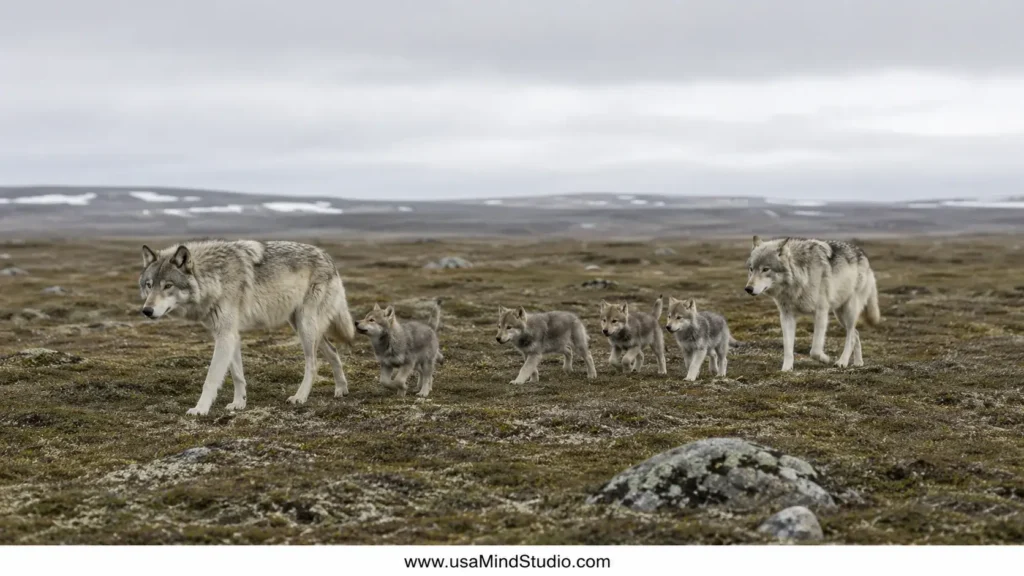
They were families. The “leaders” were just the parents. The other wolves were their kids. There was no fighting for the crown, because you do not fight your mother and father for a rank. You grow up and you leave.
In 1999, Mech published a formal correction in a scientific journal, arguing plainly that the field should stop using “alpha” for wild wolves and call the leaders what they are, the parents. He put Schenkel’s original study on his own website, labeled as the source of an idea that turned out to be wrong. And he spent over twenty years asking his own publisher to stop printing his famous book.
It stayed in print until 2022. Fifty-two years. He knew it was wrong for most of that time and could not stop it.
That is how symbolism works, compressed into one career. A careful scientist created an idea by accident, spent decades trying to kill it, and watched it outlive his corrections, jump off the wolf entirely, and become a word people use to describe men in offices and gyms. You can read Mech’s own account of the reversal through the International Wolf Center, which he helped found.
What a Wolf Pack Actually Is
A real wolf pack, in the wild, is a breeding pair and their offspring from the last two or three years. Usually somewhere around six to ten animals. The parents lead because they are the parents. The young wolves eventually head off to find mates and start families of their own.
Look back at the top of this article. Loyalty and family, the two readings that felt almost too sweet to be accurate, turn out to be the true ones. As Mech puts it, what would be the point of calling a human father the alpha male? The dominance and the ladder of rank, the part that got famous, was an artifact of a zoo. The wolf that actually exists is more about raising pups than winning fights.
How the West Learned to Fear the Wolf
If the wolf really means family, where did the fear come from? It was built, piece by piece, and you can watch it happen.
Start with the opposite, because it makes the point. At the founding of Rome sits a she-wolf who finds two abandoned human infants, Romulus and Remus, and nurses them. The Capitoline wolf is not a monster. She is a mother. One of the greatest cities in history chose a wolf as the creature that saved its founders.
Then the reading flips. In the Bible, the wolf shows up over and over as a threat to the flock, the predator the shepherd guards against. The phrase “a wolf in sheep’s clothing” comes straight out of scripture, and it is still one of the most common ways English speakers describe a hidden danger.
European folklore piled on. The wolf at the door. The wolf in the fairy tale who eats the grandmother. The werewolf. Centuries of stories, all pointing the same direction.
And then, in the United States, the fear became law. Wolves were hunted with government backing as part of deliberate eradication programs, and they were wiped out of most of the lower 48 states before later efforts began bringing a few back. The fear was not just something people felt. It was policy, written down and funded.
So the frightening wolf was built, slowly, out of scripture and story and law. And the nurturing wolf was built too, in Rome, out of a different need. Neither one is the animal. Both are us.
Put simply, wolf symbolism is layered. It draws on religion, folklore, art, and everyday observation, and no single meaning belongs to every culture or every person. Reading wolf symbolism as a prompt for reflection rather than a prediction keeps the symbol in its proper place.
Encountering a Wolf and What People Make of It
Here is a quiet fact to end on. Most Americans reading this will never see a wild wolf. They are gone from most of the country, and the encounter that folklore is so afraid of almost never happens anymore.
The animal that fills so much of our imagination, that gave us a word for dominance and a phrase for hidden danger, is one that nearly none of us will ever actually meet.
So if a wolf means something to you, the useful question is not what it is warning you about. It is not warning you about anything. The useful question is which wolf you inherited. The one from the zoo study. The one from the fairy tale. Or the real one, the parent raising its young in hard country, loyal to its family for reasons that were never a metaphor at all.
Wolves are only one of several animals with deep roots in Native American tradition. The turtle and the hummingbird each carry their own meanings in those traditions, and each is worth reading alongside the wolf.
Editorial Reflection Note
USA Mind Studio writes about symbolism as a subject for reflection, not prediction. Nothing here forecasts events or tells anyone what to do. Meanings differ across cultures and people, and we try to say plainly where a meaning came from and where the record runs out. You can read more in our Editorial Policy.
Frequently Asked Questions
What does a wolf symbolize spiritually? Loyalty, family, instinct, and staying true to your people. Those readings track how wolves actually live, which is as a close family group.
What does the wolf symbolize in psychology? It often stands for instinct and the wild part of the self. That is interpretation, not a finding, and it varies by who is using it.
What does wolf energy mean? An informal phrase, usually meaning independence mixed with loyalty to your inner circle. It is a modern idea, not an inherited tradition.
Is the wolf a positive or negative symbol? Both, depending on who is looking. Rome saw a mother, scripture saw a threat. The animal is neither. The meaning was always ours.
What zodiac is the wolf spirit? None, traditionally. The wolf is tied to some modern zodiac systems and Native-themed calendars, but those are recent inventions, not old astrology.
What does a wolf say about your personality? Nothing measurable. People drawn to wolves often value loyalty and independence, but that is self-selection, not the animal revealing anything.
Which animal is most loyal to humans? The dog, which descends from the wolf. The loyalty people admire in wolves is the same trait we bred into their domesticated cousins.
What is the core idea behind wolf symbolism? Wolf symbolism is built from layered history and culture rather than one fixed rule, which is why the sections above separate the documented sources from later popular claims.
Does wolf symbolism mean the same thing everywhere? No. Wolf symbolism changes from one culture, era, and personal experience to the next, and this article notes where a meaning is well documented and where it is not.
Should wolf symbolism be treated as a prediction? No. Wolf symbolism is a subject for reflection. Nothing on this site forecasts events or replaces professional advice.
Where does wolf symbolism come from? Wolf symbolism comes from a mix of religion, folklore, art, and everyday observation, and the sections above trace the main sources one by one.
Why do people search for wolf symbolism? People look up wolf symbolism when they notice the subject in a dream, a memory, or an ordinary moment and want context rather than a verdict.
Keep Reading
- Spider Symbolism: What the Spider Means and Why It Depends on Who Is Looking
- Ladybug Symbolism: Luck, Our Lady, and a Warning in Red
- Cat as a Symbol: Why Black Cats Mean Opposite Things in Two Countries
- Purple Color Symbolism: How Snails Made It the Color of Kings
- 000 Angel Number: What Triple Zero Symbolizes and Where It Comes From