A robin’s breast is orange. Look at one. It is plainly, obviously orange. And yet English has called that bird a redbreast for centuries.
This guide to orange color symbolism separates what history and tradition actually record from what the internet likes to repeat.
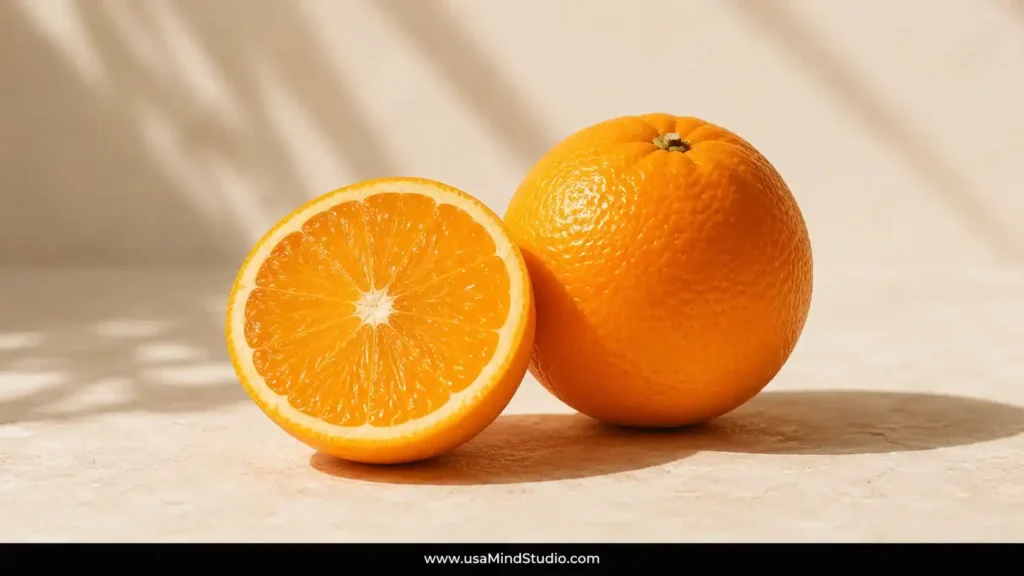
It is not the only one. Foxes are orange, and we call them red foxes. Red hair is orange. Red deer are orange. Even Mars, the “Red Planet,” is really more of a rusty orange. English is full of orange things labeled red, and there is one strange reason for it. When these things got their names, there was no word for orange. The color had no name of its own until a piece of fruit came up the trade routes and handed it one.
In the United States and everywhere English is spoken, we use “orange” without a second thought, but it is the newest major color word we have. This is the story of orange color symbolism, and it begins with a gap in the language.
SUMMARY
- Core meanings: energy, warmth, appetite, caution, enthusiasm, and autumn.
- The fruit named the color: English had no word for orange until the fruit arrived, so orange things were just called “red” or “yellow-red.”
- Orange is not in the Bible: none of the languages scripture was written in had a word for the color.
- The Dutch wear orange because of a French town named after a Celtic water god, not because of the fruit or the color.
- The stance here is reflection, not prediction.
What Orange Color Symbolism Means
Orange is a loud, warm color, and its meanings match. Energy. Warmth. Appetite, which is why so many food brands use it. Enthusiasm. Caution, as in road cones and safety vests. And autumn, the season it owns completely. The spiritual take runs along the same lines: vitality, creativity, warmth. If orange turns up in a dream, people read it the same way they read it awake.
Here is the thing to hold onto, though, and it is unusual. Orange is the only major color in English named after an object. Red, blue, green, yellow, black, white: none are named after a thing. Orange is named after the fruit. And almost everything orange has ever meant is younger than that name.

The Fruit Came First
A Color With No Name
Before the fruit, English did have a way to talk about orange. It just was not elegant. Old English called it geolurēad, which means, literally, “yellow-red.” That was the whole vocabulary. Chaucer described a rooster’s color as somewhere between yellow and red, because that was the best anyone could do.
The word “orange” entered English in the 1300s, and at first it meant only the fruit. It did not mean a color for roughly another two hundred years. The first recorded use of “orange” as a color name in English shows up around 1502, describing cloth bought for Margaret Tudor, and again in a will from 1512. A color everyone could see finally had a single word, borrowed from a piece of produce.
The Road the Word Traveled
The word took a long journey to reach English. It began in a Dravidian language of southern India, passed into Sanskrit as nāraṅga, then into Persian, then into Arabic as nāranj, into Spanish as naranja, into Old French, and at last into English. Spanish and Italian kept that first letter n. English and French dropped it.
And the way English dropped it is delightful. “A naranj” slowly became “an aranj.” The n at the front of the word migrated over to the little word in front of it. The same thing happened to turn “a napron” into “an apron,” and “a nuncle” into “an uncle.” So English got its only object-named color partly by mishearing the edge of a word.
The Birds Are the Evidence
The best proof that orange had no name is sitting in a garden. The European robin has an orange breast. But English calls it redbreast, French calls it red-throat, and Dutch and Swedish call it red-chest. Every one of those languages named that bird before it had a word for the color the bird actually is, so they all reached for the closest thing they had, which was red.
Then, in fifteenth-century England, it became fashionable to give familiar animals human first names. The daw became the jackdaw. The pie became the magpie. And the redbreast became “robin redbreast,” and eventually just robin.
Now the part that matters for American readers. English settlers arrived in North America, saw a bird with an orange chest, and called it a robin too. But it is not the same bird, and not even a close relative. The American robin is a big thrush. The European robin is a small Old World flycatcher. They share a name only because of a color that had no name and a nickname from the 1400s.
This site has a running thread on Americans naming birds by loose association, from the cardinal named for a priest’s robes to the blue jay whose blue is not even real. The robin is where that thread starts.
The point is a little strange. The color did not exist as a category until an object arrived to anchor it. People could see orange perfectly well. They just had nowhere to file it. That is the same argument the blue article makes from the opposite side. Blue had no name because there was nothing solid to hold. Orange had no name because nothing had been named after it yet.
What Orange Symbolizes in the Bible
The answer is that orange is not in the Bible, and the reason is the cleanest on this whole site. There was no word for orange in any of the languages the Bible was written in. Hebrew did not have one. Greek did not have one. English itself did not have one until around 1502, almost a century after the first English Bibles.
Orange things existed, of course. Fire, autumn leaves, clay, ochre. But the category, orange as its own named color, did not. There is an extra twist too: sweet oranges were not in the ancient Near East either, since citrus came from Southeast Asia and reached the Mediterranean late. So the fruit was not there, the word was not there, and the color, as a color, was not there. Pages that assign orange a biblical meaning tend to do it by mixing what red means with what yellow means, which is arithmetic performed on a category that did not exist yet.
The Dutch Wear Orange Because of a Celtic Water God
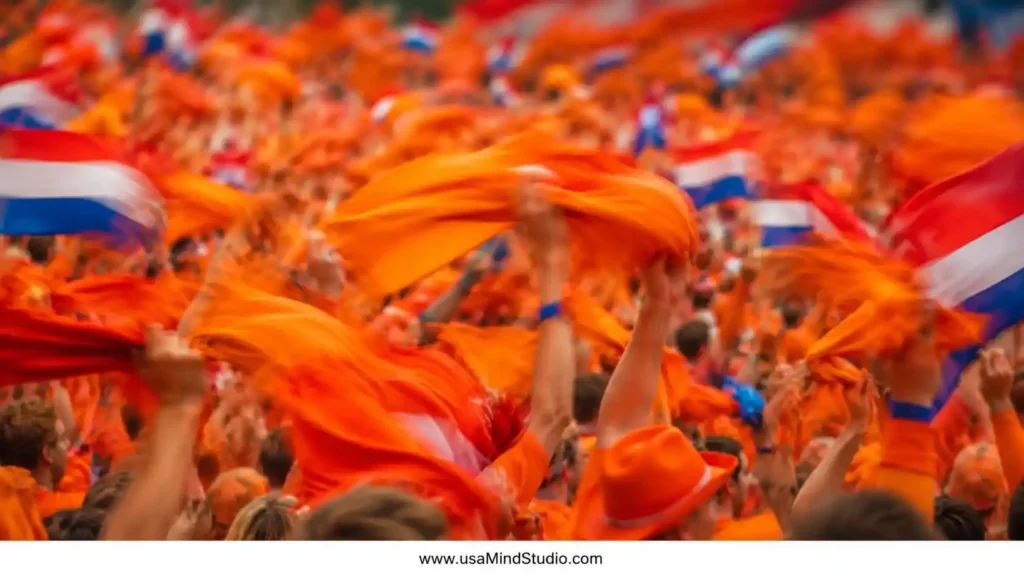
The Netherlands is famously orange. The national soccer team, the crowds, the holidays, all of it. The color comes from the royal family, the House of Orange-Nassau, named for the old Principality of Orange, a small territory in southern France.
And that town has nothing to do with the fruit. Its name comes from Arausio, a Celtic water god, and dates back to Roman times, long before any orange was traded through the region. The resemblance to the fruit is a complete accident of sound. The family eventually leaned in and adopted orange as its own.
The giveaway is the Dutch language itself. The Dutch do not even call the fruit “orange.” Their word for it is sinaasappel, meaning “China’s apple.” So the national color and the national word for the fruit have no connection at all. One came from a French town and a Celtic god. The other came from China by way of the trade routes.
And That Is Why Orange Means Protestant
The House of Orange was Protestant, and it took the Protestant side in the French Wars of Religion. From there, the color hardened into a religious marker. That is why the Orange Order exists, why orange is the Protestant color in Northern Ireland, and why the Irish flag has an orange stripe for one community and a green stripe for the other, with white for peace between them. The green article on this site covers the other side of that same flag.
Sit with the whole chain. A Celtic god’s name happened to sound like a fruit. A French town inherited the name. A Dutch family inherited the town. And four hundred years later there are marches in Belfast organized around the color orange. Not one step of that chain was ever about the color itself.
The Saffron Robe
Across the world, the largest religious use of orange is the robe worn by Buddhist and Hindu holy figures. The association with renunciation, with giving up worldly things for the sacred, is genuine and old.
But the origin is practical, not doctrinal. The earliest Buddhist monks wore cloth other people had thrown away, dyed with whatever was on hand: bark, roots, heartwood, spices. What all of that produces is a range of yellows, ochres, and oranges. The color of holy renunciation is really the color you get when you cannot choose a color.
That is the exact reverse of the ultramarine story in the blue article. Blue became sacred because it cost the most of any color on earth. Orange became sacred because it cost nothing at all. Two colors, opposite paths, both landing on the divine.

Orange in America
Blaze Orange
Here is a fact that is this whole site’s argument in a single safety vest. Hunters wear blaze orange so other people can see them clearly. But deer cannot see it. Deer eyes work differently from ours and do not separate orange from green the way human eyes do. So the exact same wavelength is glaringly obvious to the hunter and nearly invisible to the deer.
One signal, two visual systems, two opposite readings. The blue jay article makes that point using feather structure. This makes it using biology. The meaning was never in the color. It was in the eye doing the looking.
The Rest of It
Almost every other American use of orange was chosen because it stands out. Prison uniforms, traffic cones, road crew gear. All picked for visibility, all within about the last century, all now carrying meanings nobody assigned on purpose. Orange means caution in America because someone needed a color that jumped out against sky and grass.
And Agent Orange, one of the heaviest terms in twentieth-century American history, was not even orange. It was named for the orange stripe painted on the storage barrels. A color became a permanent scar in the language because of a stripe on a drum.
Put simply, orange color symbolism is layered. It draws on religion, folklore, art, and everyday observation, and no single meaning belongs to every culture or every person. Reading orange color symbolism as a prompt for reflection rather than a prediction keeps the symbol in its proper place. For a general overview of the color orange, see this reference article.
Encountering Orange and What People Make of It
Most Americans meet orange as a warning before anything else: a cone, a sign, a vest, a flashing light.
So if orange catches your eye, you do not need to ask what it is telling you. It is not telling you anything. The more interesting thing is to notice how much of what you feel about it was installed on purpose, by road crews and safety codes, within living memory.
And here is the thing to leave with. For most of the history of English, there was no orange at all. There was red, there was yellow, and there was a gap in between that people could see clearly and had no word for. Then a fruit came up the trade routes and the gap finally got a name. Everything orange has ever meant has happened since about 1502. The color is old. The word is not.
Editorial Reflection Note
USA Mind Studio writes about symbolism as a subject for reflection, not prediction. Nothing here forecasts events or tells anyone what to do. Meanings differ across cultures and people, and we try to say plainly where a meaning came from and where the record runs out. You can read more in our Editorial Policy.
Frequently Asked Questions
What does the color orange symbolize in the Bible? It does not appear. None of the languages of scripture had a word for orange, and sweet oranges had not yet reached the ancient Near East.
What does the color orange symbolize in a dream? The same as awake: energy, warmth, creativity, or boldness. No fixed meaning exists, and what it brings to mind for you matters most.
Why is orange named after the fruit? Because English had no word for the color until the fruit arrived. Before that, orange things were simply called red or “yellow-red.”
Why is a robin’s red breast actually orange? It is orange. English named the bird “redbreast” centuries ago, before the language had any word for the color orange at all.
Why do the Dutch wear orange? From the royal House of Orange, named for a French town named after a Celtic water god. It has nothing to do with the fruit.
What does orange symbolize spiritually? Vitality, creativity, and warmth. In Buddhist and Hindu tradition it marks renunciation, a meaning that began with cheap, undyed cloth rather than doctrine.
Why does orange mean caution in America? Because it stands out sharply against sky and grass. Safety gear, cones, and signs adopted it for pure visibility within the last century.
What is the core idea behind orange color symbolism? Orange color symbolism is built from layered history and culture rather than one fixed rule, which is why the sections above separate the documented sources from later popular claims.
Does orange color symbolism mean the same thing everywhere? No. Orange color symbolism changes from one culture, era, and personal experience to the next, and this article notes where a meaning is well documented and where it is not.
Should orange color symbolism be treated as a prediction? No. Orange color symbolism is a subject for reflection. Nothing on this site forecasts events or replaces professional advice.
Where does orange color symbolism come from? Orange color symbolism comes from a mix of religion, folklore, art, and everyday observation, and the sections above trace the main sources one by one.
Why do people search for orange color symbolism? People look up orange color symbolism when they notice the subject in a dream, a memory, or an ordinary moment and want context rather than a verdict.
Keep Reading
- Rose Color Meanings: The Flower Whose Messages Keep Changing
- Burgundy Color Meaning: The Color Named After a Swedish Tribe
- Purple Color Symbolism: How Snails Made It the Color of Kings
- 111 Angel Number: What Triple One Symbolizes and Where It Comes From
- Bear Animal Symbolism: The Only Predator We Call Grandmother